• Home
  • The Bird with the Flaming Red Feet
  • Rare Bird: Marbled Murrelet
  • A Sideways Look at Clouds
  • Author
  • Events
  • Blog
  • Contact
Menu

Maria Mudd Ruth

Street Address
City, State, Zip
Phone Number
author and naturalist
Homepage-Banner.jpg

Maria Mudd Ruth

  • Home
  • Books
    • The Bird with the Flaming Red Feet
    • Rare Bird: Marbled Murrelet
    • A Sideways Look at Clouds
  • Author
  • Events
  • Blog
  • Contact

Slow Birding

April 1, 2026 Maria Mudd Ruth

Waiting for the return of the Pigeon Guillemots—the birds with the flaming red feet—to the shores of Puget Sound, Washington.

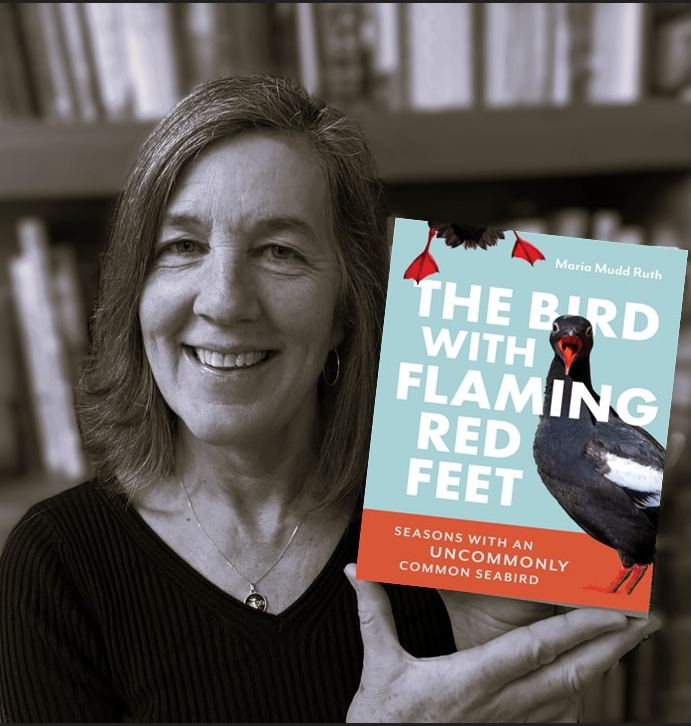
April 1, 2026, will go down in my calendar as one of my favorite April Fool’s Day. Not because after years of playing mild-but-devious pranks on friends and family (and then eventually avoiding communicating with those same family and friends altogether on this day), someone “got me” early this morning with an April Fool’s joke. No, today someone else “got me,” which is to say they totally got the message of my new book, The Bird with the Flaming Red Feet.

The “gotcha” took the form of a book review in the newsletter of the South Sound Bird Alliance (formerly the Black Hills Audubon Society). The newsletter arrived by e-mail and I clicked the link to “The Armchair Birder” column as I usually do before diving into the rest of the birdy news. I started reading and felt like someone had been reading my mind and heart for the past several years.

Read the Review Here

 The reviewer did not attempt to summarize the book, excerpt passages, or get into the particulars of the Pigeon Guillemot’s life history or the community science project focused on this Pacific seabird. The reviewer took a 30,000-foot view of what it means to spend time among the birds in the 21st century and wove in Roger Tory Peterson’s essay “What Are you Really?” (on how birders identify themselves) and Shunryu Suzuki’s classic Zen Mind, Beginner’s Mind.

I wasn’t familiar with Peterson’s essay and hadn’t read Suzuki’s book since college but the short excerpts from  these two works in the review of my book aptly addresses my struggle to figure out what kind of a birder I am given that I don’t keep a life list or know much about any birds other than the Pigeon Guillemot and the Marbled Murrelet (the subject of my book, Rare Bird). It was only after a decade studying the Pigeon Guillemots on the same beach near my home in Olympia, Washington, that I began to think of myself as a birder—a “slow birder” or even a “one-bird birder” (absurd as that may seem).  

And it was only after reading the “Armchair Birding” book review this morning that I realized how deeply satisfying and novel it is to let one bird guide you into its life and shape how you think about its unique life.

Video of Pigeon Guillemots on Puget Sound, Washington. Courtesy Hillary Smith.

In Pigeon Guiillemots, Puget Sound BIrds, Pacific Northwest Birds Tags Pigeon Guillemots, South Sound Bird Alliance, Puget Sound, The Bird with Flaming Red Feet, Community Science
Comment

THE YEAR OF THE AUK

February 20, 2026 Maria Mudd Ruth

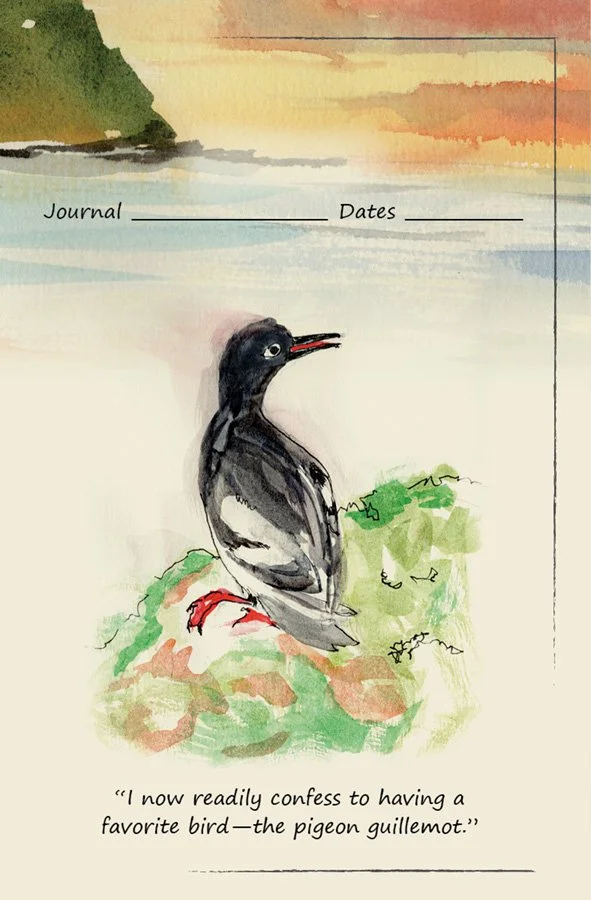
Frances Wood’s watercolor of the Pigeon Guillemot graces the front, back, and inside covers of this blank journal.

Is is something in the air? Possibly, but more likely something in the water—salty water. The family of seabirds known as auks, or alcids, are having a bit of a heyday in the publishing world. For those of you unfamiliar with this varied and fascinating family of birds, it includes twenty-four species including the most familiar puffins as well as auklets, dovekie, razorbill, murres, murrelets, and guillemots. They are the web-footed, surface-diving seabirds of the Northern Hemisphere.

Whidbey Island writer and artists Frances Wood has just published a blank, spiral-bound journal with her watercolor portraits of the guillemots on the covers (above). Frances is a co-founded of the Salish Sea Guillemot Network, which is how I found my way to these wonderful seabirds. France’s art is as lively and charming as the guillemots themselves. And just think—fifty blank pages for you to weave a tale of your favorite seabird or begin your Spring journal or field sketches of your feathered friends. Order your copy of this blank journal here. See Frances's watercolor aviary of other birds here.

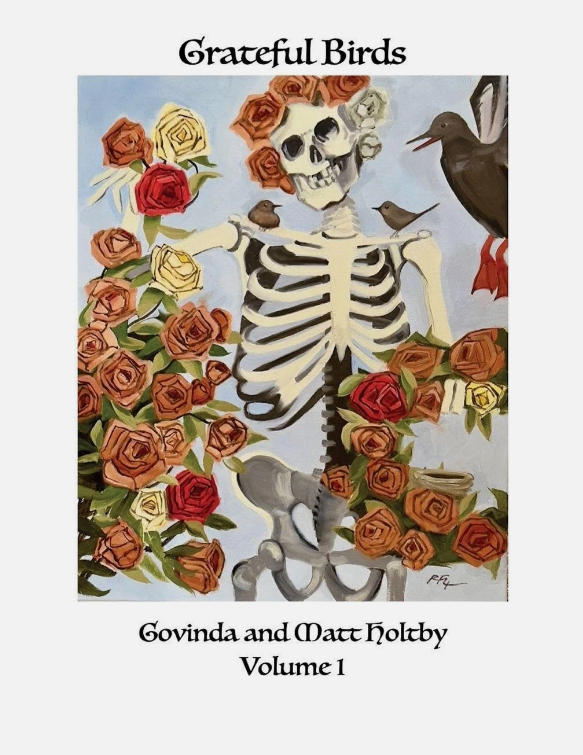
Yes, a bird with flaming red feet can improve a Grateful Dead album cover.

Also from Whidbey Island, Govinda and Matt Holtby have published a delightfully quirky and authoritative book that takes a look at 40 Grateful Dead songs, and pairs them with 40 Washington State birds, plus encores. They have managed to carve the connection between birders and deadheads. The book is filled with fun facts, unusual facts, and interesting facts about the bird and or the song that it is paired up with. Our grateful guillemot (prominently featured on the book’s cover, below) is cleverly paired with the song “Cassidy,” “Ah—child of the boundless seas.”

This book is a fundraiser for two non-profits: LittleBIGFest, and Whidbey Audubon Society. LittleBIGFest is a nonprofit organization based on Whidbey Island. They are dedicated to supporting regional musicians and artists and creating scholarship opportunities for local students. They produce annual festivals and events featuring local, national and international musicians and artists. Whidbey Audubon Society founded the Salish Sea Guillemot Network, a community science program for surveying our beloved Pigeon Guillemots. Govinda is a long-time Pigeon Guillemot surveyor on Whidbey Island. This is a must read for Deadheads, birders, music lovers, admirers of creatives like Govinda and Matt. Order copies of Govinda and Matt’s book here.

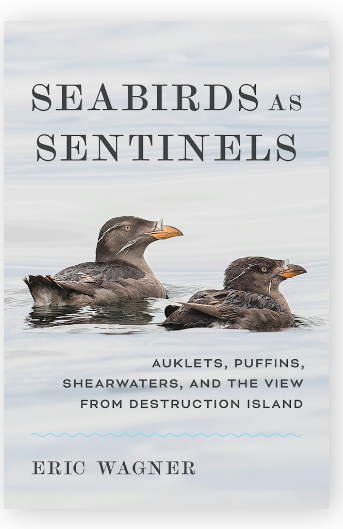
A new natural history of two more auks (auklets and puffins) due out in March from University of Washington Press.

Seattle-based biologist and writer Eric Wagner has a new book coming out in March 2026—Seabirds as Sentinels: Auklets, Puffins, Shearwaters and the View from Destruction Island (above). This small, rugged island off the Washington State outer coast is the site of a long-term research project to study the thousands of Rhinoceros Auklets—an alcid the comes to land to nest each summer. It’s deep earthen burrows and nocturnal nesting habits make it a formidable challenge, an exercise in stamina, and a source of wonder for Eric and his colleagues.

I had the pleasure of reading an advance copy of Eric’s book and endorsing it with these words: "With his trademark honesty and passion for his subject, Eric Wagner has left no stone unturned or question unasked in this timely and deeply informative natural history. With the seabirds front and center, this narrative also brings into intimate focus large-scale ecological processes, ocean dynamics, cultural and maritime history, and—most importantly—the vital work of the many scientists studying seabirds in the field and in a time of uncertainty."

You can order copies here. Eric and I will be speaking together about our featured seabirds at The University of Washington’s Burke Museum in Seattle on May 6, 2026. More details on my events page.

Gone but not forgotten, the Great Auk lives on in Tim Birkhead’s new book.

It wasn’t a suite of environmental pressures, but human greed—a “destructive obsession”- as one reviewer wrote—that drives the narrative of The Great Auk (Bloomsbury 2025). Written by biologist and prolific author, Tim Birkhead, this beautifully written and definite natural history account tells of the largest member of the auk family, the extinct Great Auk. This flightless bird, measuring some three feet in height, was once abundant across the North Atlantic Ocean and nested in colonies of hundreds of thousands of birds. By 1844, the last of its kind was killed on the coast of Iceland. Birkhead weaves a gripping tale, a tragic one, of the demise of this bird with his surprising and personal story of its afterlife. Purchase The Great Auk through your local indie bookstore via Bookshop here.

In Pigeon Guiillemots, Puget Sound BIrds, Salish Sea Seabirds, Books on Seabirds, Tim Birkhead Tags Tim Birkhead, Eric Wagner, Frances Wood, Govinda and Matt Holtby, The Great Auk, Seabirds as Sentinels, Grateful Birds, Grateful Dead
Comment

Judge This Book by Its Cover

January 18, 2026 Maria Mudd Ruth

What a joy to have received an advanced printed copy of my new book, The Bird with Flaming Red Feet. After years of seeing my manuscript on my computer screen and seeing it in parts, it was such a thrill to hold the book in my hands, feel its heft, touch the paper pages, and see the full integration of the text with the photographs and artwork.

The cover and title makes me smile every time I see it. It’s the work of designer Jen Grable and other creatives at Mountaineers Books (which is to say all the staff). Jen also designed the covers for my previous two books, A Sideways Look at Clouds (2017) and the reissue of Rare Bird; Pursuing the Mystery of the Marbled Murrelet (2014).

About the cover: The cover says the subject of this book is a lively bird with a lot to say. And, those flaming red feet, dangling like loose rudders from the top edge of the book, hint at the laughable and sometimes awkward way the Pigeon Guillemots approach the water when they land. The guillemot is an entertaining bird for the birdwatcher and I hope my book is equally entertaining for readers.

The cover with its bold colors and strong black and white subject make it eye catching. The all-caps, sans serif title is easy to read. An easy to read cover is important on bookstore shelves where there are plenty of bird books competing for attention (though none like mine!). An eye-catching cover is increasingly important at small scales because an increasing number of readers shop for books on small screens (cellphones) where book covers appear the size of postage stamps.

A word about the title: Why is the seabird pictured on the cover not in the title? Because “Pigeon Guillemot” is hard to pronounce and makes many people think my book is about a pigeon. The Pigeon Guillemot is most certainly not a pigeon, but a seabird. And “guillemot” is pronounced “gill-uh-mot,” which rhymes with nothing and seems like it is French and should be pronounced “ghee-ya-mow.” And because when many people first see this bird, they describe it as “the bird with the red feet.” Red is usually modified so its really red, bright red, fire-engine red, or flaming red. It’s what people notice and what distinguishes this seabird from most others on the water.

The subtitle, Seasons with an Uncommonly Common Seabird subtly tips you off that this is not a book about a pigeon. Birders tend to think of birds in two seasons—Summer and Winter—because they exhibit two very different plumages over the course of the year. In my book, the guillemots get all four seasons; they are, after all, Pigeon Guillemots year round, not just when they are in our binoculars. And “uncommonly common” because the guillemot is a relatively abundant bird, well distributed throughout its range. It’s not listed of threatened or endangered species. It’s extraordinarily adaptable in its nesting habitat. And it’s seems to be a bird that’s hidden in plain sight, one that’s overlooked by birders keen on seeing less common seabirds. Such as the iconic puffin, a cousin of the guillemot.

What’s behind the cover of my book is the story of the Pigeon Guillemot, a work of narrative non-fiction, a natural history. My book is based on more than a decade of research in the field as a volunteer community scientists and in the library (physical and digital) as a curious naturalist with a penchant for rabbit holes. My book is a tribute the community science, to volunteer data collectors and devotees of the Pigeon Guillemot. It’s an invitation to learn about and connect to the natural world around you in a new and deeply satisfying way.

I’m so grateful to everyone at Mountaineers Books for bringing my book into the world and for introducing readers to the world of the Pigeon Guillemot. It’s a big world and you’re in it. Even if you’ve never heard of a Pigeon Guillemot, I think it will soon become your favorite new bird. I hope that The Bird with the Flaming Red Feet will bring the guillemots—or your special backyard bird—into your life this year.

Pigeon Guillemots by Susan Morgan.


In Pigeon Guiillemots, Puget Sound BIrds, Salish Sea Seabirds Tags The Bird with the Flaming Red Feet, Pigeon Guillemots, Book Cover Design, Pacific Northwest Books
Comment

Pigeon Guillemots in Winter

December 19, 2025 Maria Mudd Ruth
Four Pigeon Guillemots in Winter Plumage

Pigeon Guillemots (Cepphus columba) in basic (winter) plumage on Puget Sound, Washington. Photo by Hillary Smith.

“As the shortest day of the year rapidly approaches, the dark and the cold drive many animals who do not migrate into a state of hibernation, estivation, dormancy, or torpor. Many of us human vertebrates feel the urge for late mornings, afternoon naps, or occasional hunkering down.

While other animals may be resting, hundreds of thousands of Pigeon Guillemots remain on the coastal waters of the North Pacific Ocean—fully alive amid rain, sleet, snow, wind, and whitecaps. The sun has moved these guillemots through the year and returned them to a place where they garner their energy for survival. The guillemots are not migrating, not molting, not breeding.

They are on their wintering grounds, in their pale plumage.

They are diving and foraging for food, resting and roosting on the water.

They are paddling around and flying short distances over the water.

They are in their place, sheltering in place, being sheltered only by the feathers on their bodies.

They are waiting—but not waiting.

They are biding their time, free from our attention, knowledge, and passion.

The Pigeon Guillemots are simply being—being the seabirds they are, as the earth and seas spin, carrying us together into a new year.”

from The Bird with the Flaming Red Feet (Mountaineers Books, April 2026)


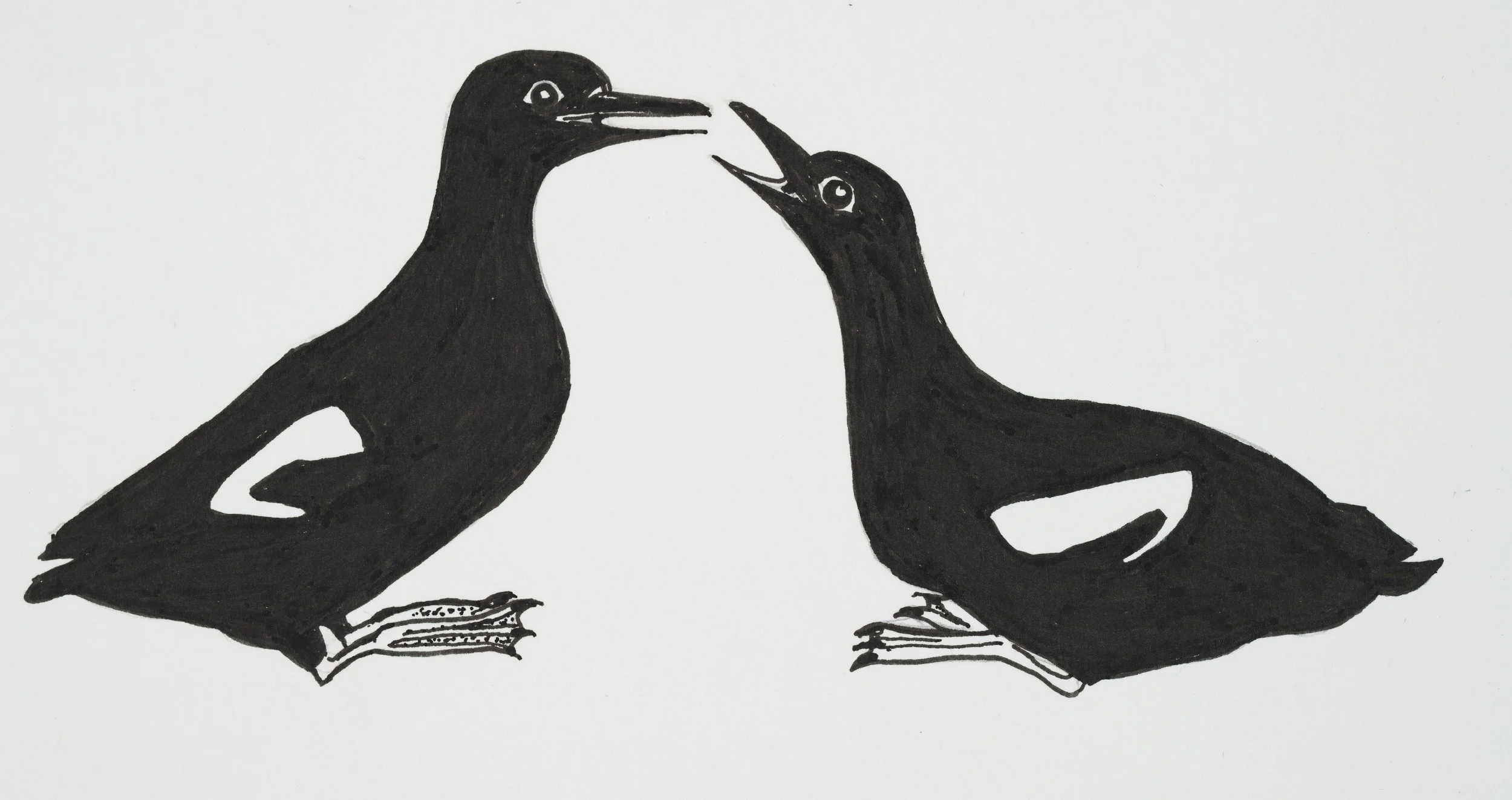
Calligraphy of Pigeon Guillemot Vocal Sonogram by Sally Penley

 
In Pacific Northwest Birds, Puget Sound BIrds, Salish Sea Seabirds Tags Pigeon Guillemots
Comment
Older Posts →

Subscribe

Sign up with your email address to receive my blog in your inbox.

Thank you!
Blog RSS

Flying from Mountaineers Books this Spring—the story of the Pigeon Guillemot—the world’s most charismatic alcid. This non-fiction natural history will be on bookshelves and available from online retailers on April 7, 2026. Click a link below to pre-order a copy now from these purveyors:

Mountaineers Books (non-profit, indie publisher based in Seattle)

Browsers Books (Olympia’s indie bookstore)

Bookshop.org (support your local bookstore)

Barnes & Noble (in the book biz since 1971)

Amazon

Other Natural History Titles by Maria Mudd Ruth…

A Sideways Look at Clouds


“Compelling…engaging.” The Library Journal

“Rare insights into the trials and joys of scientific discovery.” Publishers Weekly

Read more reviews and details here: Rare Bird: Pursuing the Mystery of the Marbled Murrelet

Enjoy this song by Peter Horne, "Little Bird, Little Boat, Big Ocean.” Written about the Marbled Murrelet, but the lyrics work well for the Pigeon Guillemot, too.


  • Clouds
  • Natural History
  • Open-water Swimming
  • Lake Swimming
  • Washington Lakes
  • Wild Swimming Washington
  • Pacific Northwest Clouds
  • Books on Clouds
  • Meteorology
  • Wild Swimming
You must select a collection to display.

Subscribe

Sign up with your email address to receive my blog in your inbox.

Thank you!
Blog RSS

©2026 MARIA MUDD RUTH  |  ALL RIGHTS RESERVED