

What a joy to have received an advanced printed copy of my new book, The Bird with Flaming Red Feet. After years of seeing my manuscript on my computer screen and seeing it in parts, it was such a thrill to hold the book in my hands, feel its heft, touch the paper pages, and see the full integration of the text with the photographs and artwork.
The cover and title makes me smile every time I see it. It’s the work of designer Jen Grable and other creatives at Mountaineers Books (which is to say all the staff). Jen also designed the covers for my previous two books, A Sideways Look at Clouds (2017) and the reissue of Rare Bird; Pursuing the Mystery of the Marbled Murrelet (2014).
About the cover: The cover says the subject of this book is a lively bird with a lot to say. And, those flaming red feet, dangling like loose rudders from the top edge of the book, hint at the laughable and sometimes awkward way the Pigeon Guillemots approach the water when they land. The guillemot is an entertaining bird for the birdwatcher and I hope my book is equally entertaining for readers.
The cover with its bold colors and strong black and white subject make it eye catching. The all-caps, sans serif title is easy to read. An easy to read cover is important on bookstore shelves where there are plenty of bird books competing for attention (though none like mine!). An eye-catching cover is increasingly important at small scales because an increasing number of readers shop for books on small screens (cellphones) where book covers appear the size of postage stamps.
A word about the title: Why is the seabird pictured on the cover not in the title? Because “Pigeon Guillemot” is hard to pronounce and makes many people think my book is about a pigeon. The Pigeon Guillemot is most certainly not a pigeon, but a seabird. And “guillemot” is pronounced “gill-uh-mot,” which rhymes with nothing and seems like it is French and should be pronounced “ghee-ya-mow.” And because when many people first see this bird, they describe it as “the bird with the red feet.” Red is usually modified so its really red, bright red, fire-engine red, or flaming red. It’s what people notice and what distinguishes this seabird from most others on the water.
The subtitle, Seasons with an Uncommonly Common Seabird subtly tips you off that this is not a book about a pigeon. Birders tend to think of birds in two seasons—Summer and Winter—because they exhibit two very different plumages over the course of the year. In my book, the guillemots get all four seasons; they are, after all, Pigeon Guillemots year round, not just when they are in our binoculars. And “uncommonly common” because the guillemot is a relatively abundant bird, well distributed throughout its range. It’s not listed of threatened or endangered species. It’s extraordinarily adaptable in its nesting habitat. And it’s seems to be a bird that’s hidden in plain sight, one that’s overlooked by birders keen on seeing less common seabirds. Such as the iconic puffin, a cousin of the guillemot.
What’s behind the cover of my book is the story of the Pigeon Guillemot, a work of narrative non-fiction, a natural history. My book is based on more than a decade of research in the field as a volunteer community scientists and in the library (physical and digital) as a curious naturalist with a penchant for rabbit holes. My book is a tribute the community science, to volunteer data collectors and devotees of the Pigeon Guillemot. It’s an invitation to learn about and connect to the natural world around you in a new and deeply satisfying way.
I’m so grateful to everyone at Mountaineers Books for bringing my book into the world and for introducing readers to the world of the Pigeon Guillemot. It’s a big world and you’re in it. Even if you’ve never heard of a Pigeon Guillemot, I think it will soon become your favorite new bird. I hope that The Bird with the Flaming Red Feet will bring the guillemots—or your special backyard bird—into your life this year.
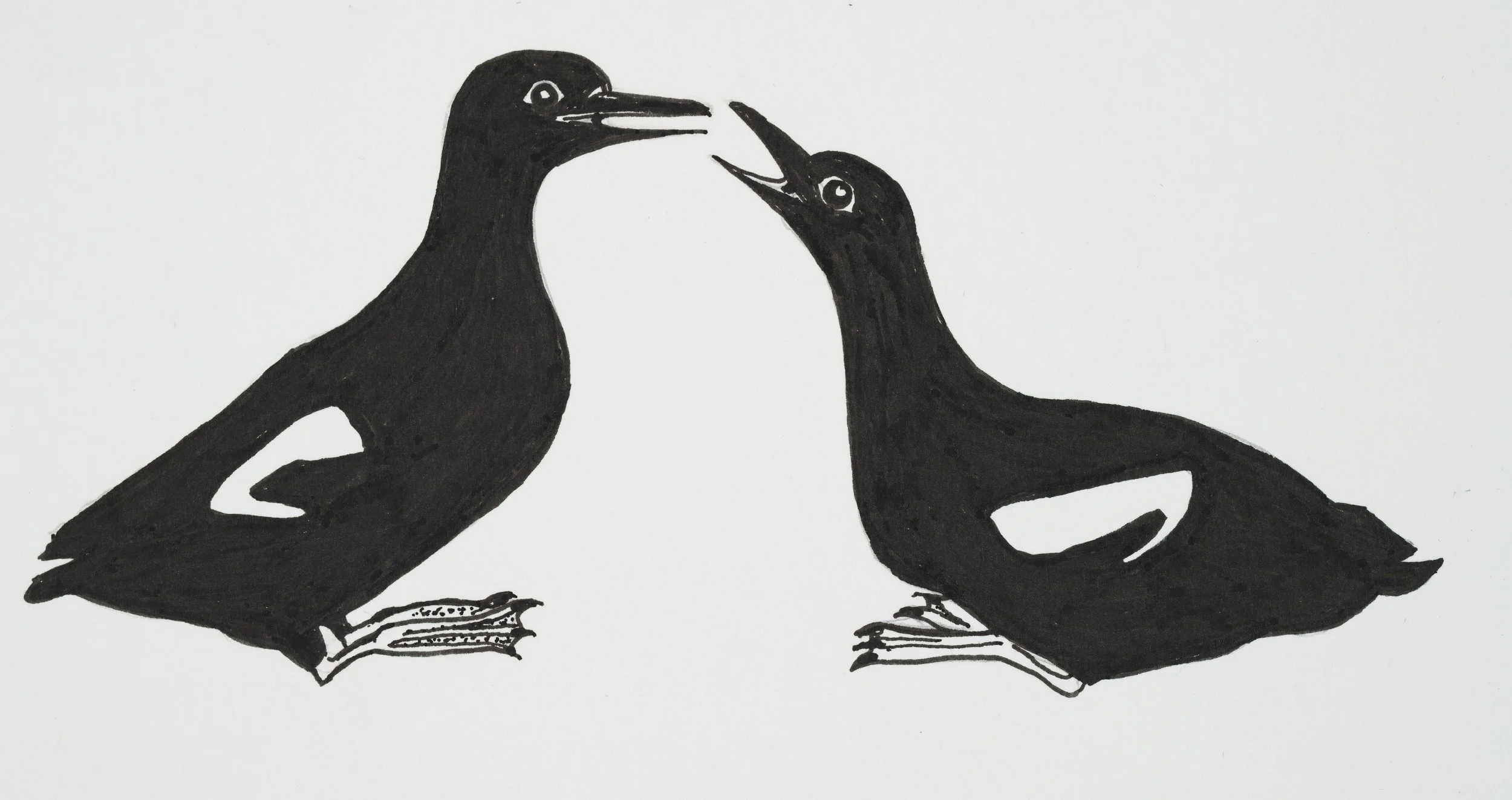
Pigeon Guillemots by Susan Morgan.