• Home
  • Author
  • Guillemots
  • Clouds
  • Rare Bird
  • Marbled Murrelets
  • Events
  • Blog
Menu

Maria Mudd Ruth

Street Address
City, State, Zip
Phone Number
author and naturalist
Homepage-Banner.jpg

Maria Mudd Ruth

  • Home
  • Author
  • Guillemots
  • Clouds
  • Rare Bird
    • Rare Bird
    • Marbled Murrelets
  • Events
  • Blog

Some Letters and a Few Words

February 3, 2021 Maria Mudd Ruth
20210203_103121.jpg

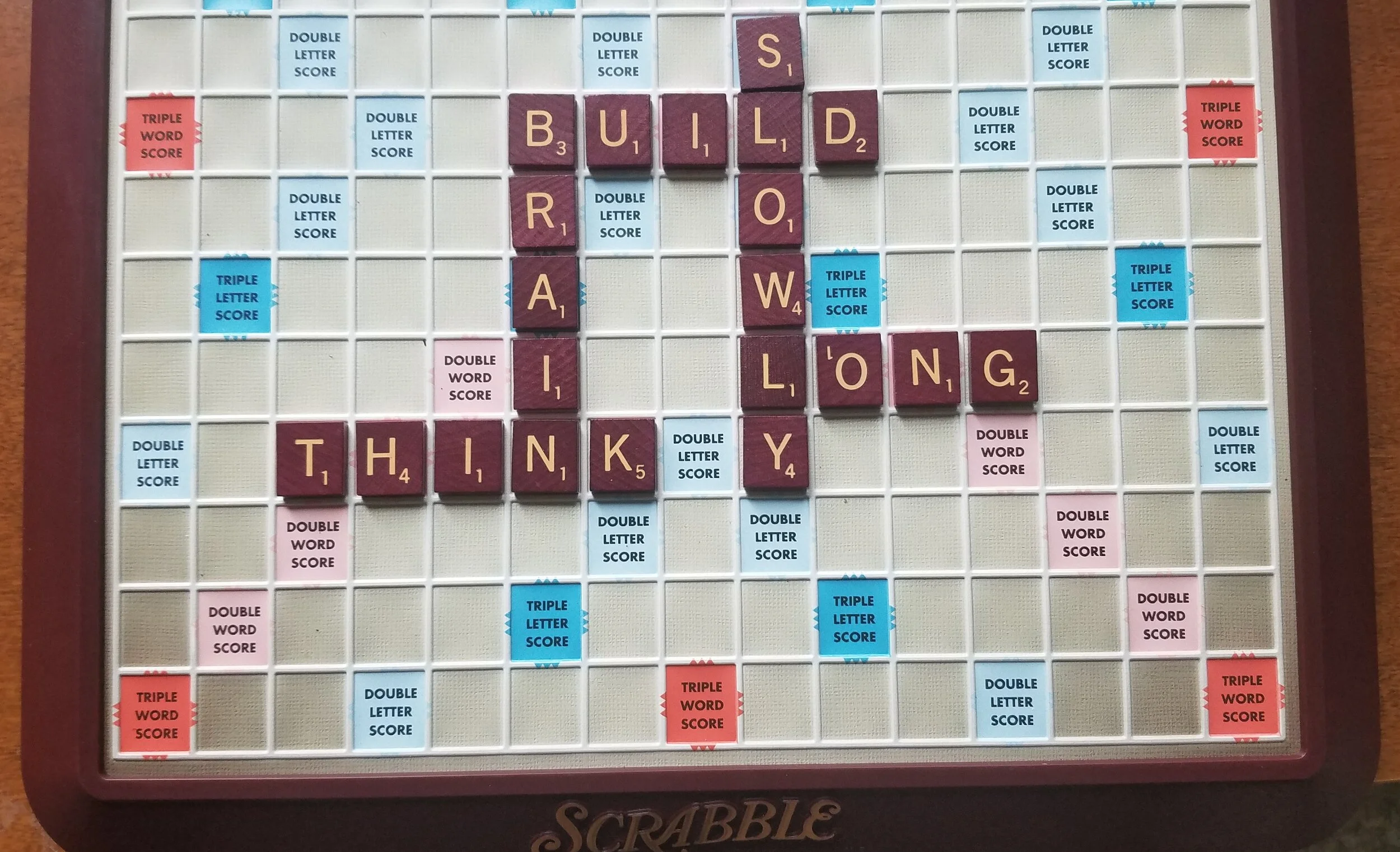
The past year has been an interesting one in the board-game world. Once I got over the thrill of figuring out which four- and six-player games can be played over Zoom, I discovered some new two-person games to play. Some were hits (Hive, Azul, Patchwork) others were flops (anything with many tiny bags of teeny pieces). The games I most enjoyed playing, however, were Scrabble and Bananagrams—two games involving square letter tiles and word making. Both were a welcome relief from a day crafting complete sentences.

20210203_102138.jpg

What so fascinates me about these two games is how completely differently they are played. Scrabble requires an orderly taking of turns and tends to be contemplative and strategic. It favors the player with a huge or specialized vocabulary (and knowledge of those “only used in Scrabble” words such as jo, aa, xi), the ability to plan a few turns ahead, play defensively, and to exercise a degree of restraint. Over and hour (or three) players build off each others’ words on a gridded board. Once you lay down your tiles, there’s no picking them back up. Each word adds to the static connections of words on the board.

I learned to play Scrabble from my grandmother. She was an excellent player and quite patient. I can still hear her saying, “Oh, honey, you don’t want to put that there, do you?” when I would lay down an as ‘S’ or unwittingly set her up to play on the triple. My grandmother was a resourceful woman, having lived through the Pandemic of 1918, WWI, the Great Depression, WWII, a divorce, Vietnam, strokes, heart attacks, surgery, cancer, and likely many other woes she never mentioned. She always made the best of the hand she was dealt—in life and in Scrabble.

Bananagrams is exactly the opposite. It’s a high-speed, frantic, shouty, grabby game in which you do not build impressive high-scoring words on a board. You create your own words, one letter at a time, from a communal “bunch” of face-down letter tiles on the table/desk/floor in front of you. You do not wait turns. You just grab a face-down letter tile when someone/anyone yells “peel” (or “go” like we do because, it’s somehow quicker to say!) If you can make a word (even “a”), you shout “go,” and everyone takes another tile. The player to make the first two-letter word calls “go” and everyone grabs a tile. It goes on and on like this, with each player making words in a their own word grid and—here’s the part I love—breaking up the words and reshaping their word grid when needed to accommodate a new letter.

For instance, you’ve been able to make “U-N-I-T-E” out of your letters but then pick a “Q.” You don’t just sit there and wait for the letters that allow you to place the Q above the U and spell another word while everyone else’s hands are flying. You just bust up U-N-I-T-E, quickly rearrange your letters to spell Q-U-I-T-E and tuck the N beneath the I to spell “IN” and yell “go!” When a player grabs the last tile, they yell “I win.” If you are me, you fall back in your chair, wipe the sweat from your brow, and decide to play Scrabble to bring your blood pressure down.

What I love about Banagrams is that it helps you practice, flexibility, (healthy) detachment, open-mindedness, and spontaneity during the game and afterward. It’s all about speed and not getting attached to the words you’ve laid out, especially a long word to which you’ve connected many other words. If you get too focussed on holding on to that word, you’ll accumulate so many letters (as others are shouting “go”) that you can’t work into your grid. What to do? Let go! You have to bust up your big word—and thus much of your grid—and begin spelling out new words with you new (and existing) letters.

Over the past several months just thinking about Scrabble and Banagrams has inspired me to completely deconstruct the book I am working on only after spending the previous months feeling very commited to a structure that was obviously not working. Getting to the “break it up” moment took a while, but everything is coming back together nicely.

So, my fellow writers and all the problem solvers and “creatives” out there—find, borrow, buy these two games. If you live near Lacey, WA, find your way to Gabi’s Olympic Cards and Comics, which has pretty much every game on the planet though “game” isn’t part of their name.

Note: Though this blog appears under the “Washington Wild Swimmer” heading, the book I am currently working on is about a different kind of wild swimmer—a seabird known as the Pigeon Guillemot. This bird is the wild and crazy cousin of the Marbled Murrelet and I’m tinkering with a new form of natural history writing. Meanwhile, I am swimming weekly in a local lake (in what we call “bioprene”—no wetsuit) and thinking about what stories to tell about Washington’s glorious lakes.

In Writing Tags Scrabble, Board Games for Writers, Bananagrams, Games as Metaphors, Two-Person Games

One Number and A Few Words

December 23, 2020 Maria Mudd Ruth
46.

46.

Yes, 46 degrees Fahrenheit. This was the water temp of Munn Lake (Thurston Count, WA) on Tuesday. THis is 10 degrees cooler since my last wild swim in late October.

Yes, 46 degrees Fahrenheit. This was the water temp of Munn Lake (Thurston Count, WA) on Tuesday. THis is 10 degrees cooler since my last wild swim in late October.

I feared that missing my weekly wild swim for nearly two months would have softened me up too much and turned me into a summer-only swimmer and hygge devotee. But my brain remembered that getting into very cold water was not life threatening and could even be pleasurable. So I was all in when my wild-swimming buddies and I planned a swim on the sunny day after the rainy winter solstice..

An hour before our swim, my brain began whispering a panicky ”bail out!” That’s when I knew it was time to put on my bathing suit, my layers of fleece, and my wool hat and socks. Time t o put the tea kettle on. Time to pack my towel, thermometer, dry robe, cell phone. Time to vacuum the house while singing to drown out that little voice in my head. As long as I kept my body moving, I gave myself no opportunity to stop, think twice, and cancel.

The lake was beautiful and calm and 46 degrees according to my thermometer. The air was a bit cooler though the sun and lack of wind made it feel warmer—even warm. Stripped out of our fleece and dry robes, my two friends and I waded slowly into the water in our bathing suits and wool hats. “Slowly” is key here as a “get-it-over-with” plunge can cause body shock and other problems (see risks here). My friends and I like to feel the water on our goosebumpy skin. So we don’t wear wet suits, swim socks or gloves, or other protective gear. We just slip in, stay pretty close to shore, and try to feel the water, the cold, the buoyancy. We like to loll, tread water, look around. When seabirds do this it’s called “loafing.” We also like to marvel at where we are (seabird may do this as well). And, best of all, we like to feel the warmth of the winter sun on our closed eyelids. With a bit of imagination, you can imagine that warmth radiating all over your body. We know it’s possible to confuse “warm” with “numb,” and even “warm” with “cold,” so we don’t stay in long—usually five or ten minutes in winter.

Today, I might have lasted four minutes. I have to admit my numb lower half was fine, but I put my arms in too quickly and they were not happy (aka they hurt). I retreated to the shore; my friends went out further and stayed in longer. One even put her head under (no cap!) which made her smile even bigger after her brain freeze thawed.

Once together onshore, we shared hot tea and conversation in the sun. We talked about “blue mind,” (the theory that being near water makes you happier), about the few people fishing on the lake, about the bald eagle flying over (were they nesting already?), the osprey calling nearby (was it mating season?), and very low angle of the sun, the conjunction of Jupiter and Saturn, about the holidays and the new year.

Standing there at the edge of the lake, I thought about how we mark time these days. Early in the pandemic, we joked about “Blursday” describing the days of the week that blurred into each other as our routines were upended, our weekends lost their place, the hours we set aside for work and play became more fluid. For me, it was a novel and not so unpleasant way to experience time. But then the fall and winter presented us with new questions: how do we mark the seasons if we cannot celebrate the holidays the way we always have? Stripped of the usual transcontinental travel at Thanksgiving and Christmas, of gatherings with family and friends, of stringing up lights, of preparing feasts to share, how would I mark these holidays? What did these holidays mean when whittled down to the bare minimum? What new and perhaps more meaningful traditions could we start? There’s the rub. Traditions take time and should evolve organically and not just dropped in to keep us distracted. Which brings me to Jupiter and Saturn and a radical idea.

Our two largest planets, which are normally hundreds of millions of miles apart, have been moving closer to each other all month and have just recently overlapped in the sky. The last visible conjunction of these two planets occurred 800 years ago (in 1226). Our healthy obsession with seeing this phenomenon in the sky reminds me of the total solar eclipse of 2017 when people gathered by the thousands in and near the “totality” zone to witness this spectacular event. These distant events mark huge expanses of time and, being relatively rare, garner the attention rightly due to them. But, but, but…what about the moon and its phases? What about the tides—low, high, spring, neap, king? What about the migrating birds, the leafing trees, flowering plants, cooling lakes and frozen rivers? Knowing the timing of these and other natural phenomenon used to help us mark time across the day, months, and seasons. Can we reconnect with some of these time-honored (is that a pun?) ways of marking time? Can we feel the way time flows through us and the rest of the natural world and without being accused of “going all pagan” as we try to get in better sync with our planet?

There at the lakeshore, we celebrated the lake, the eagle, the osprey, the air, our skin, the sun. We looked fondly on the cottonwood tree—once green and fragrant, then gold, and now bare. We leave the lake warmed, connected, re-connected. With a deeper sense of place and time, we move into brighter days.

20201222_130546.jpg

At a Loss for Words

October 6, 2020 Maria Mudd Ruth
20201006_164317.jpg

Just when the 2020 lake swimming season began for me in early Spring, the pandemic struck.. And then the new of deaths of George Floyd and Breonna Taylor and too many others at the hands of police. The Black Lives Matter movement and long-overdue social-justice movement hit full stride. And then the wildfires. Blogging about swimming in Washington lakes and the joys of open-water swimming seemed irrelevant and self-indulgent. I swam all spring and summer but had nothing to say that seemed worth saying. I was at a loss for words. Clearly, it wasn’t time to write.

It was time to listen the voices of other people in my community, to read and discuss books about racism, to talk about white privilege, to stand up for racial justice, to write letters to elected officials, to have difficult and awkward conversations, to make sure equity and inclusion were in the forefront of my work as a natural-history writer and member of my community in Olympia, Washington.

The lakes I swam this springing summer in provided me a space to think, to feel, to shift my perspective, to accept that life would not return to “normal” any time soon. My swims were sometimes wordless solo adventures—just water and skin and breath. Sometimes they were more social and my swimming buddies and I talked and swam our way across the lake and back. Our conversations focussed on current events and crises and what actions we could take to contribute meaningfully toward positive change.

Right now, that action is VOTE


Big Basin Heartbreak

August 25, 2020 Maria Mudd Ruth
Image by Randy Vazquez/MediaNews Group/The Mercury News Via Getty Images

Image by Randy Vazquez/MediaNews Group/The Mercury News Via Getty Images

The news of the CZU Lightning Fire in California hit home for me this past week as the fire swept through Big Basin Redwood State Park—California’s oldest state park and protected habitat of the endangered Marbled Murrelet. This robin-sized seabird comes inland from the Pacific Ocean to the mature and old-growth forests during the summer to nest on the wide branches of the trees. Big Basin Redwood State Park was the center of the discovery of the murrelets’ nesting site in 1974 in a 220-foot-high Douglas-fir, the kind—and perhaps very tree that held that famous nest—that are being burned and scorched now as the fire engulfs 78,000 acres of Santa Cruz and San Mateo Counties. Many of the redwoods will survive—there is some good news here from KQED.

MAMU 5 (1).jpg

While writing my book , Rare Bird: Pursuing the Mystery of the Marbled Murrelet (Rodale 2005 and Mountaineers Books 2014), about this extraordinary bird, I spent much time in this spectacular “big-trees” state park visiting the site of the nest discovery, camping with my family under the very tree where the nest was found, and hiking the park trails under thousand-year-old trees and feeling as if I had walked back in time.

Photo of the author at Big Basin Redwood State Park (by M.D. Ruth)

Photo of the author at Big Basin Redwood State Park (by M.D. Ruth)

Big Basin Redwood State Park’s historic Headquarters and Visitors Center burned to the ground (details and photos here) and there is extensive damage in the historic core of the 18,000-acre park, including the popular campgrounds. The headquarters building was the site where the park rangers and historian gazed down on a strange downy chick, saved by a tree trimmer in the August 1974, that they identified out as a marbled murrelet—the first confirmed and later documented scientific evidence that these birds nested in trees. Now this historic building is gone.

The remains of the headquarters building at Big Basin Redwood State Park, the site where park rangers solved the great nesting mystery of the marbled murrelet in August 1974.     Image by Randy Vazquez/MediaNews Group/The Mercury News Via Getty Imag…

The remains of the headquarters building at Big Basin Redwood State Park, the site where park rangers solved the great nesting mystery of the marbled murrelet in August 1974. Image by Randy Vazquez/MediaNews Group/The Mercury News Via Getty Images

The 1974 discovery eventually placed the murrelet on the list of federally threatened and endangered species and helped project much of its nesting habitat from logging—the single biggest threat to this bird’s survival. While the redwoods and other conifers are thick-barked species and adapted to withstand fire, the murrelets themselves are not adaptable. Their populations in California and throughout their range (north to Alaska) have been declining precipitously. The increased frequency, intensity, and duration of wildlife is not merely a “threat” to these and other birds and wildlife. These fires are happening now.

Please consider making a donation to the Sempervirens Fund to help restore Big Basin Redwood State Park. The Sempervirens Fund is a non-profit land trust dedicated to the conservation of forests in the Santa Cruz Mountains. To the first 20 of my readers who donate $50 to help restore Big Basin Redwood State Park, I will send you a complimentary copy of my book, Rare Bird: Pursuing the Mystery of the Marbled Murrelet. Just send me (mariaruthbooks@comcast.net) a screenshot of the to of the email acknowledging your donation and your mailing address. Thank You!

Send me a screen shot like this (with your name in the To field and I’ll send you a copy of Rare Bird!

Send me a screen shot like this (with your name in the To field and I’ll send you a copy of Rare Bird!

Screen Shot 2020-08-24 at 10.38.27 AM.png
In Conservation, Endangered Species, Marbled Murrelets, Maria Mudd Ruth, Natural History, California Wildfires, Habitat Conservation Tags Big Basin Redwood State Park, CZU Lightning FIre, Big Basin Redwood State Park Wildfire, California State Parks, Marbled Murrelets, old-growth forests, Rare Bird Pursuing the Mystery of the Marbled Murrelet, Sempervirens Fund
← Newer Posts Older Posts →

Subscribe

Sign up with your email address to receive my blog in your inbox.

Thank you!
Blog RSS

Flying from Mountaineers Books this Spring—the story of the Pigeon Guillemot—the world’s most charismatic alcid. This non-fiction natural history will be on bookshelves and available from online retailers on April 7, 2026. Click a link below to pre-order a copy now from these purveyors:

Mountaineers Books (non-profit, indie publisher based in Seattle)

Browsers Books (Olympia’s indie bookstore)

Bookshop.org (support your local bookstore)

Barnes & Noble (in the book biz since 1971)

Amazon


A Sideways Look at Clouds from Mountaineers Books

A Sideways Look at Clouds from Mountaineers Books

Rare BirdORDER TODAY >>

Rare Bird: Pursuing the Mystery of the Marbled Murrelet

“Compelling…  engaging.” —Library Journal

“Rare insights into the trials and joys of scientific discovery.” —Publisher’s weekly

Learn more about Rare Bird...

Enjoy this song by Peter Horne, "Little Bird, Little Boat, Big Ocean.” Written about the Marbled Murrelet, but the lyrics work well for the Pigeon Guillemot, too.


  • Wild Swimming
  • marbled murrelet
  • clouds
  • A Sideways Look at Clouds
  • Mountaineers Books
  • Rare Bird
  • old-growth forests
  • Open-water Swimming
  • Maria Mudd Ruth
  • Lakes of Washington
You must select a collection to display.

Subscribe

Sign up with your email address to receive my blog in your inbox.

Thank you!
Blog RSS

©2025 MARIA MUDD RUTH  |  ALL RIGHTS RESERVED