• Home
  • The Bird with the Flaming Red Feet
  • Rare Bird: Marbled Murrelet
  • A Sideways Look at Clouds
  • Author
  • Events
  • Blog
  • Contact
Menu

Maria Mudd Ruth

Street Address
City, State, Zip
Phone Number
author and naturalist
Homepage-Banner.jpg

Maria Mudd Ruth

  • Home
  • Books
    • The Bird with the Flaming Red Feet
    • Rare Bird: Marbled Murrelet
    • A Sideways Look at Clouds
  • Author
  • Events
  • Blog
  • Contact

Lake Chelan Wild Swim

October 11, 2019 Maria Mudd Ruth
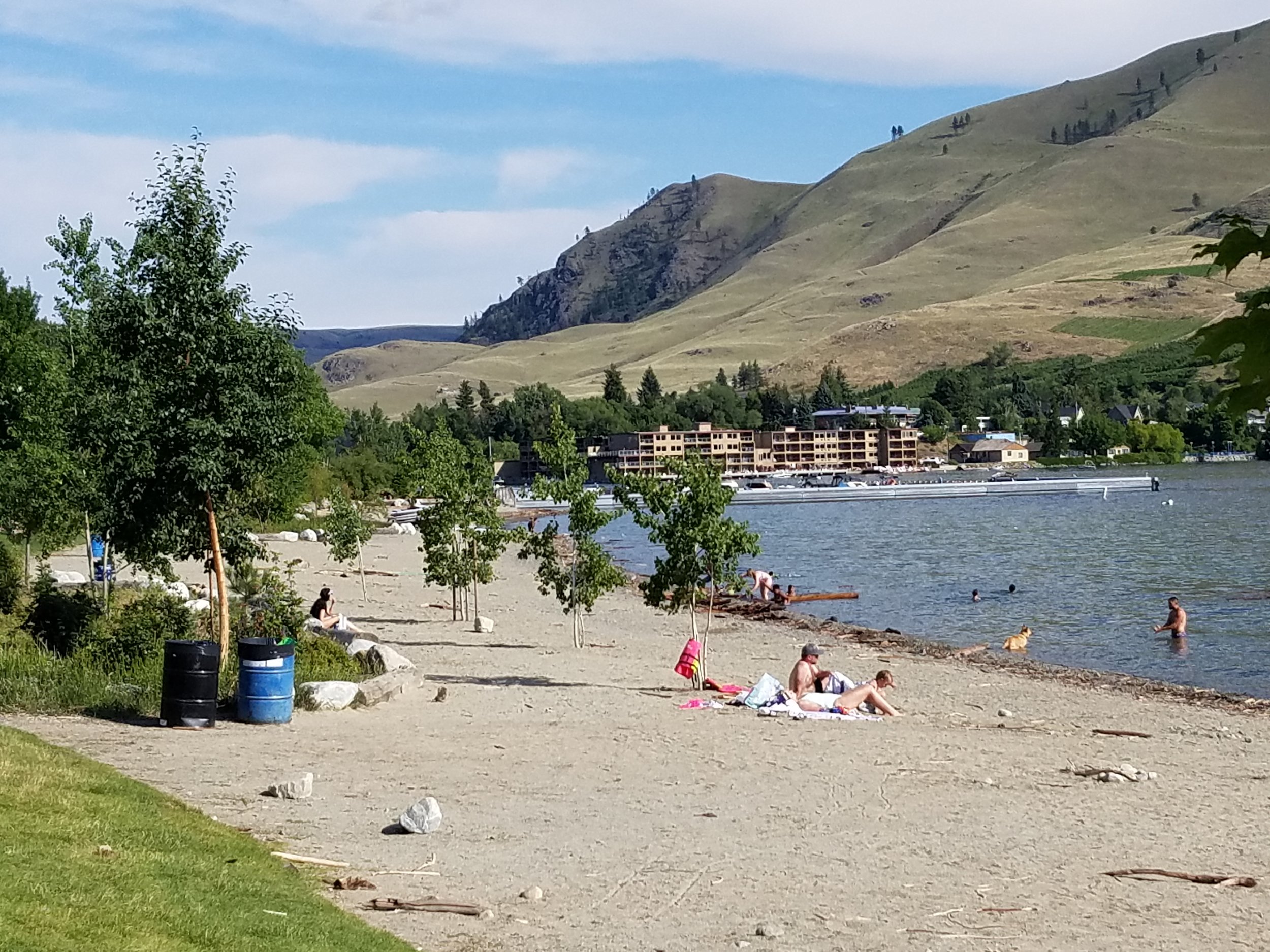
Mild, not wild. The south end of Lake Chelan in July is a popular destination. The water was warm enough to be popular for swimming (not just dipping ‘n’ screaming) and clear enough to see all the way to the bottom. (Photo by M.M Ruth)

Mild, not wild. The south end of Lake Chelan in July is a popular destination. The water was warm enough to be popular for swimming (not just dipping ‘n’ screaming) and clear enough to see all the way to the bottom. (Photo by M.M Ruth)

At its south end, Lake Chelan doesn’t say “wild swim” the way other lakes do. At Don Morse Lakeshore Park, it says “recreational lake for summer tourists, locals, and Coppertone.” Which was fine. I’m all for people getting outside enjoying and recreating in nature. This was my first trip to Lake Chelan (pronounced by most as Shuh-lan) and I wanted to experience both this popular municipal beach near the (over)-developed south end of the lake and the remote shores of the north end 55 miles away near the remote village of Stehekin.

While a swim from the municipal beach was easy (almost a drive-up swim), getting to the remote north of the lake required more planning. Stehekin, like every place along the north half of the lake is accessible only by boat, floatplane, horseback, or by hiking trail.

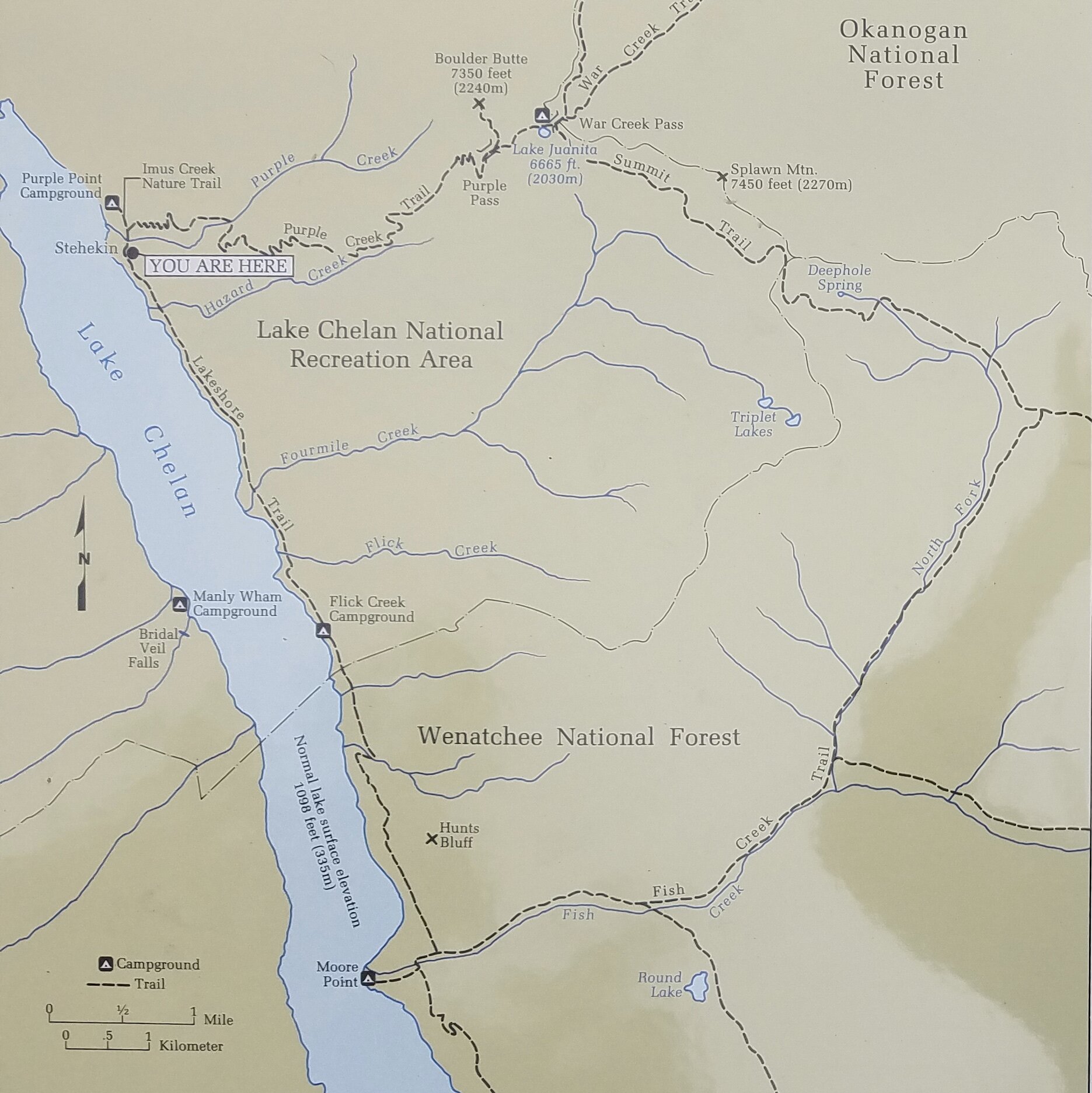
In the wake of the Pleistocene…a ice-gouged valley and a 1,485-foot-deep lake. (Photo by M. M. Ruth of map on display aboard the Lady of the Lake passenger ferry.

In the wake of the Pleistocene…a ice-gouged valley and a 1,485-foot-deep lake. (Photo by M. M. Ruth of map on display aboard the Lady of the Lake passenger ferry.

Lake Chelan is 55 miles long, between 1 and 2 miles wide (except at the narrows where it’s just 1/3 mile wide), and snakes its way across three separate Green Trails topographic map sheets (Nos. 82, 11, and 114). This lake is an unfathomable 1,485 feet deep at its deepest . It is the largest naturally-formed lake in Washington, though it cannot be called a natural lake due to the small dam built in 1928 at the south end. Lake Chelan developed in a broad glacial valley during the Pleistocene, about 2.5 million years ago. Everything north of the town of Chelan was buried under the Okanagan lobe of the ice sheet that covered the northern third of Washington. Lake Chelan is steep sided and surrounded by rugged wilderness areas, national forests, national recreation areas, and North Cascades National Park.

Most tourists do not come to Lake Chelan to swim, though there is a “family fun” open-water 1.5-mile Lake Chelan Swim event every Saturday after Labor Day from Manson Bay, eight miles north of the town of Chelan. They come to recreate around Chelan and to take the Lady of the Lake passenger ferry up the lake. Some passengers are bound for Holden Village, a former gold- and copper-mining town and now religious retreat operated by the Lutheran Church. Others deboard at “flag stops” (i.e. flag the captain and he’ll stop/crash the boat along the shore, extend the ramp/gang plank, and send you and your backpack on your merry way into the wilderness).
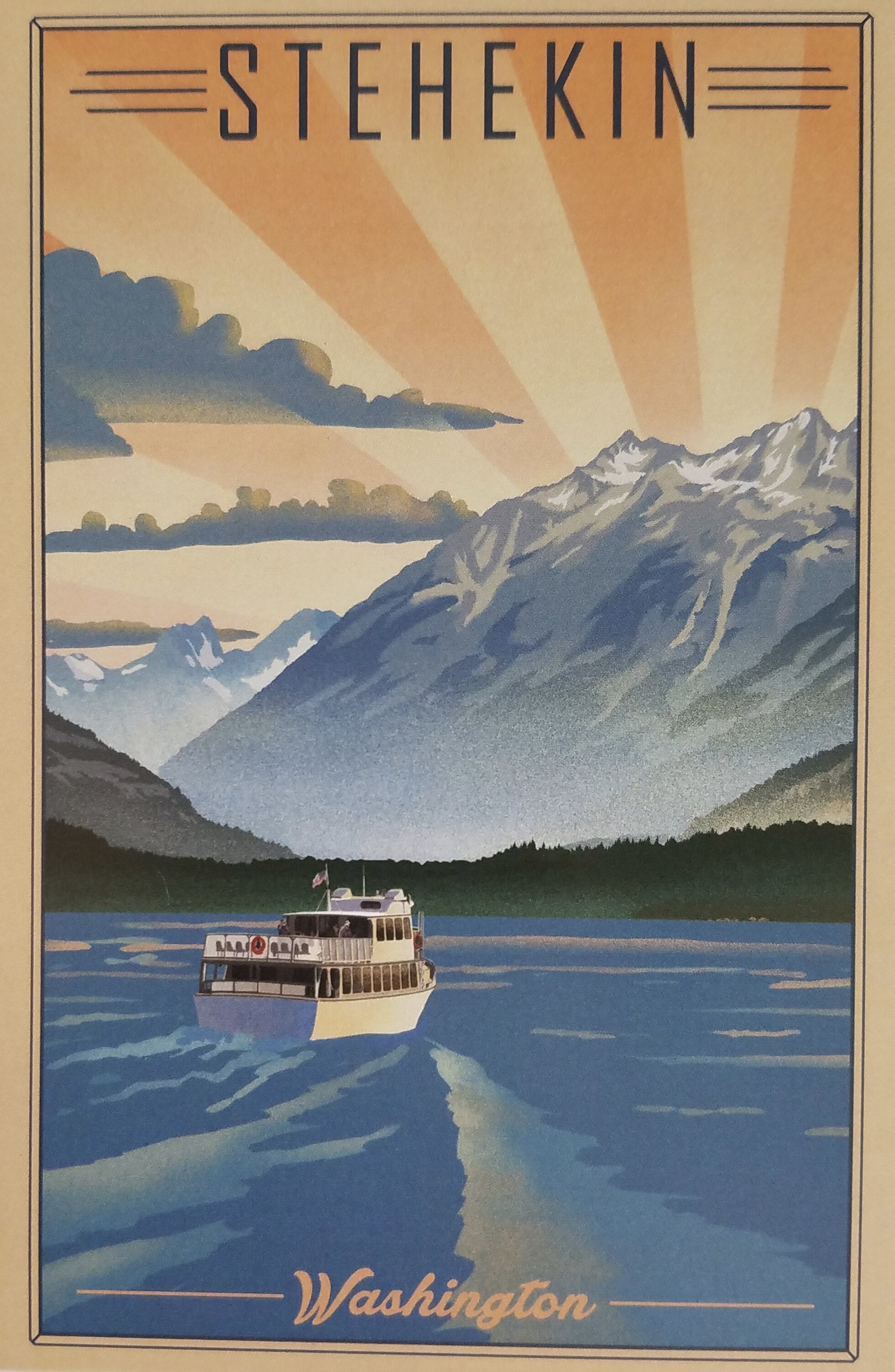
The Lady of the Lake passenger ferry runs daily trips from Chelan to Stehekin. It’s a grand way to enjoy the scenery, mingle with fellow travelers and residents, and enjoy the ferry captains’ informative narrative. Plan on making unscheduled stops f…

The Lady of the Lake passenger ferry runs daily trips from Chelan to Stehekin. It’s a grand way to enjoy the scenery, mingle with fellow travelers and residents, and enjoy the ferry captains’ informative narrative. Plan on making unscheduled stops for interesting sights and to drop off and pick up passengers hiking and camping in the wilderness areas surrounding the lake.

The majority of passengers are headed to Stehekin to spend just a few hours exploring the town, the valley, and famous Stehekin Bakery by shuttle bus. Others set off from Stehekin to hike the trails (including the Pacific Crest Trail) in the surrounding wilderness. Overnighters can camp along the lake or stay at the lovely historic North Cascades Lodge. Some will rent kayaks or canoes to explore the lake.

Kayaks rented from the North Cascades Lodge in Stehekin make a great way to explore Lake Chelan but be aware of shifting winds that can make paddling northward a slog. Photo by M.M. Ruth
Kayaks rented from the North Cascades Lodge in Stehekin make a great way to explore Lake Chelan but be aware of shifting winds that can make paddling northward a slog. Photo by M.M. Ruth

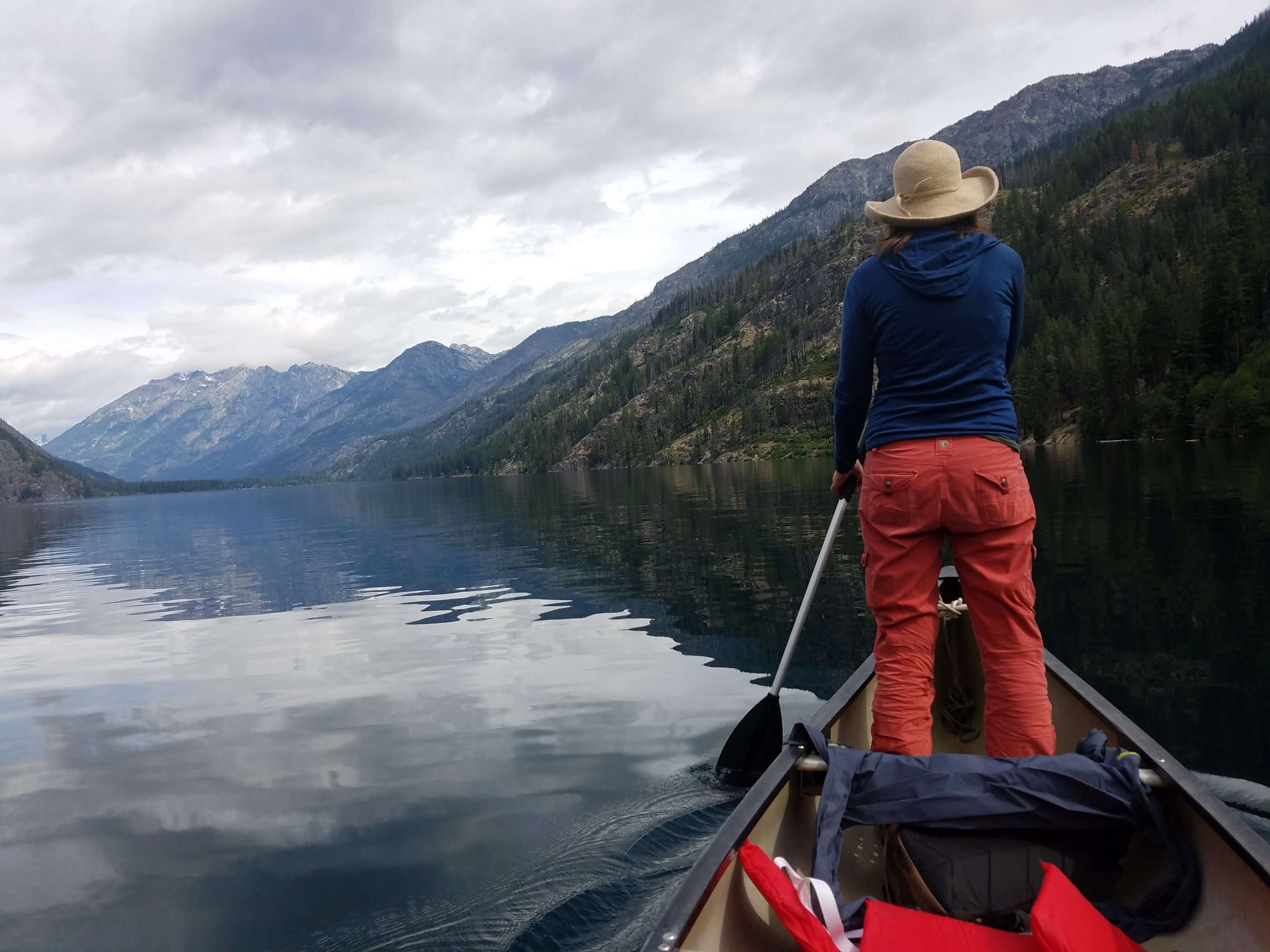
Stand-Up Paddle Canoeing isn’t the rage yet on Lake Chelan but I recommend it for a pleasant change in perpective of the water and the clouds floating in it. Plus it gives the stearnsman a ridiculous photo op. (Photo by M.D. Ruth)

Stand-Up Paddle Canoeing isn’t the rage yet on Lake Chelan but I recommend it for a pleasant change in perpective of the water and the clouds floating in it. Plus it gives the stearnsman a ridiculous photo op. (Photo by M.D. Ruth)

During the two days I stayed at the lodge, I did see two other swimmers (“bathers” might be a better term) but I think I was the only person who swam for pleasure.

“Pleasure” might be a bit of an overstatement. The water at the north end of Lake Chelan at Stehekin was much colder than at the south end. A short hike south on the Lakeshore Trail lead us to Flick Creek campground and a decent-enough access point. And by “us” I mean me. My three companions were not interested in sharing my obsession with wild swimming on this day.

This was one of the briskest swims I took all summer. I’d say it was below 60 degrees—but the clouds and the wind made it seem colder. I guess if meteorologists can talk about “wind-chill factor,” I can talk about “cloud-chop” factor. I swam in 52-degree water in March, but the water was calm and the day was an unseasonably warm and sunny 80 degrees. There is some interesting research on our perception of “cold” water. The air temperature, wind, cloud cover, our mood, our caffeine level, our previous night’s alcohol consumption, and other factors influence not only our perception of the water temperature but also our ability to tolerate it.

Advice: If you are a) solo swimming in a 1,486-foot-deep lake and are b) not wearing a wet suit and c) not accompanied by anyone interested in or willing to get in the water and d) the water is really really cold and choppy and e) it is cloudy and c…

Advice: If you are a) solo swimming in a 1,486-foot-deep lake and are b) not wearing a wet suit and c) not accompanied by anyone interested in or willing to get in the water and d) the water is really really cold and choppy and e) it is cloudy and cool…do not stay in long or go far from shore. This swim in Lake Chelan qualified for a-e and so was under ten minutes. (Photo by M.D. Ruth)

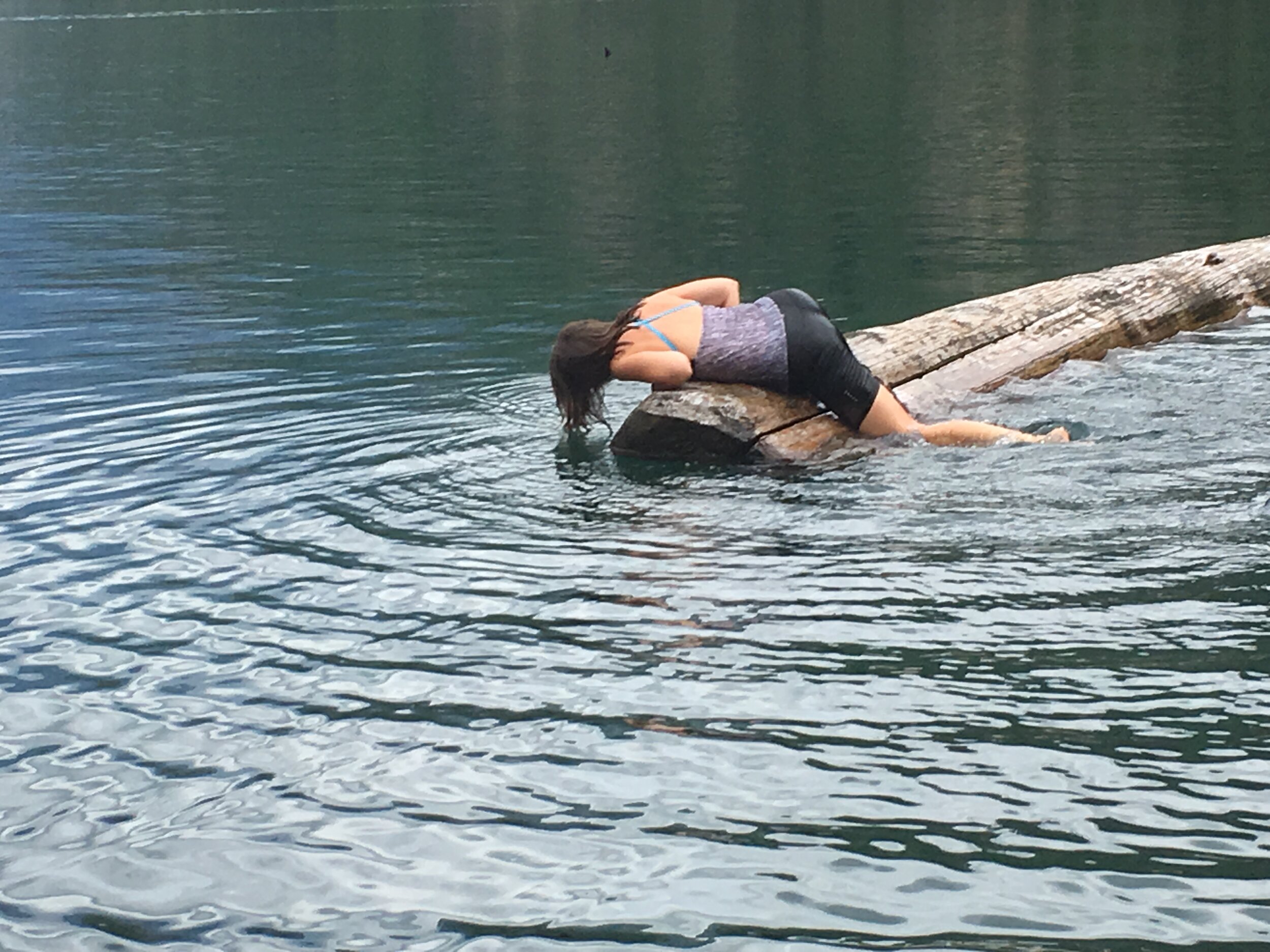
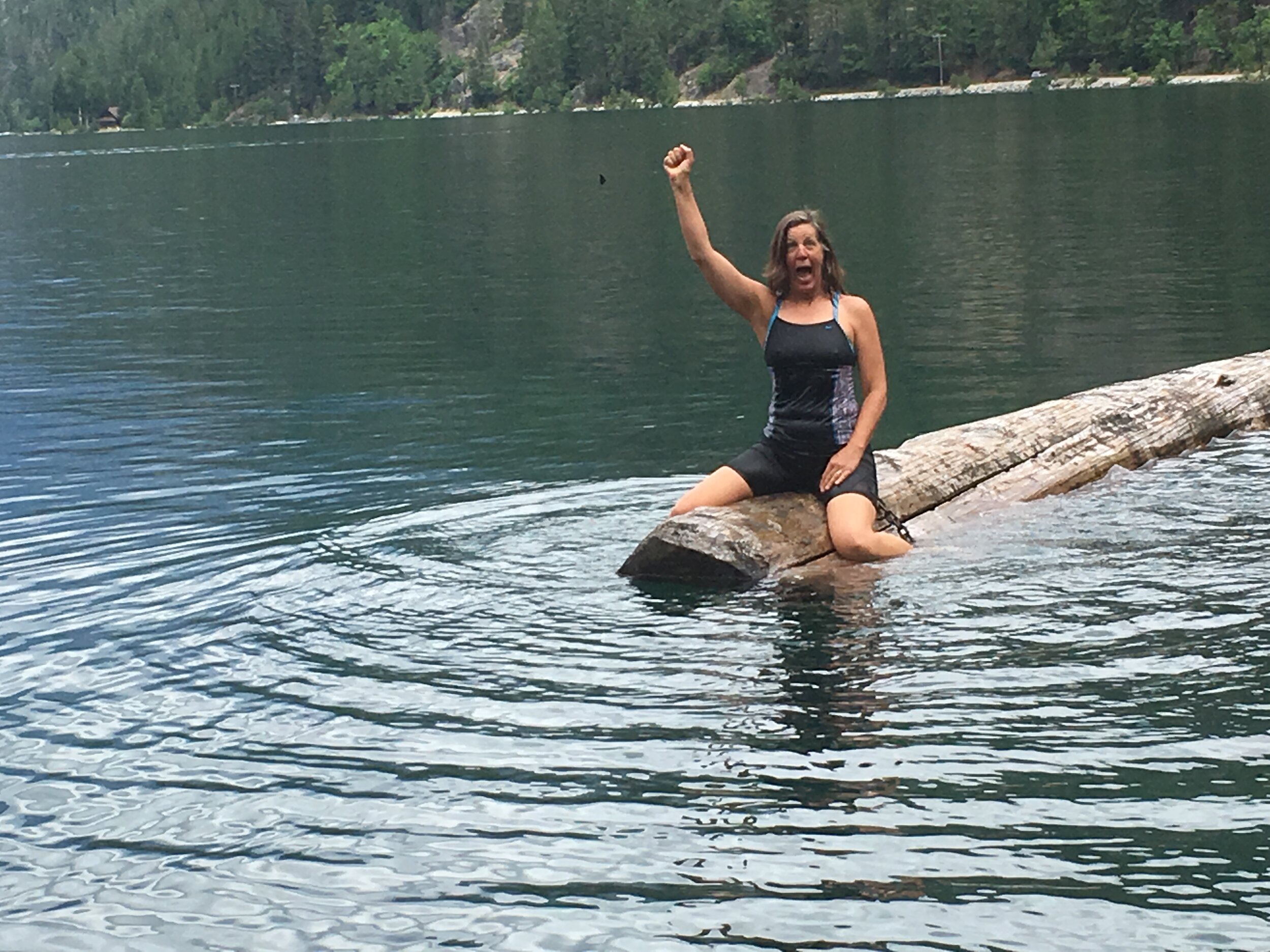
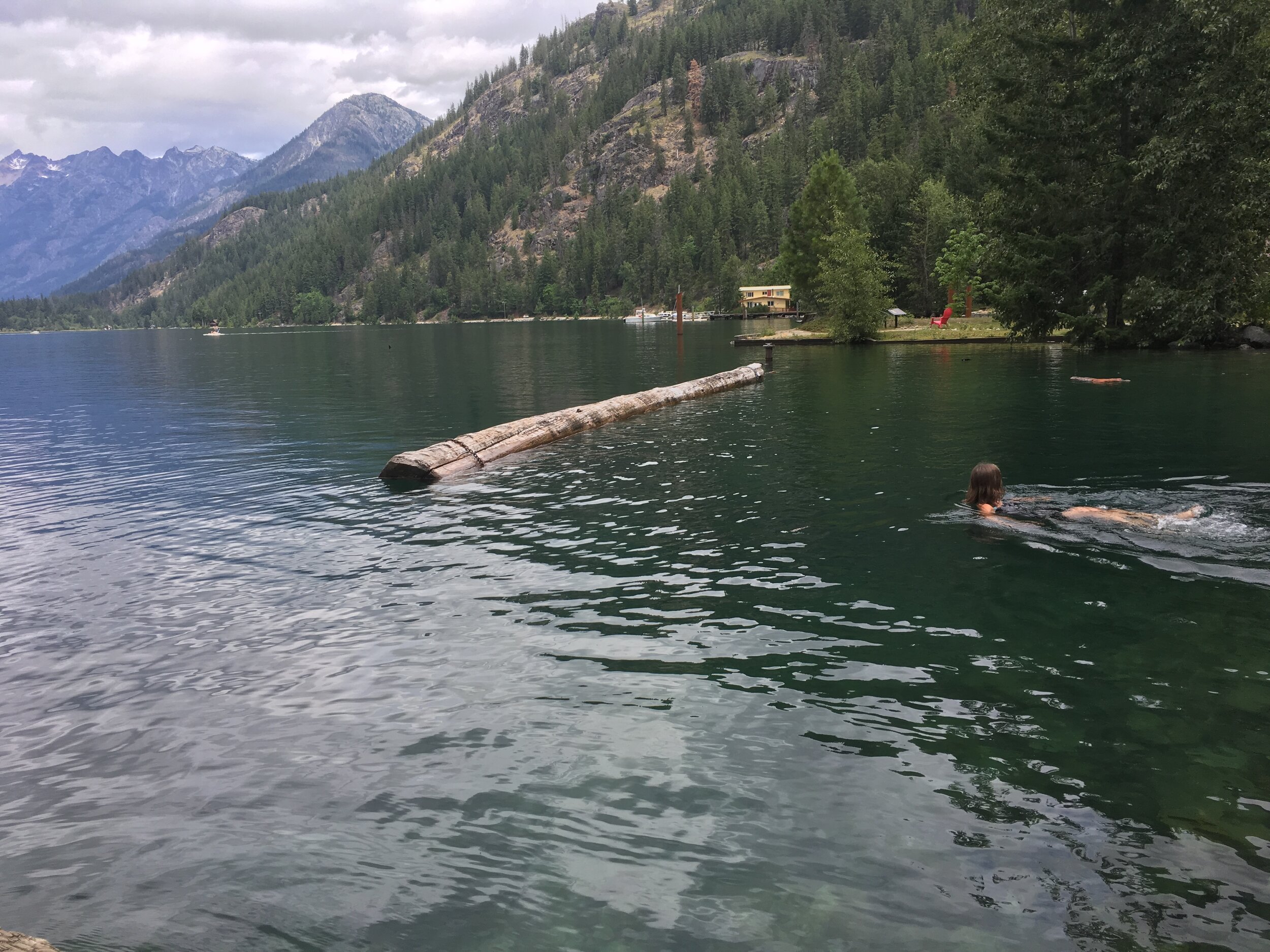
And shortly before getting on the ferry to return home, I took a swim near the boat docks in front of the North Cascades Lodge. A very easy access point and I had enough time to swim to this mooring log and back. I’m so glad I did so I can keep living up to my motto: Never give up an opportunity for a wild swim.

Yeehaw!
IMG_0492.JPG
IMG_0494.JPG
IMG_0495.JPG
20190709_161812.jpg

Next Up: Wild Swims on the East Coast, including Thoreau’s Walden Pond (which is a lake).

In Lake Swimming, Open-water Swimming, Wild Swimming, Wild Swimming Washington Tags Lake Chelan, Stehekin, WA, Washington Lakes, Washington Lake Swimming, Wild Swimming, North Cascades Lodge

“I Need to Show You This Lake...

September 2, 2019 Maria Mudd Ruth
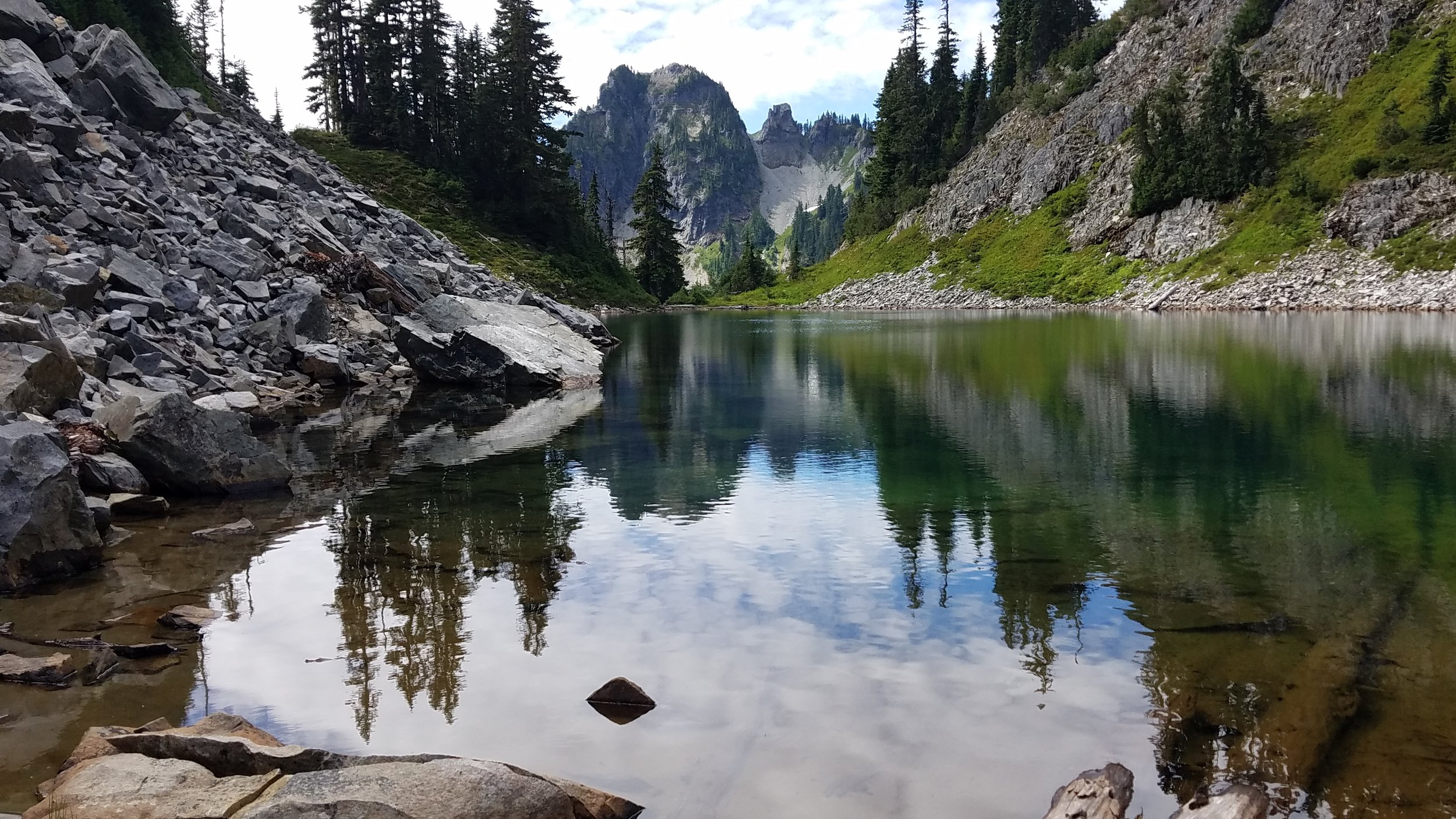
Shhhhhh.                                                                                                                                           Photo by M. M. Ruth

Shhhhhh. Photo by M. M. Ruth

…only I can’t tell you where it is and you can’t tell anyone once we show it to you.”

Over the summer a few of my fellow lake-swimming enthusiasts have been kind enough to take me to their secret lakes as long as I promised not to provide the name or directions to others. I’ve found these secrets easy to keep because Washington state boasts thousands of swimming lakes. I feel lucky to live in a landscape so pervious, pock marked, glacier scoured, and potholed that the secret holders are not depriving anyone of the experience of lake swimming.

Most of our swimmable lakes are accessible by public boat ramp, dock, beach, or trail. The secret lakes require way-finding skill and sometimes a bit of bushwhacking. Trail markers and cairns are entirely absent.

None of the secret lakes I’ve been to have official names and don’t always appear on maps. They become known because someone discovers them and then they tell a friend who tells two friends and so on. And, while I might tell you about these lakes, I cannot for the life of me retrace my steps to return to them or describe the roads and routes and landmarks that would get you anywhere but lost.

Photo by M.M. Ruth

Photo by M.M. Ruth

So it was this past when when two friends guided me on a hike-scramble to this beauty. It was the clearest water I have ever swum in—so clear that it is easy to forget it is water. So clear that, as one friend said, “it’s hard to remember not to breathe it.”

It was what I might once have called “freezing” but now, after months of lake swimming, I’ll call it perfectly delightful cold. We swam, floated and swam some more. When the clouds parted and the sun shone down on the lake, we warmed up on the rocks on the far shore. The lake was silent save for the occasional squeak of a pika and the clattering wings of the grasshoppers echoing against the rocks and cliff. There was no human presence at all—just wilderness all around.

While the sun warmed our skin it also warmed the thin skin of the lake. When we slipped back into the water, the top few inches of the lake had noticeably warmed. To preserve that layer of warm water, we swam slowly without kicking and churning up the cold water beneath. I stretched out on my back and floated, spinning slowly around to memorize the contours of the shore, hill, and peaks and to take in the last bit of summer’s warmth.

I left the water and walked down the sandy shoreline toward my towel, lunch, and thermos of hot tea. I walked slowly, scanning the edge of water for newts. Something caught my eye. There on the beach, scrawled in the sand in all capital letters:

ONLY

WITH

SOUL

In Lake Swimming, Natural History, Open-water Swimming, Washington Lakes, Wild Swimming, Wild Swimming Washington Tags Lakes of Washington, Lake Swimming in Washington, Wild Swimming

Alpine Lakes Wild Swims

August 20, 2019 Maria Mudd Ruth
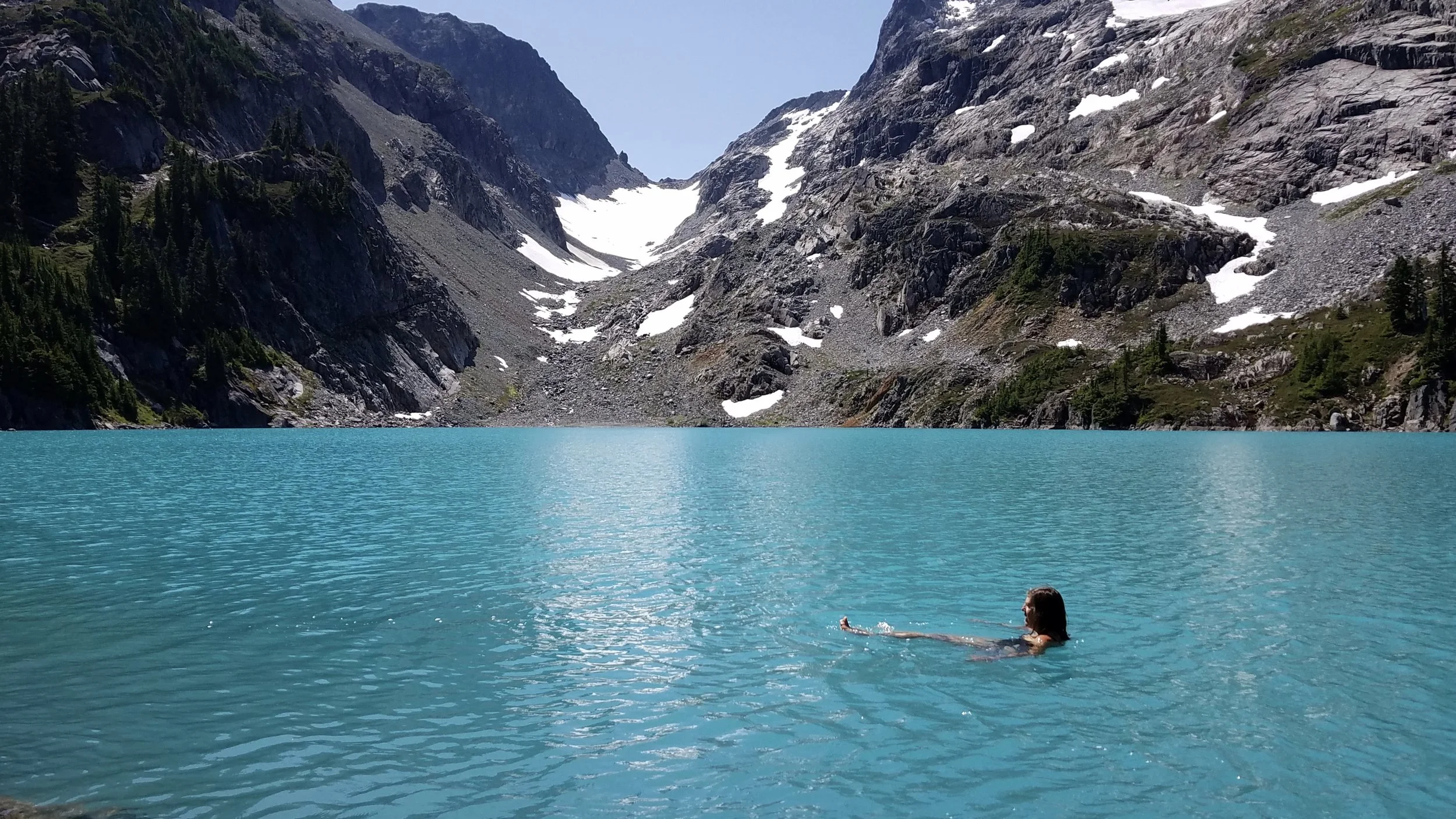
If you have one big Pacific Northwest hike left in you the summer, get to Jade Lake in the Alpine Lakes Wilderness. Please read the WTA trip reports before you go.

If you have one big Pacific Northwest hike left in you the summer, get to Jade Lake in the Alpine Lakes Wilderness. Please read the WTA trip reports before you go.

The most extraordinary wild swim of my Summer ‘19 so far—and most arduous hike to it—is Jade Lake, one of the more than 700 lakes in the 415,000-acre Alpine Lakes Wilderness. I would have been happy/ecstatic if I had just loafed around on the shores of nearby Marmot Lake where my husband and I had pitched out tent, but I’m glad we heeded the advice of all the hikers we talked with on the trail: “Go to Jade,” they said. “You’ll be richly rewarded.” Indeed.

We accepted the challenge and with our day packs, lunch, and a pair of hiking poles between us, we set off for Jade Lake. It is not a hike but a steep, slow, ankle-twisting scramble across a talus slope that extends from just south of Marmot Lake all the way to a flattish stretch of boggy land on the approach to Jade. There was no trail, just a very spare but thoughtful series of cairns to guide us toward our destination. The only difference between the rocks used to build the cairns and the other rocks all around us was that the cairns were distinctively horizontal. Once we reached the first cairn, we just stood there scanning the wide slope from edge to edge looking across a field of mostly chunky squarish boulders and rocks for some anomalies: discreet piles of flat rocks—usually just four or five. Talus slopes are dynamic and it’s likely there were more and possibly taller cairns (or even trail markers once upon a time) that have succumbed to gravity, the push of rain, ice, and snow that covers these slopes most of the year.

We were in no hurry to cover the two miles. The weather was dry and sunny and the longer we baked on the hike, the more delicious the icy water would feel on our skin.

Though we had seen photographs of Jade Lake, nothing prepared us for the moment we first saw the lake. The color is laughably stunning and surreal. “Jade” doesn’t quite capture it. Turquoise? Teal? Aquamarine? Swimming-pool Blue? Maybe we should just call it “Jade-Lake Jade.”

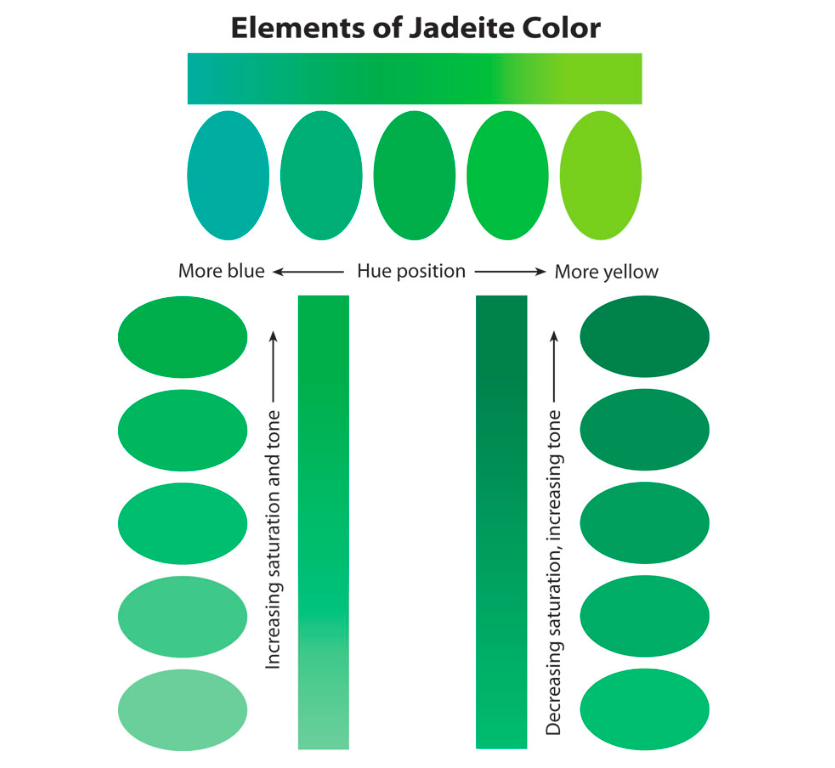
The color known as “jade” comes in many hues, tones, and saturation levels. None here or in other color charts I consulted match the water I swam in.

The color known as “jade” comes in many hues, tones, and saturation levels. None here or in other color charts I consulted match the water I swam in.

The color of Jade Lake is attributed to the fine, almost talcum-powder-fine crushed rock worn down by the scouring of the glaciers and carried into the lake by the meltwater. This “glacial milk” or “rock flour” as it is known remains suspended in the lake water like silt and causes the most stunning color of blue-green of the sun’s visible light spectrum to be reflected to our eyes. The other colors, the longer wavelength reds and oranges are absorbed in the lake and not reflected back to our eyes.

Other lakes in and beyond Jade Lake—and some rivers as well—show this beautiful jade color, but none is quite as thoroughly jade as Jade.

After a good long while of oohing and ahhing by the edge of the lake, it was time to swim. I dipped my feet in for a quick test of the water temperature. It was probably around 55 degrees F, maybe more. I’ve been swimming since March when an actual thermometer read 52 degrees F so I had a sense of what I could tolerate and enjoy safely. I slipped in and felt that ear-to-ear smile break across my face. I dog paddled with my head above water, spinning around so I could see the entire shoreline of the lake. I was in a vast bowl of cool liquid jade. The bottom of the lake wasn’t visible—the lake is opaquely jade but I could see my feet as if the water was crystal clear. I swam a little ways off shore, testing how far I could go toward the middle without the risk of becoming hypothermic and not having enough muscle strength to get back to shore.

One of the most challenging aspects of swimming in such beautiful water in such a remote wilderness (and working hard to get there) is knowing when enough is enough. I wanted to stay in for hours. It might be my once-in-a-lifetime visit to Jade Lake but I also didn’t want to turn myself into a shivering mass of hypothermia. I floated around a bit, then swam a few strokes, the floated some more while spinning myself around to take in the scenery. I was in a total of fifteen minutes or so, no more than 50 feet from the shore. Little did I know the best part was still to come.

Sitting quietly in the sun on the warm rocks, my husband and I heard the calls of an osprey on the far side of the lake. We eventually spotted it as it flew from the top of one tall evergreen on the far shore to another, its white wings bright against the dark green trees. Back and forth, back and forth. And then…

And then it flew over the edge of Jade Lake and the underside of those white wings and white body turned the color of the lake. A Jade Bird. It floated over the water just long enough for us to do a double-take and then fully take in this glorious natural sight. I attempted a photograph but that kind of light, that kind of ephemeral beauty, just can’t be captured.

Before you go to Jade Lake, please read the trip reports on the Washington Trails Association (WTA) page here. It looks like this lake is getting more love (and less respect) that it needs. Please tread lightly, camp quietly, swim without whoopin’ it up.

In addition to swimming in Jade Lake on this trip, we swam in Marmot Lake, Hyas Lake, Little Hyas Lake, and Lake Clarice. I had plenty of time to stare into these beautiful lakes, especially Marmot Lake where we camped. I’m eager to learn more about the different effects on our brains of the sight and sound of rippling lake water, flowing river water, and wave-rolled ocean water.

Lake Ozette Wild Swim

August 4, 2019 Maria Mudd Ruth

Lake Ozette sprawls across the remote northwest corner of Washington just a mile from the Pacific Ocean. The lake was named for the village of Ozette, a now-abandoned whaling village occupied from 440 BC to 1750 AD by the Makah peoples. Lake Ozette’s waters, shoreline, and buffering forest fall entirely within Olympic National Park.

In terms of superlatives, Lake Ozette ranks as one of Washington’s top three largest natural, undammed lakes. Establishing the exact ranking is a challenge. Lake Washington is often cited as the first orsecond largest undammed lake and Lake Chelan still gets listed as second largest despite the fact that it was dammed in 1927.

No matter, Lake Ozette is immense as an ocean to a wild swimmer. This wild and undeveloped lake is about nine miles long and averages two miles across (for a total of 12 sq. mi) and is 331 feet deep at its deepest point. It shoreline and bathymetric contour lines are convoluted.

The convoluted shoreline of Lake Ozette makes it a great place to explore by canoe—plenty of bays, coves, points, nooks, crannies, and few uninhabited islands.

The convoluted shoreline of Lake Ozette makes it a great place to explore by canoe—plenty of bays, coves, points, nooks, crannies, and few uninhabited islands.

The lake’s shoreline is undeveloped. There is a ranger station, campsites, parking lot, restrooms, and boat launch at the north end of the lake and a boat ramp on the eastern shore. Most visitors to Lake Ozette do not come to swim or even boat on the lake, but to hike the ~3-mile mostly board-walked trails to the Pacific Coast at Sand Point or Cape Alava, or hike the “Ozette Triangle,” which includes these trails and (tide willing) the stretch of beach between then camp along the coast. I was there to swim. 

There are no designated swimming beaches on Lake Ozette. In fact, there is no information at all at the ranger station or in my guide books about swimming in the lake. I have discovered that our state’s lakes are underswum; they merely give their names to trails, provide a scenic destination for a picnic, or offer a place to fish. Swimming is rarely, if ever, mentioned as a possibility. Which is a shame. For me, there is no better trail’s-end reward than a refreshing swim.

Given its size, remoteness, and proximity to the ocean, I have always thought of Lake Ozette as intimidating though I had never visited to find out for myself. To discover the best swimming spot and also to swim safely, my husband and I set aside two days in late June to explore the lake in our Penobscot 16 canoe and camp at Erickson’s Bay on the lake’s west shore. The weather was warm, the air calm, and I had my wetsuit and had been lake swimming since March. I was as ready as I’d ever be. 

We launched our canoe at Ozette and paddled south on lightly choppy water for four miles toward Erickson’s Bay. We had the entire lake to ourselves, minus a family of mergansers.

Despite the fact that Erickson’s Bay is a boat-in-only campsite, I was expecting the place to be swarming with boats and campers who had arrived ahead of us. Much of the Olympic National Park has been designated the Daniel J. Evans Wilderness and to reduce the human impact in these areas, there is now a permitting systemin place for overnight camping. Along the coast west of Lake Ozette are limited to just a few sites; Erickson’s Bay was listed as having “99+” sites—in other words, it was a large site with a virtually unlimited number of permits. 

As we paddled toward the shore of the bay, we did not see a single canoe, kayaked, or anchored motor boat. We did not see a single sign marking the way to the camping area. The only indication that we were on target was a break in the shoreline salad hedge and a trail leading to a beautiful driftwood bench.

The only sign that you’ve arrived at the entrance to the primitive campground at Erickson’s Bay on Lake Ozette is this alluring driftwood bench. Photo by MM Ruth.

The only sign that you’ve arrived at the entrance to the primitive campground at Erickson’s Bay on Lake Ozette is this alluring driftwood bench. Photo by MM Ruth.

Civilization! We beached the canoe and walked up the trail. Not only was there the bench, there was a stone fire ring and a smooth flat spot for our tent. And a nearby privy. Before committing to this perfect bay-view site, we strolled through the forest and discovered not a single human soul, but a very tidy forest of young red-cedars and sword ferns.

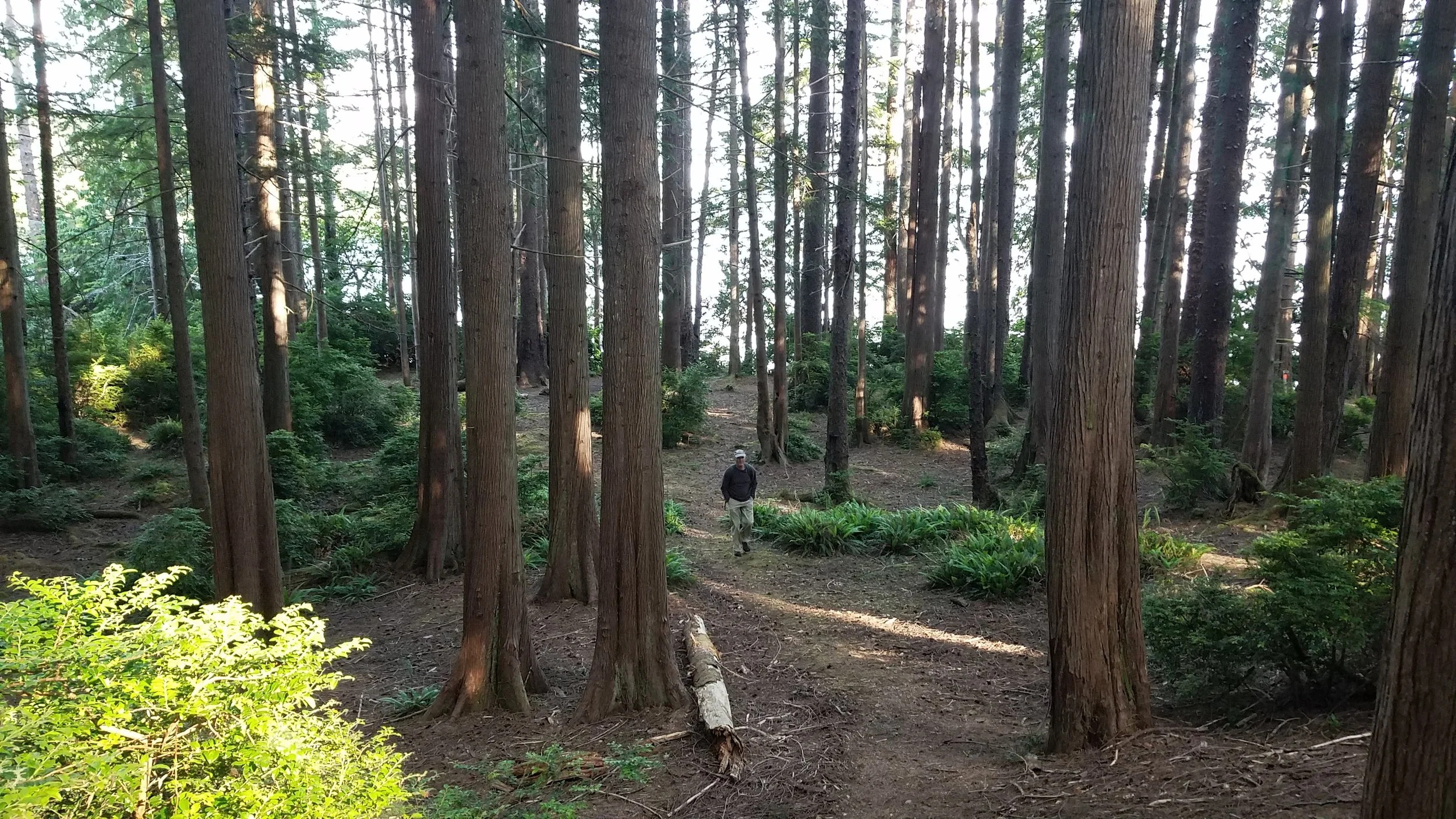
Erickson’s Bay campground on Lake Ozette features a very young, tidy forest of western red-cedars, ferns, and huckleberry and looks like a Hollywood set. Photo by MM Ruth.

Erickson’s Bay campground on Lake Ozette features a very young, tidy forest of western red-cedars, ferns, and huckleberry and looks like a Hollywood set. Photo by MM Ruth.

We set up our tent and took a clothing-optional dip in the lake. The water was much warmer than I expected. Unlike other large lakes on the Olympic Peninsula (Quinault, Crescent), Lake Ozette is not fed by glaciers atop Mt. Olympus. The drainage basin to the lake is entirely beyond the reach of the icy tributaries. Lake Ozette is fed by many rivers, the largest being Big River and Umbrella Creek. Most flow through private timber lands—aka young forests, clearcuts, lack of shady, cooling tree canopy. 

The lake was also much more shallow than we anticipated. Though the lake is 331 feet deep at its deepest, we had to walk across twenty feet of soft sand, twiggy branches, and forest duff to get into water deep enough to swim in.

Here in the sunny shallows of Erickson’s Bay, Lake Ozette was anything but intimidating. I felt more like the kiddie pool at a community aquatic center: a good place to test the waters and refreshing once I got out.

For a wild trail to the coast (dashed red lines), boaters can access the boat-in-only trailhead just a mile south of Erickson’s Bay. The better maintained trails (solid red line) to the north form two sides of the popular “Ozette Triangle” and can b…

For a wild trail to the coast (dashed red lines), boaters can access the boat-in-only trailhead just a mile south of Erickson’s Bay. The better maintained trails (solid red line) to the north form two sides of the popular “Ozette Triangle” and can be accessed from the Ozette Ranger Station.

The next day, we packed a lunch and my swimming gear and canoed south to find a trail to the coast. This was not one of the two well-traveled trails of the Ozette Triangle, but a primitive (as in not marked or maintained) trail that serves as an evacuation route from the coast in case of a tsunami. We beached the canoe and walked two miles through the woods. It was totally enchanting, lush, and was the home of enormous Western red-cedars and Sitka Spruce.

The enchantingly primitive tsunami evacuation trail starts one mile south of Erickson’s Bay on Lake Ozette. Photo by MD Ruth.

The enchantingly primitive tsunami evacuation trail starts one mile south of Erickson’s Bay on Lake Ozette. Photo by MD Ruth.

We had the entire trail to ourselves. The plank boardwalk is quite dilapidated (and possibly dangerous even if you are not rushing to beat a tsunami toward). This turned out for the best as it slowed our pace down. We had to be careful with every step, which meant we stopped often to look around and admire the giant trees. After our picnic on the beach, we returned to our canoe--my husband to his lifejacket and paddle and me to my wetsuit and goggles. And off I went—swimming back home to Erickson’s Bay.

I’m always a bit breathless when I start a swim. I am never sure if it’s nerves or just a matter of getting up to speed aerobically before I get in an easy rhythm and groove. Having my husband shadow me in the canoe on my left side made me feel safe and also provided a visual marker to keep me on track. I breathe on my left side when I swim and caught a reassuring glimpse of the green canoe with every breath. Though the water was plenty warm enough (75?) to swim without a wetsuit, I wore it for extra buoyancy (and ease swimming) and also to prevent the possibility of hypothermia. Even if we think the water is “warm,” hypothermia can set it if you’re in it long enough.

 I moved across the lake in my usual medley of crawl, backstroke, breast stroke, and floating on my back to take in the sky and clouds and expanse of the lake. Oh, and an Esther Williams’ moment, too. The lake was a tawny tannin color and I could see the bottom clearly as I hugged the shore. I ventured a bit further out, lost sight of the bottom, and had a wee surge of “freak out” and returned to shallower water. Why the freak out? I can’t really say but I am interested in exploring the idea that everyone has a comfort zone in the water—a certain depth, a certain distance from shore, a certain level of surface chop. I swim regularly sans freak-out in a lake that is 65 feet deep. I cannot see the bottom but I can always see my feet clearly. I can see the entire shoreline. Lake Ozette was different—unfamiliar, a bit murky, a bit too vast to feel a kind of hug from the shoreline. I tried to embrace the vastness of Lake Ozette, which turned out to be easy once I turned onto my back and looked into the big beautiful sky and clouds overhead. I had forgotten that I can rely on my old pals, the clouds, for perspective.

Lake Ozette Wild Swim—just a mile from tsunami trail to Erickson’s Bay on June 26, 2019. Photo by MD Ruth

Lake Ozette Wild Swim—just a mile from tsunami trail to Erickson’s Bay on June 26, 2019. Photo by MD Ruth

In Lake Swimming, Open-water Swimming, Washington Lakes, Wild Swimming, Wild Swimming Washington Tags Lake Ozette, Erickson's Bay, Wild Swimming, Washington Lakes, Washington Lake Swimming, Ozette Triangle, Canoeing on Lake Ozette
← Newer Posts Older Posts →

Subscribe

Sign up with your email address to receive my blog in your inbox.

Thank you!
Blog RSS

Flying from Mountaineers Books this Spring—the story of the Pigeon Guillemot—the world’s most charismatic alcid. This non-fiction natural history will be on bookshelves and available from online retailers on April 7, 2026. Click a link below to pre-order a copy now from these purveyors:

Mountaineers Books (non-profit, indie publisher based in Seattle)

Browsers Books (Olympia’s indie bookstore)

Bookshop.org (support your local bookstore)

Barnes & Noble (in the book biz since 1971)

Amazon

Other Natural History Titles by Maria Mudd Ruth…

A Sideways Look at Clouds


“Compelling…engaging.” The Library Journal

“Rare insights into the trials and joys of scientific discovery.” Publishers Weekly

Read more reviews and details here: Rare Bird: Pursuing the Mystery of the Marbled Murrelet

Enjoy this song by Peter Horne, "Little Bird, Little Boat, Big Ocean.” Written about the Marbled Murrelet, but the lyrics work well for the Pigeon Guillemot, too.


  • Wild Swimming
  • marbled murrelet
  • clouds
  • A Sideways Look at Clouds
  • Mountaineers Books
  • Rare Bird
  • old-growth forests
  • Open-water Swimming
  • Maria Mudd Ruth
  • Lakes of Washington
You must select a collection to display.

Subscribe

Sign up with your email address to receive my blog in your inbox.

Thank you!
Blog RSS

©2025 MARIA MUDD RUTH  |  ALL RIGHTS RESERVED