• Home
  • The Bird with the Flaming Red Feet
  • Rare Bird: Marbled Murrelet
  • A Sideways Look at Clouds
  • Author
  • Events
  • Blog
  • Contact
Menu

Maria Mudd Ruth

Street Address
City, State, Zip
Phone Number
author and naturalist
Homepage-Banner.jpg

Maria Mudd Ruth

  • Home
  • Books
    • The Bird with the Flaming Red Feet
    • Rare Bird: Marbled Murrelet
    • A Sideways Look at Clouds
  • Author
  • Events
  • Blog
  • Contact

The Dip & The Deschutes River Falls

July 8, 2019 Maria Mudd Ruth
Screen+Shot+2019-07-08+at+8.23.39+AM.jpg

In The Gentle Art of Tramping, a charming and delightfully dated book published in 1926, author Stephen Graham writes about the joys of swimming during his extended forays “tramping”—hiking, walking, swimming, lolling, exploring in the wild under the open sky. In a chapter called “The Dip,” he writes this:

The morning swim is such an embellishment of the open-air life that many are tempted to plan their whole expedition with that in view. “

Yes! The morning swim is a marvelous way to start a day and on Sunday, two friends and I set off—for a remote stretch of the Deschutes River for our second annual swim. I imagine Stephen Graham would have devoted an entire chapter about this dip. Deschutes Falls Park is a small park with a few short trails that lead to dramatic views of the river, falls, and plunge pools. Swimming is not exactly encouraged as a recreational activity here but I’d say it’s the finest swim in Thurston County.

20190707_091255.jpg
20190707_092823.jpg

This particular section of the Deschutes River falls within Thurston County’s Deschutes River Falls Park southeast of Yelm, WA. The river is accessible by trail and then off-trail along the rocky banks of the river. It’s nothing like the Deschutes that flows through Pioneer Park in Tumwater or the City of Olympia near Budd Inlet. This is a fast-flowing, deep blue-green river, moving through a narrow slot-canyon. There are deep (`8 feet) pools between sets of falls where you can safely swim. But you must be ready for cold water—I’m guessing 55-60 degrees F. Listen to this river sing! (click video below)

We scrambled down the rocks and slipped into the water for “The Dip.” I knew the water was “really cold” but surprisingly we slipped right in much more easily and quickly that we did last year. We’ve been swimming since early spring, and think that our tolerance (and enjoyment) of cold water has increased. In fact, we stayed in the water for over half an hour—no wet suits, no whining. We swam upstream to the base of the falls (what a strong current!), relaxed in eddies in cave-like coves, looked at caddisflies on the rocky river bottom, and marveled at the coreopsis, terms, and delicate exoskeletons of stoneflies still clinging to the rocks along the shore (after the adult form of this macro -invertebrate hatched out into the air). Both caddisflies and stoneflies are indicators of clean, well-oxygenated water and therefore good signs for human swimmers looking for clean water.

We were smiling so much our faces hurt. It was hard to get out of the water but will tingling fingers and toes, we decided to crawl out on the rocks, put on dry clothes, do some jumping jacks, and fill up on hot tea to warm up. Once the tingling stopped, the post-immersion euphoria set in and lasted all day. Wow.

What a privilege to have such a park, such a river, such a beautiful wooded setting, and such friends to enjoy this gift of nature with…again. What a dip!

IMG_0440.JPG

More information on Deschutes Falls Park here.

Washington Lakes--Lost and Found

June 29, 2019 Maria Mudd Ruth
Take your hip waders but leave your wet suit and swimming goggles in the car.

Take your hip waders but leave your wet suit and swimming goggles in the car.

This is Disappearing Lake in the Gifford Pinchot National Forest the Mount Adams Ranger District in Klickitat County. It’s part of the gorgeous South Prairie and functions as a wetland and prairie in the summer, a basin for holding rain, snow, and ice in the fall and winter, and a lake for a very short period in the spring.

You’ve probably heard of Mt. Hood (second largest volcano in Lower 48), the town of Hood River, Oregon (famous as a wind-surfing, soft-fruit, and craft-beer mecca) and it’s sister town, White Salmon, Washington (white-water rafting, mellow non-Hood-River vibe). You may also be familiar with Gifford Pinchot National Forest—the 1.3 million acres of forested land stretching north from the Columbia River gorge.

As a day hiker who defaults to the Olympic Peninsula and Mt. Rainier for recreating, I have only occasionally visited this beautiful part of Washington State. A few times to hike in the Gifford Pinchot National Forest and once to survey for the egg masses of the endangered Oregon Spotted Frog. Never once did I hear or read about Disappearing Lake or the lake from which the town of Trout Lake gets its name.

Not until I began my research on Washington Lakes and lake swimming and watched a 2014 episode of Oregon Field Guide (it’s just 6 minutes long, worth a viewing) did I learn about Disappearing Lake. It doesn’t show up on most maps or Forest-Service road signs. It’s just called South Prairie. Which makes sense. It’s part of an extensive prairie south of Mt. Adams and is a prairie from mid-summer to late-fall and then, when the rains come the prairie begins to fill with water. The water that fills a lava tube freezes and acts like a plug in a bathtub. The prairie fills up with rainwater and snow and, in late spring, emerges as a beautiful lake you can canoe and kayak on if you time it right. Like most of my wilderness adventures (see my blog on Banks Lake), I’m always a bit off on my timing of natural spectacles. We arrived in mid-June having just missed the canoe-able—and I had hoped chilly-but-swimmable—period of Disappearing Lake. Alas, I’d pack my wetsuit again next spring and be ready to head to the lake on a moment’s notice to try again.

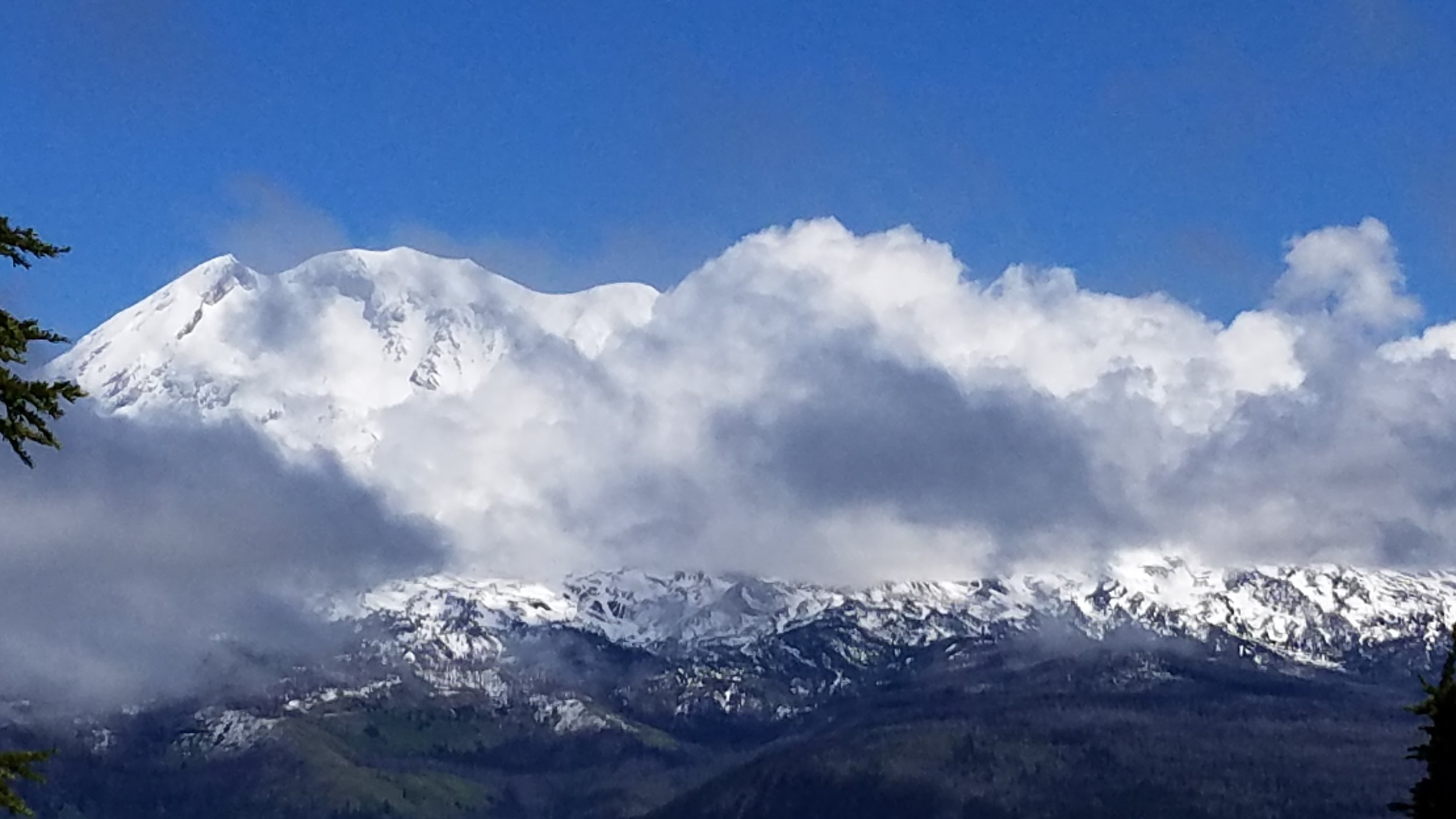
Not wanting to feel foolish about driving for 4 hours with a canoe strapped to the top of our car and not getting it wet, we headed for Goose Lake. But it was raining heavily that Friday afternoon and there was a fishing derby on the lake the next day. So my husband and I up Sleeping Beauty instead for bit of aerobic exercise and a spectacular view of Mt. Adams dancing with the cumulus clouds. What could top this as a consolation prize?

Mt. Adams and the clouds from atop a rock formation known as “Sleeping Beauty.”

Mt. Adams and the clouds from atop a rock formation known as “Sleeping Beauty.”

On the way back from the hike, we drove through the town of Trout Lake, wondering exactly the eponymous lake was and why there were no signs (not even the subtle Forest Service brown ones) advertising its presence. My husband had a hunch we might have luck following Lake Rd. a road marked as a Dead End. A few minutes later, we parked our car at a classic wooden kiosk and were happy to discover we needed a Discovery Pass. We had arrived at the Trout Lake Natural Area Preserve (NAP) managed by the Washington Department of Natural Resources (DNR). The lake was part lake, part creek, part wetland and a hot spot for the endangered Oregon Spotted Frog.

Screen Shot 2019-06-13 at 5.39.07 PM.png
Screen+Shot+2019-06-13+at+5.40.16+PM.jpg

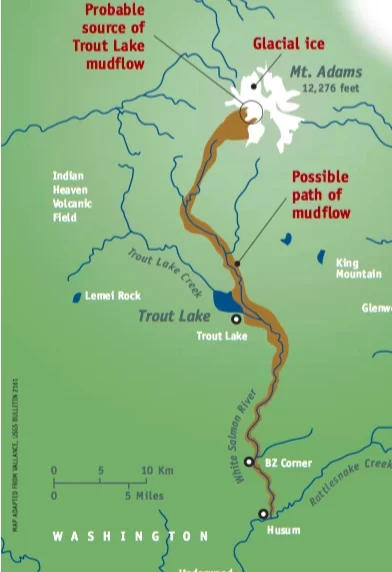
On our left was an interpretive trail that hugged the southwest side of the creek and wetland. Here we learned that an avalanche of volcanic debris and mud, known as a lahar, flowed down from Mt. Adams about 6,000 years ago. The lahar traveled some 35 miles, following the river channels and leaving deposits as thick as 65 feet. The lahar raised the floor of the White Salmon River, thus blocking one of its tributaries—today’s Trout Lake Creek. The newly formed lake was much more extensive than it is today; sedimentation, especially over the last 50 years, has been filling in the open lake, increased the wetlands.

Screen Shot 2019-06-29 at 8.13.34 AM.png

After our short trail walk, we returned to our car and noticed a pair of flip-flops on the muddy edge of the water. That was the only sign I needed that it was time to grab my wetsuit and goggles and launch the canoe.

20190609_110110.jpg

We weren’t sure if we’d be paddling in a creek or a lake or deadend in a meadow of reed canary grass or for how long before we got stuck, but the water called. To our delight and amazement, we paddled for a good 30 minutes up the most gentle, intimate little waterway a Discover Pass could buy. The shore was undeveloped the bank was tangled with all the makings of a Hollywood riparian buffer: reeds, sedges, rushes, grasses, willows, snags, and cottonwood trees further off. Paddling upstream was easy and the water so inviting.

20190609_124242.jpg

We pulled off in an eddy at a very grassy spot and, with Oregon Spotted Frog tadpoles wiggling around my toes, I braced myself for a plunge into the clear cold water flowing off Mt. Adams in the distance.

20190609_122540.jpg

Despite my attempt at looking relaxed (what’s with my right foot?), it was nearly impossible to go gently into that good lake. Or any lake-river that takes your breath away and leaves you uttering ridiculous but ultimately helpful self-motivating phrases.

Getting upstream was harder than I thought. But worth the effort. My first-ever downstream swim was like flying.

In Lake Swimming, Geology of Washington, Lakeside Geology, Natural History, Open-water Swimming, Volcanoes, Washington Lakes, Wild Swimming, Wild Swimming Washington Tags Lake Swimming in Washington, Trout Lake Washington, Disappearing Lake, Gifford Pinchot National Forest, Mt. Adams Washington, Department of Natural Resources, Natural Area Preserve, Outdoor Swimming

Outdoor Swimming Society

May 9, 2019 Maria Mudd Ruth
This lovely silicone swim cap keeps your head warm (ish) and increases your visibility among boaters. It makes a great gift (thanks Max!)

This lovely silicone swim cap keeps your head warm (ish) and increases your visibility among boaters. It makes a great gift (thanks Max!)

This past winter, I discovered the Outdoor Swimming Society’s wonderful website, I knew it was going to be challenging to decide which I enjoyed more: peursuing their website or actually swimming outside. This UK-based organization makes swimming outside—especially in very cold water lakes, rivers, pools, seas, and bays—look very very appealing. All the wool-hatted swimmers look like they are having so much fun in that freezing air and chilly water! (Sometimes I wonder if it’s actually August and they are faking it!)

The Outdoor Swimming Society website is not only full of inviting photographs of happy swimmers in outdoor swimming spots (mostly in the UK) but also excellent information on issues such as swim safety, cold-water acclimatization, swim events, some OSS gear (see my “imported” silicon cap in the photo) and links to many award-winning or award-worthy films on outdoor swimming. If you’ve read Roger Deakin’s Waterlog: A Swimmer’s Journey Through Britain, you might be surprised to discover in Deakin’s wake dozens of similarly wonderful, personal, quirky, enticing, books about “wild swimming.” There are links and reviews of them on the OSS site.

And movies! You can stream (often for free) film( mostly documentary, often short) about wild swimmers and wild swimming. Click here to watch. A few of my favorites are Johanna Ice Swimmer, My Big White Thighs & Me, and The Litter Mermaid. One indie offering, A Film Called Blacks Can’t Swim by British Rapper Frank “Ed Accura” Awuah, isn’t in wide release but check out the preview and get your local indie movie house to request a screening. A socially relevant and important film to help ensure everyone in our community has the opportunity to enjoy and feel safe swimming.

The Outdoor Swimming Society—the organization and the website—appeals to a wide range of outdoor swimmers: wild-water swimmers, outdoor pool and lido swimmers, competitive swimmers, and anyone who love to dip or plunge or float in the gloriously liquidy part of our earth.

Get out there!

Screen Shot 2019-05-09 at 7.39.09 PM.png
In Open-water Swimming, Wild Swimming Books, Wild Swimming Tags Outdoor Swimming Society, Wild Swimming, Outdoor Swimming, Books About Wild Swimming, Films About Wild Swimming, Roger Deakin

Swimming with Geese in Munn Lake

April 30, 2019 Maria Mudd Ruth

Until last Thursday, swimming in Munn Lake has been a relaxed affair This early in the season, we swimmers have been sharing the lake with just a few fishermen, a scenic drift boat or two, and the delightful soundtrack of red-winged blackbirds in the cattails. Canada geese fly over the lake and might be nesting somewhere on the shore out of sight, but they are usually not on the lake when we are. Oh, but Thursday morning was different. There were two geese in the middle of the lake when we entered the water and then they flew off and we lost track of them. We must not have been paying attention. Suddenly it seemed a single goose was on the water and moving toward us. I have never had a personal encounter with a Canada goose but I knew they have a reputation for being aggressive, strong, and defensive when protecting a nest or goslings

So I put on my swim goggles to protect my eyes. The goose continued toward us and we made the assumption that it was protecting a nest so we swam toward the opposite shore. This goose was not posturing defensively, honking, or hissing at us. It was simply swimming toward us. Closer and closer.

When it got within a few feet of us (yes as in 2 or 3 feet), my friend splashed it with water and told it to go away but to no avail. In hindsight, splashing water on waterfowl was not a brilliant defense. Likely the goose thought “Fun! My people!”

We swam harder to evade the goose, but it continued its pursuit. We decided to swim in different directions to reduce our “army of two” and lessen the goose’s perception of us as a threat, but the goose picked one of us to follow: my friend. Who decided to simply tell the goose that we were friends and we were not going to harm it or bother its nest. The goose took my friend at her word and decided to continue on the path toward friendship. We decided to put our heads down and swim crawl stroke toward the boat ramp and leave the goose in our wake. Ha!

The goose followed us and waddled up the boat ramp and into the parking lot where we had left our towels and thermos of tea. When it came within a few feet of us, it stopped and began preening.

20190425_115232.jpg

That’s when we noticed the monofilament fishing line wrapped around its ankle. From a few feet away it didn’t seem that the line was constricted the goose’s ankle but was more of a foreign-object irritant to the goose. It began tugging at the line and, because we believe in trans-species communication, concluded that the goose was asking for our help. It was pursuing us on the lake but couldn’t show us its ankle until we were on land. With the heartbreaking images of the mother orca whale displaying her dead calf above the waters of Puget Sound last summer still fresh in our minds and hearts, we were only too willing to answer this goose’s plea for help.

We didn’t let the fact that we had no wildlife rehabilitation skills, goose wrangling experience, or pair of scissors between us hold us back. Both of us imagined we could just throw one of our towels over it to keep the goose’s wings still while we untangled the fishing line. Yes, the goose was asking us to do exactly this. This is how goose whisperers are born.

After a few towel tosses and goose stepping…we admitted that maybe we should just call the Washington Department of Fish and Wildlife, which manages the boat ramp and stocks the lake with fish. Perhaps they had a wildlife biologist with the necessary skills and a pair of scissors at the ready. Until then, we couldn’t do much for the goose so we decided to help future geese by picking up strands of monofilament, lures, and cigarette butts from the area around the boat ramp. There was more than there should have been given there is a monofilament disposal tube right there next to the ramp. Our good deed done, we began walking toward our car, assuming the goose would turn back to the lake. Ha!

It followed us to my car and stood buy the driver’s door. Uh oh. I had read stories about young goslings and ducklings imprinted on humans and had seen the movie “Fly Away Home,” but this was an adult goose and we had only spent about 15 minutes in its company on the lake and another 5 on land. I slowly backed the car up and drove toward the road. The goose ran alongside my car by my window. And then it fell behind the car. Phew. We had outrun it.

I looked in the rearview mirror expecting to see the goose in the distance waddling toward the lake. But no. My rear-view mirror was full of Canada goose. This crazy bird was flying behind the car right at the back windshield. What is the only thing to say in a situation like this? “Holy shit!”

The goose didn’t expect me to slow down and stop before turning out of the parking lot and onto the road. So when I slowed down, the goose flew over the top of the car and slid down the front windshield. Yes, I had a goose on my front windshield, its wings stretched across the entire windshield for a few seconds before it landed in front of the car.

20190425_120848.jpg

Had this goose imprinted on a blue 2002 Prius? What to do?

We’d turn right (away from a major road) and into the neighborhood where we would make a series of left and right turns and elude the goose. I turned onto the road and before I knew it, the goose was flying along side my car at eye level. Soon, I feared, it would be flying into the car, nestling down in the back seat, and putting on its seatbelt. I pulled the car over to the side, made a U-turn, and hoped the goose would fly back toward the lake as we passed the entrance to the boat ramp.

The goose turned and ran along side the car (see video above). Illegal move #1: I grabbed by cell phone and tossed it at my friend. “Quick! Take a video!” The only reasonable response to this request was, “No, I’ll hold the steering wheel and you take the video.” Illegal move #2: My friend held the steering wheel and yours truly fumbled with my android camera and managed to capture the video of “our” goose. When I noticed a car coming toward us and the goose, tossed my camera onto the floor and flashed my headlights. The car slowed down and then stopped. The goose landed and stopped. This was our chance to escape.

We drove past the goose and the stopped car, but for reasons neither my friend nor I can explain, I turned back toward the boat ramp and parked the car behind the port-a-potties. Because this is what trained wildlife biologists do. They hide from wildlife so they can better observe their behavior. Tucked behind this impromptu "duck blind,” we were sure we would be soon seeing our goose waddling or flying back down to the lake. We waited and waited. And then my friend got out of the car and snuck up toward the road. No goose. The coast was clear. Phew.

We drove away from the lake again and headed home. Only to see our goose standing in the middle of the road about 500 feet ahead of us with cars stopped on both sides of the road. We figured the goose would be confused by so many cars and not be able to track mine. We lucked out this time. And headed home, hoping the goose made it back to Munn Lake safely.

Upon returning home, my friend called a few wildlife biologists and rehabilitators and described our encounter. The listened patiently. “Uh-huh.” “Uh-huh.” “Huh.” “Wow.”

The only explanation they could think of was that this particular adult goose had likely imprinted earlier on someone who had been feeding it and may have looked like one of us. Which might have made sense if were were standing in a yard tossing cracked corn at it. But all this goose saw of us was our heads sticking up out of the lake as we swam.

I'm not sure we'll ever know the real story. I have been back to the lake twice since our Close Encounter of the Goose Kind. Our goose wasn’t there nor were any of its buddies. I am hoping our goose will return so I can be sure our encounter wasn’t a dream. It was so surreal that I sometimes wonder.

When I told this story to another friend, she loaned me her copy of Bernd Heinrich’s Geese of Beaver Bog. This lovely book chronicles his time raising a Canada goose gosling named Peep when his son was 3 years old. This is a story of intentional imprinting and opens this way.

“The speed limit on the highway a mile form my home in Vermont is 45 miles and hour, and Peep was pushing it. She was winging along a foot or two behind and just to the left of the cab of my Toyota pickup truck…”

So it’s obviously a Toyota thing. Just to make sure, I’ll read past page 1 and let you know.

20190430_105850.jpg
In Lake Swimming, Open-water Swimming, Washington Lakes, Wild Swimming Washington Tags Munn Lake, Canada Geese, Thurston County Lakes, WDFW Fishing Lakes, Open-water Swimming, Bernd Heinrich, Goose of Beaver Bog, imprinting, Waterfowl on lakes
← Newer Posts Older Posts →

Subscribe

Sign up with your email address to receive my blog in your inbox.

Thank you!
Blog RSS

Flying from Mountaineers Books this Spring—the story of the Pigeon Guillemot—the world’s most charismatic alcid. This non-fiction natural history will be on bookshelves and available from online retailers on April 7, 2026. Click a link below to pre-order a copy now from these purveyors:

Mountaineers Books (non-profit, indie publisher based in Seattle)

Browsers Books (Olympia’s indie bookstore)

Bookshop.org (support your local bookstore)

Barnes & Noble (in the book biz since 1971)

Amazon

Other Natural History Titles by Maria Mudd Ruth…

A Sideways Look at Clouds


“Compelling…engaging.” The Library Journal

“Rare insights into the trials and joys of scientific discovery.” Publishers Weekly

Read more reviews and details here: Rare Bird: Pursuing the Mystery of the Marbled Murrelet

Enjoy this song by Peter Horne, "Little Bird, Little Boat, Big Ocean.” Written about the Marbled Murrelet, but the lyrics work well for the Pigeon Guillemot, too.


  • Wild Swimming
  • marbled murrelet
  • clouds
  • A Sideways Look at Clouds
  • Mountaineers Books
  • Rare Bird
  • old-growth forests
  • Open-water Swimming
  • Maria Mudd Ruth
  • Lakes of Washington
You must select a collection to display.

Subscribe

Sign up with your email address to receive my blog in your inbox.

Thank you!
Blog RSS

©2025 MARIA MUDD RUTH  |  ALL RIGHTS RESERVED