• Home
  • The Bird with the Flaming Red Feet
  • Rare Bird: Marbled Murrelet
  • A Sideways Look at Clouds
  • Author
  • Events
  • Blog
  • Contact
Menu

Maria Mudd Ruth

Street Address
City, State, Zip
Phone Number
author and naturalist
Homepage-Banner.jpg

Maria Mudd Ruth

  • Home
  • Books
    • The Bird with the Flaming Red Feet
    • Rare Bird: Marbled Murrelet
    • A Sideways Look at Clouds
  • Author
  • Events
  • Blog
  • Contact

The Lake-Swimming Adventures Begin

April 10, 2019 Maria Mudd Ruth
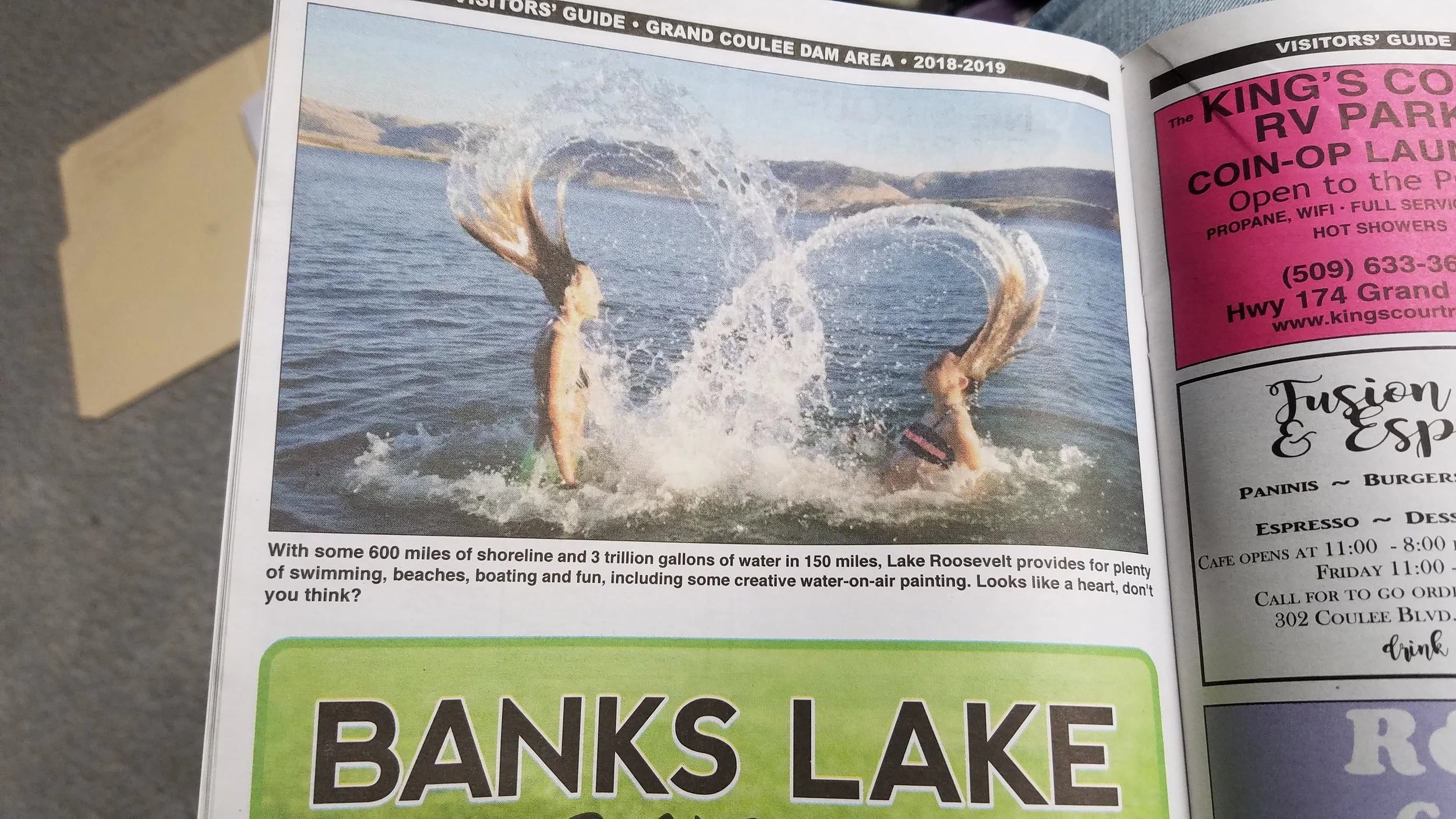
Look how fun water can be in in its liquid state! The lakes around the Grand Coulee Dam in eastern Washington attracts crowds of recreational boaters, fishers, swimmers, and frolickers in summer and fall.

Look how fun water can be in in its liquid state! The lakes around the Grand Coulee Dam in eastern Washington attracts crowds of recreational boaters, fishers, swimmers, and frolickers in summer and fall.

One hot, dry September nearly a decade ago, I traveled with two friends to swim in the lakes south of the Grand Coulee Dam in eastern Washington. We spent hours in both Lake Lenore and Banks Lake swimming in the refreshingly cool water after long hikes in the dry, cactus-loving hills above the lakes. And I do mean swimming—crawl, breast stroke, back stroke—not just dipping into the shallows to cool off. 

Ten years ago, I was newish to Washington and to the story of the Missoula Floods that shaped this strange landscape. I remember being impressed by the strange basalt cliffs and asking my family to imagine the boulder fields of Joshua Tree National Monument laid out in the bottom of the Grand Canyon and then to imagine the canyon flooded with water to leave the tops of the boulders exposed. That’s what it was like swimming in these lakes. When I turned my head to breathe while swimming in Lake Lenore, my face was inches from the sheer basalt walls. In Banks Lake, you could swim into a maze-like cove strewn with sun-warmed boulders, crawl out onto a boulder to warm up, then slip right back into the water. 

It was sublime.

But I had since forgotten exactly where that Banks Lake cove was and I wanted to swim there again. After a spate of unseasonably warm March days in Olympia, I packed my wetsuit and my husband and I strapped the canoe on the car for a weekend at the lake.

Alas, Banks Lake was not how I remembered it.

Why didn’t anyone tell me it got really really cold in eastern Washington in winter? Photo by M.D. .Ruth.

Why didn’t anyone tell me it got really really cold in eastern Washington in winter? Photo by M.D. .Ruth.

Yes, that’s ice. Except for the liquid water along the nearshore, Banks Lake was frozen. 

Yes, I could have found this out with a simple phone call, but it was inconceivable to me that all that water could have frozen at all or could still be frozen. Though I’ve been living in Washington for 12 years, I am still very newish to eastern Washington.

I was disappointed but luckily, there was a vast landscape to explore by foot and car. There was much geology to see and understand. And I was happy to embrace the legacy of the Missoula Floods without installing an ice-breaker on the prow of our canoe or getting hypothermia.

Embracing the Missoula Floods meant doing my homework and reading a few of the excellent books on this subject. It meant studying the interpretive signs posted along the highways that lead from Soap Lake to the Grand Coulee Dam along Highways 17 and 155. It meant asking my husband (the geology major) lots of questions he cannot answer because it’s just too incredible. And—most importantly—it meant giving my imagination plenty of time to expand to take in the scope and magnitude of the floods. 

Next Blog: Why Banks Lake is a lake and why it is where it is.

In Geology of Washington, Lake Swimming, Lakeside Geology, Washington Lakes Tags Banks Lake, Grand Coulee, Missoula Floods, Open-water Swimming, Wild Swimming

Still on Cloud Nine

March 31, 2019 Maria Mudd Ruth
Olympia’s skies feature clouds 228 days a year. Learn about these natural wonders on April 18th.

Olympia’s skies feature clouds 228 days a year. Learn about these natural wonders on April 18th.

Though I could talk about the clouds for days or weeks on end, I had just an hour of pleasant cloud conversation and cloud gazing with Molly Walsh of Thurston Talk last week, in advance of my April 18th talk at the Olympia Country and Gold Club. Read Molly’s article in Thurston Talks here. And then join me on April 18th at 5:30 (socializing) for my presentation (6 p.m.). This event is open to the public! No need to bring your four iron! I’ll have books on hand to sell and sign.

Olympia Country and Golf Club
3636 Country Club Drive NW, Olympia
360-866-7121

In Books on Clouds, Clouds, Meteorology, Natural History, Pacific Northwest Clouds Tags A Sideways Look at Clouds, Cloud watching, Thurston Talks, Olympia Golf and Country Club, clouds, clouds over Olympia

Munn Lake Swim #1

March 20, 2019 Maria Mudd Ruth
This is what 52 degrees F looks like. It feels much better!

This is what 52 degrees F looks like. It feels much better!

What better way to celebrate the vernal equinox than to tiptoe into a local lake with a friend and fellow cold-water enthusiast? It was a spontaneous plunge—planned just minutes before the official moment of spring at 2:58 p.m. Pacific Daylight Time. With the air temperature in the low 80s in Olympia today—and cooling back down to the 60s tomorrow, it was a carpe diem kind of event.

I had been to my local Y in the morning with my new swim goggles and plan to see if I could swim for an hour without any significant breaks. Surprisingly I could. It was almost anticlimactic. I thought I would be struggling by the end of 45 minutes and would finish the hour feeling like I had preserved and really accomplished something. I swam for an hour and ten minutes and then I just felt done. Eventually, I’d like to build more speed, strength, and stamina so I can swim comfortably for an hour in open water. But there is a big difference between a lap pool and a lake (especially if its cold) and I wanted to work on getting acclimated to cold water so I could enjoy a long swimming season this year. I didn’t want to wait until the summer solstice to start. So why not see how cold a cold lake feels right now?

A few e-mails back and forth with my friend and we were off to Munn Lake, at the south edge Olympia. There were just a few fishermen on the lakeBetween the two of us, had two enormous towels, one wetsuit, two big fleecy sweaters, one hotpot of water for tea, two mugs, one thermos of coffee with Kahlua, and Discover Pass, and one very excited golden retriever. And a thermometer for testing the water. It was 52 degrees F. Bracing? Refreshing? Painfully cold? It was hard to tell.

I wasn’t sure I was going to get all the way in the lake, but my friend just peeled down to her bathing suit and started walking down the submerged concrete boat ramp. Just like that. I announced that my goal was to get in slowly, eventually, and not scream or use any swear words. By the time my ankles were wet, my friend was already in up to her neck, smiling. “It’s lovely! It’s hard on the arms, but otherwise perfect.” She looked like she meant it.

So I tried to follow suit. The longer I stayed above the water, feeling the unseasonably warm sun on my skin, the colder the water felt. Forward, ho! My legs numbed quickly, I splashed water on my arms, winced, then pushed off the last concrete slab and was in. It was…not bad.

There is definitely a timing trick here. Plunge in to quickly and you could shock your system (heart) in a dangerous way. Too slowly and you are letting matter get over mind, giving yourself too many opportunities to change your mind, lose your resolve, and retreat to your big warm towel and steaming cup of hot something.

I turned on my back and floated myself up the surface of the water to take advantage of the relatively warm water and the very warm sun. Now it was delightful and I relaxed into the lake, into the landscape, into an afternoon that was the fulfilled promise of Spring.

In Lake Swimming, Open-water Swimming, Washington Lakes, Wild Swimming Washington Tags Munn Lake, Lakes in Thurston County, Open-water Swimming, Swimming Lakes in Olympia, Wild Swimming, Spring Equinox Swim

How I Stopped Worrying and Learned to Love the Plunge

March 9, 2019 Maria Mudd Ruth
Looking warmish, but not exactly relaxed, after a90-minute summertime swim around and across cool Josephine Lake on Anderson Island, WA.

Looking warmish, but not exactly relaxed, after a90-minute summertime swim around and across cool Josephine Lake on Anderson Island, WA.

“Wild swimming” and “open-water swimming” both take place in lakes, ponds, rivers, bays, and oceans, with “cold-water swimming.” Cold-water swimming takes places in natural bodies of water, too, but it is accompanied by xtreme bravado and/or a wetsuit, yelping and/or cold-water acclimatization training, and the risk of both hypothermia and euphoria. At least this is what I thought.

This winter, I have read Lynne Cox’s Swimming to Antarctica(not a metaphorical title). I’ve watched many videos of crazy-happy people dipping into icy lakes in Speedos and wool hats. I stood idly and warmly by while 300 people jumped off a dock and into a lake during the New Year’s Day 2019 Polar Bear Plunge. The water as 40°F that day. No one really “swam,” but they were immersed in that water for at least 30 seconds, which counts for a lot in my book. The Polar Bear Plungers looked ecstatic as they waded back to shore—either because they were glad to be done or because they had quickly reaped the benefits of a dip in cold water: adrenaline rush, exhilaration from increased endorphin levels, and reduced cortisone levels. Or they knew that they would later benefit from increased mental fortitude and clarity, boosted immune system, supercharged metabolism, reduced inflammation, less pain from rheumatism, fibromyalgia, and asthma. What’s not to like about cold-water swimming? 

Just some of the 300 swimmers who joined the New Year’s Day 2019 Polar Bear Plunge in the extremely-cold-by-any-standard Long Lake, in Lacey, Washington.

Just some of the 300 swimmers who joined the New Year’s Day 2019 Polar Bear Plunge in the extremely-cold-by-any-standard Long Lake, in Lacey, Washington.

You have to get into cold water.

Really cold water.

But how cold is “cold” water I wondered. “Cold” is very subjective, it turns out. Some people consider water below 70°F “cold.”  Others use a standard of 64.4°F to define “cold”—or really “too cold.” This is the temperature at which hypothermia is believed to set in for those people not acclimatized to this temperature and who are suddenly immersed in such chilly water, typically when cast overboard from a boat. Some rare swimmers are acclimatized and habituated to swimming as low as 45°F and do not become hypothermic. Is 45°F “cold” or “too cold” for them?

Cold? Cool? Bracing? Refreshing? Too Cold? It’s up to you to decide.

Cold? Cool? Bracing? Refreshing? Too Cold? It’s up to you to decide.

Because I am planning to write about the natural and human history of several lakes in Washington, I wanted to be prepared for swimming in them when I did my “field work.” I figured I would have to work hard to join the ranks of the elite open-water wild swimmers who frolick in those 45°F waters year-round. I was dreading it. I worried about not only becoming hypothermic but also about just being plain uncomfortable. But wait! 

I swim in cold water! I’ve swum in the Tenino Quarry Pool for crying out loud! The water temperature is between 50 and 55°F. In 2018, I swam from April to October in lakes and rivers around western Washington. I doubt any of them were over 65°F. Only once did I feel the water was too cold and that my safety was at risk. I returned to shore as quickly as my sluggish body would let me.

The perception of cold is influenced by many factors: Air temperature as well an individual’s acclimatization and habituation to cold water, physical condition, body size and build, body mass index, attitude, alcohol level, psychological makeup, swimming ability, can affect an individual’s response to the water. The importance of knowing how cold is too cold for yourelates to yoursafety, which is really about and how far and how quickly yourbody temperature drops and you become hypothermic. The temperature of the water and how long you are in the water must both be factored in. A 2-minute dip into 50°F water is one thing, but a 20-minute swim is another. 

On the excellent LoneSwimmer blog, I found references to a smart and flexible guide for clarifying “cold.” Using the “Combined 100” method for ranking “cold.” If the combined temperature and water temperature (in Farenheit) is less than 100. For example, when the water temperature is 60°F and the air temperature is less than 40°F, it’s cold. But on a 70°F day, 60 is merely “cool.”

Now that I have convinced myself (sort of) that I am not a wimpy swimmer or an Xtreme cold-water swimmer, I can stop worrying about the semantics and look forward to a long season of wild, open-water swimming in water that may or may not seem to be cold. I have to remember to carry a thermometer to test the water and air temperature before I enter a lake. And I have to pay close attention to how my own watery body responds to being in the water. Relaxing into a nice long swim is a valid response. So is yelping, swearing, and thrashing, and shivering yourself warm. 

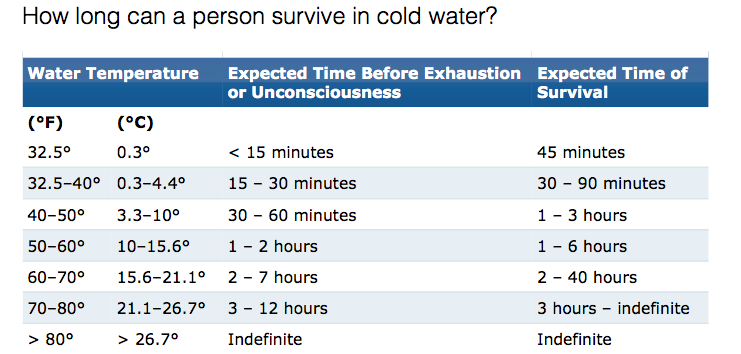
 Meanwhile…while you are learning what “cold” means for you, please look at this helpful chart and info on hypothermia from the Minnesota Sea Grant program’s website:  

Screen Shot 2019-03-08 at 5.14.07 PM.png

Write here… 

Screen Shot 2019-03-09 at 8.59.55 AM.png
In Lake Swimming, Maria Mudd Ruth, Washington Lakes Tags Wild Swimming, Open-water Swimming, Cold-water swimming, How cold is cold water?, Long Lake, Lake Swimming in Washington, Thurston County Parks, Lakes in Thurston County, Hypothermia, Lone Swimmer, Minnesota Sea Grant
← Newer Posts Older Posts →

Subscribe

Sign up with your email address to receive my blog in your inbox.

Thank you!
Blog RSS

Flying from Mountaineers Books this Spring—the story of the Pigeon Guillemot—the world’s most charismatic alcid. This non-fiction natural history will be on bookshelves and available from online retailers on April 7, 2026. Click a link below to pre-order a copy now from these purveyors:

Mountaineers Books (non-profit, indie publisher based in Seattle)

Browsers Books (Olympia’s indie bookstore)

Bookshop.org (support your local bookstore)

Barnes & Noble (in the book biz since 1971)

Amazon

Other Natural History Titles by Maria Mudd Ruth…

A Sideways Look at Clouds


“Compelling…engaging.” The Library Journal

“Rare insights into the trials and joys of scientific discovery.” Publishers Weekly

Read more reviews and details here: Rare Bird: Pursuing the Mystery of the Marbled Murrelet

Enjoy this song by Peter Horne, "Little Bird, Little Boat, Big Ocean.” Written about the Marbled Murrelet, but the lyrics work well for the Pigeon Guillemot, too.


  • Wild Swimming
  • marbled murrelet
  • clouds
  • A Sideways Look at Clouds
  • Mountaineers Books
  • Rare Bird
  • old-growth forests
  • Open-water Swimming
  • Maria Mudd Ruth
  • Lakes of Washington
You must select a collection to display.

Subscribe

Sign up with your email address to receive my blog in your inbox.

Thank you!
Blog RSS

©2025 MARIA MUDD RUTH  |  ALL RIGHTS RESERVED