• Home
  • The Bird with the Flaming Red Feet
  • Rare Bird: Marbled Murrelet
  • A Sideways Look at Clouds
  • Author
  • Events
  • Blog
  • Contact
Menu

Maria Mudd Ruth

Street Address
City, State, Zip
Phone Number
author and naturalist
Homepage-Banner.jpg

Maria Mudd Ruth

  • Home
  • Books
    • The Bird with the Flaming Red Feet
    • Rare Bird: Marbled Murrelet
    • A Sideways Look at Clouds
  • Author
  • Events
  • Blog
  • Contact

Floating in the Universe

February 26, 2019 Maria Mudd Ruth
20190222_114239.jpg

After that delicious first plunge into fresh water, one of the great pleasures of a swimming lake is floating on your back, buoyant, relaxed, warmed by the sun on one side of your body and cooled by the water on the other. 

Over the past several years, I have spent much time floating on my back, mostly to watch the clouds. I float pretty well but am always aware of my legs sinking and my neck straining a bit. And the locations of the few fishing boats, canoes, and other swimmers. And the happy voices of people swimming and cavorting around the lake. Floating is deeply relaxing and meditative but it is not a ‘sensory-deprivation’ experience. I’ve always been curious about sensory-deprivation tanks and what would happen to “me” when deprived of all distraction and sensory input. So I signed up for a 90-minute float at Oly Float near my home in Olympia.

Oly Float does not use the words “sensory deprivation” or “tank” (which sounds more like torture than pleasure). They call it “flotation therapy” and “sensory relief therapy.”  Their website extols the benefits of floating: relief from pain, increased natural production of endorphins and other “happy” chemicals in our bodies, improved sleep, greater athletic performance, deepened self-awareness. This time of year, everyone could use a mood bounce and I’m always trying to get a better night’s sleep but I was simply curious to experience the beautiful feeling of total weightlessness and buoyancy in the water without the distractions of a popular outdoor recreational lake.

So in I went into a surprisingly large private room with a shower, changing area, towels, and a surprisingly small wooden door leading into a surprisingly small “tank.” It was not a tank but an 8’x 5’ space. That space was blue and warm and inviting. That space included the 8’ x 5’ pool of water and a ceiling that was 7 feet above it. I showered, put in ear plugs, and held the grab bar as stepped in. I expected to step down a few steps like I was entering a hot tub, but the water came up to the middle of my calf. What? How was I going to float in 10 inches of water? There was 1,000 pounds of Epsom salt (magnesium sulfate) in there, that’s how. I wasn’t aware of a briny smell or any salty stinging on my leg so I moved into the floating position I hope to assume for the next 90 minutes. I turned off the blue light and closed my eyes.

It took me longer than I thought to find the best position for floating. My lower body relaxed quickly and my legs all but disappeared. It was my neck, where I seem to hold all my tension, that would not relax. As the rest of my body relaxed into oblivion, all I was was my neck.  I tucked a foam pillow under my head. I changed the position of my arms a few times. I put the pillow aside. I held my arms above my head and because but I was pretty sure they were going to float out and touch the sides of the pool (sensation!).  I took a lesson from the sea otters who wrap rooted giant kelp fronts around themselves to stay anchored while sleeping at night. I wrapped my shoulder-length hair around my fingers in a coil. There. Anchored.

And then my small space became as large as the universe and I was floating in a galaxy of stars. This was not a galaxy of my own invention. It was the galaxy of stars in which the young Ludwig von Beethoven imagined himself floating in the final scene of the film, “Immortal Beloved.” It is a stunning scene—the older, now near totally deaf composer is listening to a public performance of his Symphony No. 9 and, during the “Ode to Joy,” he goes into a reverie that takes him back to his childhood. The scene is at night and the young Beethoven is at the edge of a lake. He wades into the water, gets on his back and is floating there in the dark water. Thanks to some simple special effects, the viewer is given a bird’s-eye-view of the scene, with Beethoven’s pale body outstretched like a star in the middle of dark water that becomes a star-studded dark sky. 
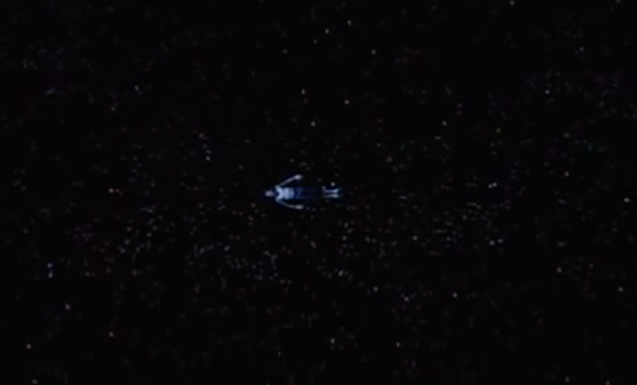
Scene from “Immortal Beloved. “

Scene from “Immortal Beloved. “

While my body was floating in relatively tiny artificial space, my being was in the middle of the Milky Way with one of the most beautiful pieces of choral music ever written. I have never learned the words to this ode, which is a good thing as I might have spent my 90 minutes singing them in my head.  Luckily, the music didn’t float through my head either. It was just me and the pure experience of floating in a universe of joy. 

After my luxurious float, I found the scene from “Immortal Beloved,” which I had last watched perhaps 10 years ago. The scene in the lake captured the sensation I had experienced. Was it Life imitating Art? Art imitating Life? Or just Life? 

I have friend who, no matter what you are talking about, manages to work in the refrain “We are all stardust.”  I know it’s true in the grand scheme of things and a existentially depressing given that I usually hear “We are all dust in the wind” (remember this sad 1977 hit song from the band Kansas?). But somehow that 90-minute float turned this all around and now I feel grateful to the stars (and the Epsom salt) for the once-and-future moment when I’ll be back among them.

 Here is a 7-minute clip of Immortal Beloved. The first part is unhappy memories from his childhood, but then you just might end up happily floating in your own salty tears.


In Lake Swimming, Open-water Swimming, Washington Lakes Tags Ode to Joy, Oly Float, Sensory Deprivation Tank, Flotation Therapy, Sensory Relief Therapy

Taking the Plunge: Lakes of Washington

February 21, 2019 Maria Mudd Ruth
Just one of thousands of lakes to explore in Washington. Where to begin?

Just one of thousands of lakes to explore in Washington. Where to begin?

The lake above is where I ended my last book, A Sideways Look at Clouds. I was floating on my back contemplating the watery bodies that are the lake, the clouds, the human body. And this is where I am beginning my next writing project (hardly anything I can call a book at this point).

The Washington landscape is a feast of lakes that are scenic, ecologically significant, life-sustaining, and a source of joy for a wild swimmer. “Wild swimming” the name for swimming in natural lakes, ponds, rivers, sounds, bays, and open ocean. It’s a big deal in England. There’s the Outdoor Swimming Society to prove it.

Ever since I moved to Olympia in 2006, I have been swimming in lakes around the state. Though my pursuit of lakes to swim in has been casual, not purposeful, I’m up to about 30 lakes so far and am only just dipping my proverbial toe into the thousands of lakes our state has to offer. So where to begin my research? The usual places for this natural-history writer. In the library and in the field.

Every writing project begins with a gentle plunder of my public library and mining of resources on my own bookshelves. And a map.

Every writing project begins with a gentle plunder of my public library and mining of resources on my own bookshelves. And a map.

The subject of lakes, lake ecology, limnology, lake swimming, and the pleasure of swimming and being in water is not new territory. The research is potentially endless and the physical territory where lakes are found is vast. The same was true with the clouds—only the clouds were more variable and ephemeral and required several (as in eight) years to capture in my book. A writer has to begin somewhere—to get to know the territory, to cast a wide net, to explore, brainstorm, dream. That’s where I am now.

This winter, I have been reading, taking notes, gathering resources, signing up for newsletters and emails from organizations monitoring lake water quality, watching films about people swimming in really cold water, and marking this summer’s swims on a state map. In 2018, I began swimming in late April and continued into early October. The real “wild swimmers” who swim year round would rightly call me a “mild swimmer,” so I hope to develop the skills to extend the swimming season and increase my tolerance and enjoyment of very cold water. I am not sure how to accomplish this. Probably cold showers are a start. I hear they are invigorating.

Brrrr.

Maybe this should be the working title for my book! Brrrrr: A Wild Swimmer’s Plunge Into the Natural History of Lakes in Washington.

In Lake Swimming, Open-water Swimming, Natural History, Washington Lakes, Wild Swimming Washington Tags Maria Mudd Ruth, Accidental Naturalist, Lakes of Washington, Wild Swimming, Mountaineers Books, Natural History Writing

Back Issues

January 28, 2019 Maria Mudd Ruth
20190108_104758.jpg

It was barely light outside at 8 o’clock this mid-January morning. I was in my bathrobe reading  The Olympian, which used to take me as long to read as it took me to drink a cup of coffee. But it has sadly shriveled, like so many daily papers, and this morning it’s a three-sip paper.  But I am in the mood to read. With no magazines or books within reach, I stare into the room for a while and look out the east-facing window for signs of the sun.  My gaze falls on my tidy stack of Orion magazines, spines facing out, on a shelf across from me. I try to remember what I read in those beautiful, thoughtful, ad-free pages. As a nature writer, I know I found inspiration and camaraderiein every issue, but now the specifics are lost and I just have warm fuzzy feelings about this treasure chest of the finest writing about nature, culture, and place. And about the physical presence of these magazines.

Each issue is squarely and tightly bound so that each one stacks neatly on top of the other without sliding off each other and off the shelf the way issues of the New Yorker do. The issues of Orionseem to cling to each other with magnetic force, which is part of the reason they persist on my shelf—unlike the slip-sliding New Yorkers I recycle or tuck into the magazine rack at my local YMCA. 

The Orions on my shelf are all that’s left from my on-again-off-again subscriptions, plus a few issues I had bought at my local food co-op when I had let my subscription lapse, minus those I had loaned or given away to friends. What was in those particular persistent issues that gave them staying power? What important and urgent ideas had I not taken to heart or acted on? Which writers and stories had I wrongly forgotten? What lovely heart-breaking stories were trapped in those pages that were now reduced to decorative dead weight on my shelf? 

I walked across the room and kneeled down in front of the Orion stack. There were just fourteen issues covering a decade between 2008 and 2018. I picked up the top three from the stack and returned to the sofa and my coffee. It was time to act. Time to move ideas from the page into the world. Time to move back issues forward. 

January/February 2015. Starting in the back of the issue I read reviews of four books I haven’t read. I dog-ear the page to remind myself to put Diane Ackerman’s The Human Ageon hold at my public library. I felt I have done this before. Perhaps not. Perhaps I did and let the hold expire. I hoped that when it arrives at the library I do not hear myself say, “Oh, yeah. I’ve read this.”

I turned to the front of the magazine and read the Preamble (the editor’s letter) and the Lay of the Land (charming short “reports from near and far.” I became transfixed by a black-and-white image of tree stump. The title is Against Forgetting. The caption tells me the artist joined two images—a wax rubbing of a tree stump and a inked human fingerprint. The wax rubbing is reduced in size and the fingerprint enlarged so the tree’s growth rings and the whorls of skin look uncannily similar. It is a breathtaking illustration. I cannot turn the page. I do not want to cover up the image with the next page. Should I order the book? Track down the artist, Nina Montenegro, and inquire about obtaining a print? How big would such a print be? How much would it cost to frame it? Where would I hang it? Once hung, would I love it for a while and then, after so many months, stop noticing it, stop seeing it, and then forget about it altogether. Is getting a framed print a meaningful response to this piece of art? Do I need to be reminded how much I love trees, intricate patterns in nature and how we are similar to trees in so many other ways? I cut the image out of the page for my friend, Anne. 

Screen Shot 2019-01-28 at 6.16.43 PM.png

Anne and I share deep druidical respect and passion for trees and forest conservation. We spend much of our time together walking in the woods, admiring trees, and appreciating everythinng they represent. Anne will love this image for the tree rings and fingerprint equally. One afternoon over tea, I presented her with the cut-out image, she had a good laugh and then recalled the details of the story about her fingerprints.

Anne was born in Canada and has lived in the U.S. for more than thirty years. In 2016, she began her application for U.S. citizenship. She passed all the requirements and tests with flying colors but she failed the fingerprint test. Her fingerprints were too faint to be positively identified as hers. She made three separate trips to the Department of Homeland Security’s Office of Citizenship and Immigration Services office an hour away to have her fingerprints recorded as part of her background check. After each trip, she was told that either the inking or the electronic scanning failed to yield a set of acceptable prints. Anne was also told that our fingerprints wear off as we get older. Anne did not consider herself “old” or at least not old enough to have worn her fingerprints off. What recourse did she have? She had to make a trip to the local police station to obtain a signed document confirming she had no criminal record. 

Anne became a U.S. citizen shortly afterward. What all her paperwork does not make apparent is her role as an upstanding citizen of the natural world; as an admirer and advocate of the border-crossing ecosystems, the forests, individual trees, and the birds that perch and nest in those trees wherever they are rooted; and her deep and unforgotten connection to the land and landscapes she visits. Anne is also an oral historian, a graceful and careful storyteller, and a popular columnist for the local Audubon chapter newsletter. She has a smooth writing style no whorls or spirals could possibly improve.

In Natural History Tags Orion magazine, Nina Montenegro, Against Forgetting, tree rings, fingerprint whorls

The Problems with Clean Energy

January 16, 2019 Maria Mudd Ruth
But it looks so clean!

But it looks so clean!

Washington Governor Jay Inslee says tackling climate change is our state’s “hour to shine,” but we should be under no illusions about new forms of so-called “clean energy,” especially from wind turbines.

But they look so clean! There they are, dotting the ridge lines across the landscape, turning their blades in the fresh breeze, harkening back to old-fashioned Dutch windmills or a brightly colored pinwheel toy from our childhood. What’s not to like? Much.

I have just finished writing a set of public comments critical of the Skookumchuck Wind Energy Project—a 38 wind-turbine facility proposed to be built in Lewis County (south of Olympia, east of Centralia). Why do I get to criticize this project? Because the Lewis County Community Development Department determined the project will have a significant adverse impact on the environment. How ironic! Under state laws, this determination triggers an environmental review, In this case, the “environment” encompasses the habitat of several species of wildlife listed by the state or federal government as threatened, endangered, or in need of special protection and so these species are expected to be adversely impacted by the project. “Adverse impacts” generally means the species are at risk of being directly or indirectly killed or harmed by the project.

And by “project” we are talking about not only the 38 wind turbines (each 500 feet tall) but also the 120 towers and 17 miles of transmission lines that carry the energy produced by the turbines to Puget Sound Energy’s substation where it is fed into the grid. The towers will look something like this:

An estimated 17 miles of energy generator transmission tie lines (“gen-tie lines”) and and 120 towers are included in the Skookumchuck Wind Energy Project.. Photo by Stefan Andrej Shambora (St_A_Sh), CC BY 2.0, https://commons.wikimedia.org/w/index.…

An estimated 17 miles of energy generator transmission tie lines (“gen-tie lines”) and and 120 towers are included in the Skookumchuck Wind Energy Project.. Photo by Stefan Andrej Shambora (St_A_Sh), CC BY 2.0, https://commons.wikimedia.org/w/index.php?curid=9431898

Why am I concerned? Because this project, located on Weyerhaeuser property, is sited in the Pacific Flyway for migratory birds (68 species document at the site), is a place where both Bald and Golden Eagles are common, and is on the commuting route of the endangered Marbled Murrelet—the seabird that flies through the project area en route between the Pacific Ocean and/or Puget Sound to the west and north and its nesting habitat on federal forestland at the eastern edge of the project. The proponents of the project, RES-Americas, estimates that 2.496 Marbled Murrelets will be “taken” (killed) each year as well as 4.86 Bald Eagles and 1.65 Golden Eagles during turbine operations. They are not willing to take responsibility for adverse impacts to these birds or any other wildlife during the year-long construction phase of the project when birds could be at risk for colliding with turbines, towers, and get tie-lines. This means that over the 30-year lifespan of this “clean” energy project, we are likely to lose 75 Marbled Murrelets, 66 Bald Eagles, and 23 Golden Eagles, not to mention untold numbers of migratory birds as well as bats that occur in the project area.

To its credit, RES-Americas has worked diligently to figure out ways to minimize the toll on these special-status birds and they have grappled nobly with the strange and somewhat unpredictable breeding behavior of the Marbled Murrelet, whose remarkable life history hovers on the edge of possibility. Since 2001, Washington state has lost 44% of our murrelet population. The loss of its nesting habitat—our coastal old-growth and mature forests—as well as the depletion of the fisheries that supply its food, oil pollution, and entrapment in fishing nets, and a host of habitat-degrading problems have all caused this decline. And then there’s climate change and its impacts on both the marine and forest ecosystems to which murrelets belong.

To some the murrelet is doomed and therefore why not throw 38 spinning turbines and 120 transmission towers in its way? Why not log this parcel of land, or this one, or this one? There are so many forces at work against the murrelet’s survival that no one person, agency, or corporation could possibly be accused of dealing the fatal blow. If no one can prove that the Skookumchuck Wind Energy Project caused of the deaths of the murrelets nesting nearby, or contributed to the loss of the murrelet population barely hanging on in Southwest Washington, or proverbially hammered the nail in the coffin of the 4,913 murrelets left inWashington —then who is? The Washington Department of Natural Resources? The U.S. Forest Service? The U.S. Fish and Wildlife Service? Private timber companies? The salmon gill-net fisheries? There will be such a feast of finger pointing that guilt for this crime won’t stick to anyone. But we’ll all feel it.

We’ll tell ourselves that we address climate change NOW! We must reduce human impacts on the environment NOW! We must wean ourselves from fossil fuels NOW! We need to divest our money and our souls from the dirty oil and the dirty coal that visibly pollutes our water, air, and soil. We need to tax the polluters, educate the wasteful, and “green” our economy! We need to install big, beautiful, white wind turbines across our landscape. Everyone for miles around needs to see us conspicuously generating clean energy!

Few of us will see the hundreds of bird carcasses on the ground beneath these symbols of clean energy. That job will be left to an unlucky few hired to conduct carcass searches beneath the turbines. Has any one considered that the birds using the Pacific Flyway to move northward into a cooler climate may not be able to navigate through this clean-energy obstacle course? How many birds will fatally collide with the very turbines installed in part to reduce the fatal impacts of climate change on these birds?

When operational, the proposed Skookumchuck Wind Energy Project will produce 137 megawatts of electricity. My annual electrical bill from Puget Sound Energy (PSE) is TK kilowatts. So this project could potentially power TK homes. Given the population growth in our region, this energy will not be used to replace but to supplement our current energy needs. The Evergreen State may become forested with forests of wind turbines—sterile forests where no trees grow and no birds sing.

So, Governor Inslee, how about some truly conservative policies—that is, ones based on actually conserving energy? Remember former President Jimmy Carter asking the American people to waste less energy? This was in 1979—forty years ago! (Interesting Carter didn’t ask us to use less, just to waste less!) Watch a short excerpt from his speech to the American people on energy here.

Screen Shot 2019-01-16 at 2.40.20 PM.png

Frumpy cardigan aside, what’s wrong with an extra layer of fleece? How about turning your thermostat down to 65F in the day and 55F at night (you’ll sleep better, trust me!). How about unplugging a few energy-sucking appliances, electronics, and gizmos? Would you not make some minor life-style changes to save a Marbled Murrelet? A Bald or Golden Eagle? What about a Peregrine Falcon, Pileated Woodpecker, Olive-sided Flycatcher, Vaux’s Swift, special-status bats, and any of the 68 migratory bird species flying in harm’s way?

We expect bird, bats, and other wildlife to change their habits, to fly around or over thousands of acres of enormous turbines and towers and electrical lines, to forage and nest elsewhere, and to adapt quickly and successfully to whatever impediments we decided to place in their environment. As we modify and degrade wildlife habitat in the name of “clean energy” and “progress,” we are forcing our wildlife to spend get by with less. Because we refuse to do so ourselves. This is the dirty little secret clean energy. We can do better.

Despite my criticism, the Skookumchuck Wind Energy Project has the potential to be a model project for Washington state and for any place where wildlife is abundant, imperiled, at risk. So everywhere. In my view, the project needs to be downsized. Operations of turbines needs to be curtailed during murrelet breeding season. And the investors need to rethink their expected (large) profits.

There are plenty of very smart and motivated people developing new wind-energy technologies that don’t cause more harm than good. The American Wind and Wildlife Association is leading the way on this front. Check out this uplifting video that gives a glimmer of hope as we navigate our way through our energy crisis. Skookumchuck Wind Energy Project can help us find the win-win in wind energy.

In Endangered Species, Marbled Murrelets, Maria Mudd Ruth, Volcanoes Tags conservation, murrelet conservation, wind energy turbines, skookumchuck wind energy project, American Wind and Wildlife Association, myth of clean energy
Comment
← Newer Posts Older Posts →

Subscribe

Sign up with your email address to receive my blog in your inbox.

Thank you!
Blog RSS

Flying from Mountaineers Books this Spring—the story of the Pigeon Guillemot—the world’s most charismatic alcid. This non-fiction natural history will be on bookshelves and available from online retailers on April 7, 2026. Click a link below to pre-order a copy now from these purveyors:

Mountaineers Books (non-profit, indie publisher based in Seattle)

Browsers Books (Olympia’s indie bookstore)

Bookshop.org (support your local bookstore)

Barnes & Noble (in the book biz since 1971)

Amazon

Other Natural History Titles by Maria Mudd Ruth…

A Sideways Look at Clouds


“Compelling…engaging.” The Library Journal

“Rare insights into the trials and joys of scientific discovery.” Publishers Weekly

Read more reviews and details here: Rare Bird: Pursuing the Mystery of the Marbled Murrelet

Enjoy this song by Peter Horne, "Little Bird, Little Boat, Big Ocean.” Written about the Marbled Murrelet, but the lyrics work well for the Pigeon Guillemot, too.


  • Wild Swimming
  • marbled murrelet
  • clouds
  • A Sideways Look at Clouds
  • Mountaineers Books
  • Rare Bird
  • old-growth forests
  • Open-water Swimming
  • Maria Mudd Ruth
  • Lakes of Washington
You must select a collection to display.

Subscribe

Sign up with your email address to receive my blog in your inbox.

Thank you!
Blog RSS

©2025 MARIA MUDD RUTH  |  ALL RIGHTS RESERVED