• Home
  • The Bird with the Flaming Red Feet
  • Rare Bird: Marbled Murrelet
  • A Sideways Look at Clouds
  • Author
  • Events
  • Blog
  • Contact
Menu

Maria Mudd Ruth

Street Address
City, State, Zip
Phone Number
author and naturalist
Homepage-Banner.jpg

Maria Mudd Ruth

  • Home
  • Books
    • The Bird with the Flaming Red Feet
    • Rare Bird: Marbled Murrelet
    • A Sideways Look at Clouds
  • Author
  • Events
  • Blog
  • Contact

Gratitude for This Bird

November 25, 2018 Maria Mudd Ruth
A very young Marbled Murrelet chick on its nest—a mossy branch—competing for the “angry bird” poster competition.

A very young Marbled Murrelet chick on its nest—a mossy branch—competing for the “angry bird” poster competition.

There are no holidays celebrating the Marbled Murrelet, unless you count my recent attempt to start “Nest Discovery Day” to honor the date of August 7, 1974, when the nest of this unique seabird was first discovered and documented by scientists. My celebration was just really a “whoohoo!” on social media and silly video involving a friend in a chicken suit, but that’s because I didn’t think to consult anyone at Hallmark, Inc.

The traditional Thanksgiving holiday is mostly about turkey, but the much much smaller and seriously endangered Marbled Murrelet has been the focus of my attention these days and I’m grateful for that. This little wisp of a bird is in the middle of a fight for its life and for the future of the forests where it nests in the Pacific Northwest. The forests murrelets need are described with various terms: old-growth, older, late seral, late successional, mature. The murrelet needs these trees not because of the age or size of the tree itself, but because of the size of the upper branches of these trees. A murrelet doesn’t build a nest but lays its one egg directly on the branch (usually moss covered, but sometimes bare) and so it needs a wide branch where its chicken-sized egg can be safely nestled. And it needs these branches to be at least 50 feet off the ground to keep the nest safe from ground-based predators. Such branches are found in big old trees—coastal redwood, Douglas fir, western hemlock, western red-cedar, Sitka spruce, and other varieties (including the rare occurrence in a big-leaf maple and red alder).

These trees are vanishing and so are the murrelets. Since 2001, we have lost 44% of the murrelet population in Washington state alone. The population continues to decline at the rate of about 4% every year. That might not sound like much, but if you lose 4 of every 100 murrelets every year, it doesn’t take long to get to zero. Zero is not acceptable. This is why, nearly 20 years since I first met the Marbled Murrelet in a photo on the Internet (teehee), 12 years since my book, Rare Bird: Pursuing the Mystery of the Marbled Murrelet was published, and 5 years since it was reissued in paperback…I am still talking about this bird.

I am not talking about Marbled Murrelets to sell copies of Rare Bird. I am talking about this bird because I cannot bear the thought of “losing my marbled”—of having this bird vanish from our oceans and coastal forests. By talking about the Marbled Murrelet I mean I am speaking out for it—to forest management agencies, conservation organizations, library patrons, bookshop audiences, nature-writing workshop attendees, interested friends, and tolerant family members who know I have a difficult time stopping once I start talking about this crazy little bird.

I am grateful to everyone who listens and to everyone who talks about this bird themselves. The most difficult conversations being had right now are the ones between the many people who manage the forests where the murrelet nests, the people who must generate revenue by logging these forests, and those intent on protecting these forest for murrelets. Not that opinions break cleanly along these lines. The subject of how to manage murrelets makes for complex, messy, fraught, long, interrupted, and frustrating conversations. I have been part of many of these conversations. Everyone feels trapped between a rock and hard place, facing a binary choice between saving the murrelets from extinction (possibly in our lifetime) or merely slowing down the decline to a rate we define as tolerable—the rate that will keep our children or grandchildren from cursing us.

I am grateful for the Marbled Murrelet itself for luring me to the west coast, into the deep forests where it nests and into these conversations about others about biodiversity, old-growth ecosystems, the Endangered Species Act, why birds matter, and the subtle and serious impacts of climate change on murrelets and our forest. The murrelet has given me the opportunity to think long and hard about my role as a steward and advocate, about how to walk the talk, how to resist “slacktivism” and eco-burnout, and how to let my heart go “zing” whenever I see this rare bird in the wild or in a photograph.

Who ever you are and how ever long your “life list,” let a bird into your heart. Let it live there a while. Soon it will let you know what it needs from you to survive. And what it needs is likely to be exactly what we need to survive. Listen. And give thanks.

In Conservation, Endangered Species, Marbled Murrelets, Marbled Murrlet Tags marbled murrelet, marbled murrelet conservation, why birds matter, advocating for birds
Comment

Mid-Term Re-Centering

November 4, 2018 Maria Mudd Ruth

Here at the end of Daylight Savings Time and just days before the mid-term elections, we may have the opportunity to turn inward for some peace, reflection, and the coziness of home and hearth.

These twinkling bells on my back garden gate in Olympia, Washington, used to hang on the white-picket gate of my late aunt’s home in Richmond, Virginia, where she lived from 1957 until her death in 2013. For those many decades, the bells were the welcoming sound to me and my three brothers, who spent many summers and holidays with my aunt, uncle, and two older cousins. The bells announced the transition from the driveway and the flagstone patio, backyard, and cozy Cape-Cod-style home where good cheer and real hospitality suffused the very air.

These bells conjure up so many pleasant memories for me—but a book’s worth for my aunt’s daughter—my cousin—author and philosopher Marietta McCarty, who has just published a touching and tender memoir about loving and leaving her cherished childhood home.

20181104_100705.jpg

Bereaved following her mother’s death, Marietta faces the daunting task of emptying her family home—number 1203 on a narrow avenue (really a lane). How, she asks, might she find her way through the emotional turmoil and the accumulation of more than five decades in the house at 1203? Call an appraiser? Schedule an estate sale? Call the Goodwill? Where to begin sorting the furniture, the objects, the intangible memories, the valuables, the junk, the items useful to someone somewhere? What to keep, what to let go?

Overwhelmed at times—and justifiably so—Marietta takes one day at a time, one room at a time, one corner of the pantry, basement, and garage at a time. With the help of friends, families, and strangers, she navigates her way through the months-long process, balancing tears and laughter all along the way.

Each chapter of Leaving 1203 is dedicated to a set of objects that inspire memories of Marietta’s childhood and upbringing. “Three Baseball Bats and One Tennis Racket,” “Cast Iron Skillets and a Songbook,” “Picnic Baskets and Camping Gear,” for instance. But this isn’t just about Marietta. Her book includes loving portraits of her father (my uncle) and their conversations about philosophy, literature, the passage of time, selflessness, sorry, generosity, peace, and humility. And similarly loving portraits of her mother (my aunt, my mother’s only sister) and our grandmother—born Nelly Eliza Williamson, but also known in various stages if her life as Hilda Swenson, Hilda Smith, and, to her grandchildren, "“Plum.”

Putting myself in my cousin’s shoes, I believe I would have boxed up most everything in 1203 and made room for it in my house. I would have gotten rid of all my furniture and made space for the pine tables and cabinets and handprinted furniture. I would have attempted to recreate my blissful childhood by keeping all the things that transported back through the decades of life and to a simpler time. But no. The is not the philosopher’s way.

Marietta gives it all away. (You’ll have to read the book to find out how). And in so doing, honors the memory of her mother, father, grandmother, and all those who will forever hear the bells welcoming them to 1203 and bidding them a sweet farewell after a beautiful visit, a beautiful time.

To read more about Leaving 1203 (and to order a copy) and about Marietta and her other books, click here. We need more books like this one now—more than ever.

1 Comment

BOOK CLUB IN THE CLOUDS

September 19, 2018 Maria Mudd Ruth
20180916_120958.jpg

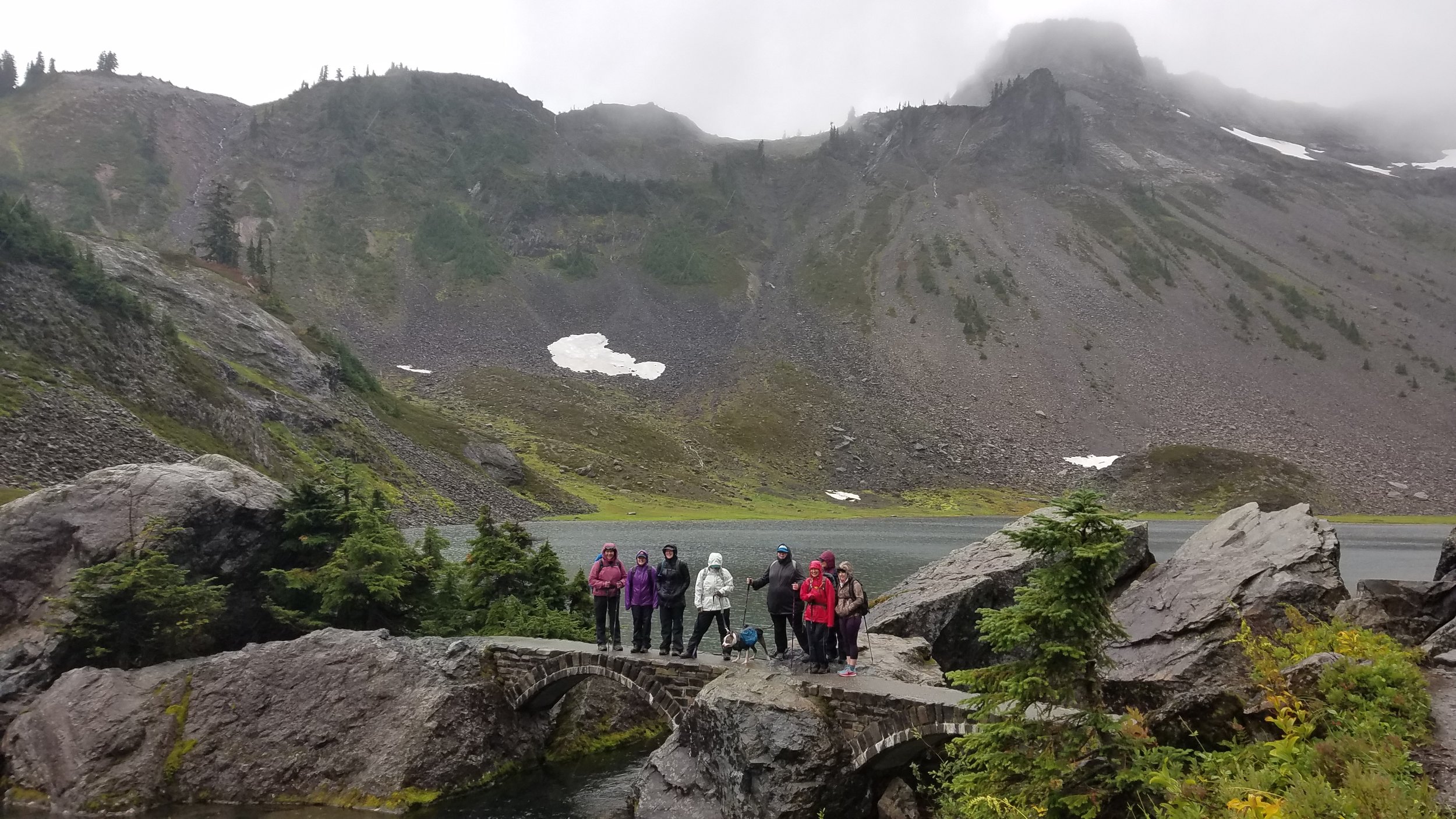
This past Sunday I was the guest hiker-speaker for the monthly adventure of the Alpine Trails Book Club, a high-energy group of hikers who love hiking and reading and talking about books in equal measure.

The trip leader had thoughtfully selected the Chain Lakes hike on Mt. Baker because of it’s elevation (5,400 feet) and stunning views of Mt. Baker, Mt. Shuksan, alpine meadows and lakes, and—ideally—cloudscape. The clouds did not cooperate but this did not matter one bit. This happy group literally laughed at the rain and the nimbostratus clouds that brought it all. A good thing I had dedicated a large chuck of my book, A Sideways Look at Clouds, to nimbostratus clouds and how it rains.

It was this kind of cloud, after all, that not only rained on us but that filled the lakes and created the waterfalls and nourished the wild blueberries that graced this lovely alpine trail.

20180916_093724.jpg
20180916_095222.jpg
20180916_120404.jpg

The ten of us were pretty much soaked from the rain when we found our way to a covered porch at the Heather Meadows Visitor Center. The hot tea was poured into mugs and china (yes, real china!) cups and then out came the homemade cloud-shaped cookies (putting to shame my dozen donut holes I brought along as a visual aid while describing the origin of the word “cloud”—from “clod.”) And then one of the trip leaders brought out a pocket sling psychrometer—an old-fashioned (non digital) but time-honored tool for measuring relative humidity and calculating dew point—the temperature below which water vapor condenses into liquid water. This is critical information for hikers interested in knowing at what point they are going to be hiking in the clouds instead of under them.

20180916_103412.jpg

Just as I was about to launch into a short reading from my book, we all smelled the sweet fragrance of wood smoke. The volunteers at the Heather Meadows Visitor Center had built a snap-crackling fire in the beautiful stone fireplace in this historic building crafted in the 1930s by workers in the Civilian Conservation Corps. So in we went to shed our wet gear and cozy up for a fireside reading about the marvels of nimbostratus clouds and the rain drops. It was a real pleasure as an author to have such an engaged group to talk and hike with—and flattering to hear their thoughtful comments and questions about my ramblings in the clouds.

20180916_113650.jpg

The rain continued so we didn’t hike higher up into the clouds. Though we had a different kind of cloudy day in mind for this hike (like the one that happened the very next day) it was crystal clear that the clouds control the narrative and this was our day to fully embrace the nimbostratus. My rain hat is off to the fair- and foul-weather outdoorswomen literati of the Alpine Trails Book Club!

To learn more about the Alpine Trials Book Club (book list, adventure tales) please visit their wonderful website here.

Comment

What Murrelets Need

September 8, 2018 Maria Mudd Ruth
Murrelets have very specific, but minimal needs.

Murrelets have very specific, but minimal needs.

What tree surgeon Hoyt Foster discovered in 1974--a Marbled Murrelet chick hunkered down on a branch 148 up a Douglas-fir--provided critical clues to the nesting habitat of this federally threatened little seabird. 

Marbled Murrelets need a wide branch, preferably covered in moss, at least 50 feet up a tree that is >150 years old and no more than 55 miles from salt water. This kind of habitat was once amply available along the Pacific Northwest coast. Now, that habitat has been reduced to patches and fragments and the murrelet population has been steadily crashing.

In Washington state, the population has dropped 44% between 2001 and 2015 and continues to decline at the rate of 4% a year. This means, based on the 2016 population in our state, that we will losing 284 murrelets a year. The primary cause is the historic and ongoing logging of our old-growth and mature coastal forests.

On September 7, 2018, the Department of Natural Resources released a long-term conservation strategy that will help determine the fate the of the Marbled Murrelet on the 576,000 acres of land it manages for these birds and other wildlife. Much this acreage is habitat, but not all of it. An estimated 154,000 acres consist of murecelt nesting habitat. As you might imagine, the management of this habitat is hotly contested. The mature and old-growth forests provide both valuable revenue to our state when horizontal; they provide critical habitat to murrelets for nesting when left vertical. 

What Marbled Murrelets do not need is Jaime Herrera Beutler, the U.S. Congressperson representing Washington's 3rd district in southwest Washington. Though she believes she is doing the right thing to protect family-wage jobs in her district, her efforts in the murrelet arena are misguided (which is to say guided by the timber industry and misinformation) and will surely backfire if she continues to refuse to understand the basic habitat needs of the murrelet. Her constituents have more to lose than gain by supporting her position on managing our state forest lands.

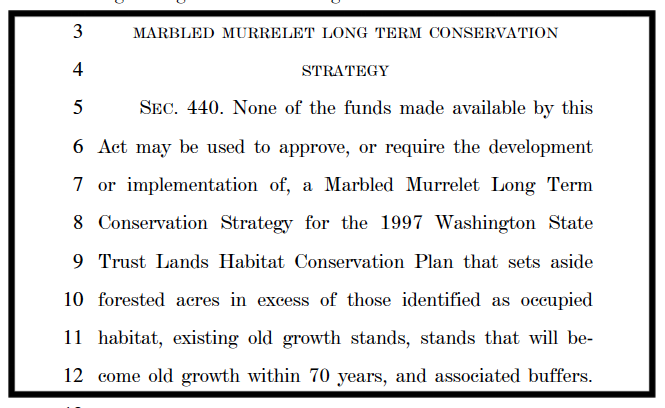
Rep. Herrera Beutler introduced an amendment to the House Appropriations Bill for Interior & Environment that would essentially result in the logging of everything but the bare essentials for nesting murrelets. Here is the text of her short-sighted bill.

Screen Shot 2018-09-05 at 12.35.10 PM.png

This stingy bill should not be supported. It proposes to protect only the highest-quality forest stands. It will create silos of habitat for the murrelet and other species that benefit from contiguous blocks of forest. It will not contribute to the recovery of this imperiled species. It will not meet the U.S. Fish & Wildlife Services criteria required of the Department of Natural Resources to continue legally harvesting their state trust lands.  

Jaime Herrera Beutler's amendment offers a bulldozer at a time when we need are well-honed axes, sharpened pencils, and sharp minds.

In its recently revised Draft Environmental Impact Statement, the Department of Natural Resources has offered several options for protecting forest lands that will eventually grow into murrelet nesting habitat. While it may irk some to set aside younger forests for future murrelet habitat, this is what is needed to give this bird a fighting chance. 

Murrelet chick ready to fledge. (Photo courtesy Hamer Environmental).

Murrelet chick ready to fledge. (Photo courtesy Hamer Environmental).

In Conservation, Endangered Species, Marbled Murrlet Tags marbled murrelet habitat, marbled murrelet, department of natural resources, jaime herrera beutler
Comment
← Newer Posts Older Posts →

Subscribe

Sign up with your email address to receive my blog in your inbox.

Thank you!
Blog RSS

Flying from Mountaineers Books this Spring—the story of the Pigeon Guillemot—the world’s most charismatic alcid. This non-fiction natural history will be on bookshelves and available from online retailers on April 7, 2026. Click a link below to pre-order a copy now from these purveyors:

Mountaineers Books (non-profit, indie publisher based in Seattle)

Browsers Books (Olympia’s indie bookstore)

Bookshop.org (support your local bookstore)

Barnes & Noble (in the book biz since 1971)

Amazon

Other Natural History Titles by Maria Mudd Ruth…

A Sideways Look at Clouds


“Compelling…engaging.” The Library Journal

“Rare insights into the trials and joys of scientific discovery.” Publishers Weekly

Read more reviews and details here: Rare Bird: Pursuing the Mystery of the Marbled Murrelet

Enjoy this song by Peter Horne, "Little Bird, Little Boat, Big Ocean.” Written about the Marbled Murrelet, but the lyrics work well for the Pigeon Guillemot, too.


  • Clouds
  • Natural History
  • Open-water Swimming
  • Lake Swimming
  • Washington Lakes
  • Wild Swimming Washington
  • Pacific Northwest Clouds
  • Books on Clouds
  • Meteorology
  • Wild Swimming
You must select a collection to display.

Subscribe

Sign up with your email address to receive my blog in your inbox.

Thank you!
Blog RSS

©2026 MARIA MUDD RUTH  |  ALL RIGHTS RESERVED