• Home
  • The Bird with the Flaming Red Feet
  • Rare Bird: Marbled Murrelet
  • A Sideways Look at Clouds
  • Author
  • Events
  • Blog
  • Contact
Menu

Maria Mudd Ruth

Street Address
City, State, Zip
Phone Number
author and naturalist
Homepage-Banner.jpg

Maria Mudd Ruth

  • Home
  • Books
    • The Bird with the Flaming Red Feet
    • Rare Bird: Marbled Murrelet
    • A Sideways Look at Clouds
  • Author
  • Events
  • Blog
  • Contact

Bad Meteorology

July 2, 2017 Maria Mudd Ruth

Seriously? The harmless cumulus clouds are being blamed for bad hair days? Sure, our hair does respond to the humidity in the air (by turning "frizzy" in high humidity and "flat" in dry air) and humidity does play a major role in cloud formation. But these clouds are the little cumulus humilis--clouds that generally form when humidity levels are not so high as to cause this OMG, like totally embarrassing up-do. Cumulus humilis are known as "fair weather" clouds and would likely flatten, not frizz hair. I have no idea of this cloud's effect on leg hairs.

Why all the clouds if it's Blue Skies LLC? Because the sky without clouds is, dare I say, boring. As is a business card. You'll notice clouds used frequently in print media as a backdrop for book or magazine articles even if the subject is not cloud…

Why all the clouds if it's Blue Skies LLC? Because the sky without clouds is, dare I say, boring. As is a business card. You'll notice clouds used frequently in print media as a backdrop for book or magazine articles even if the subject is not clouds. 
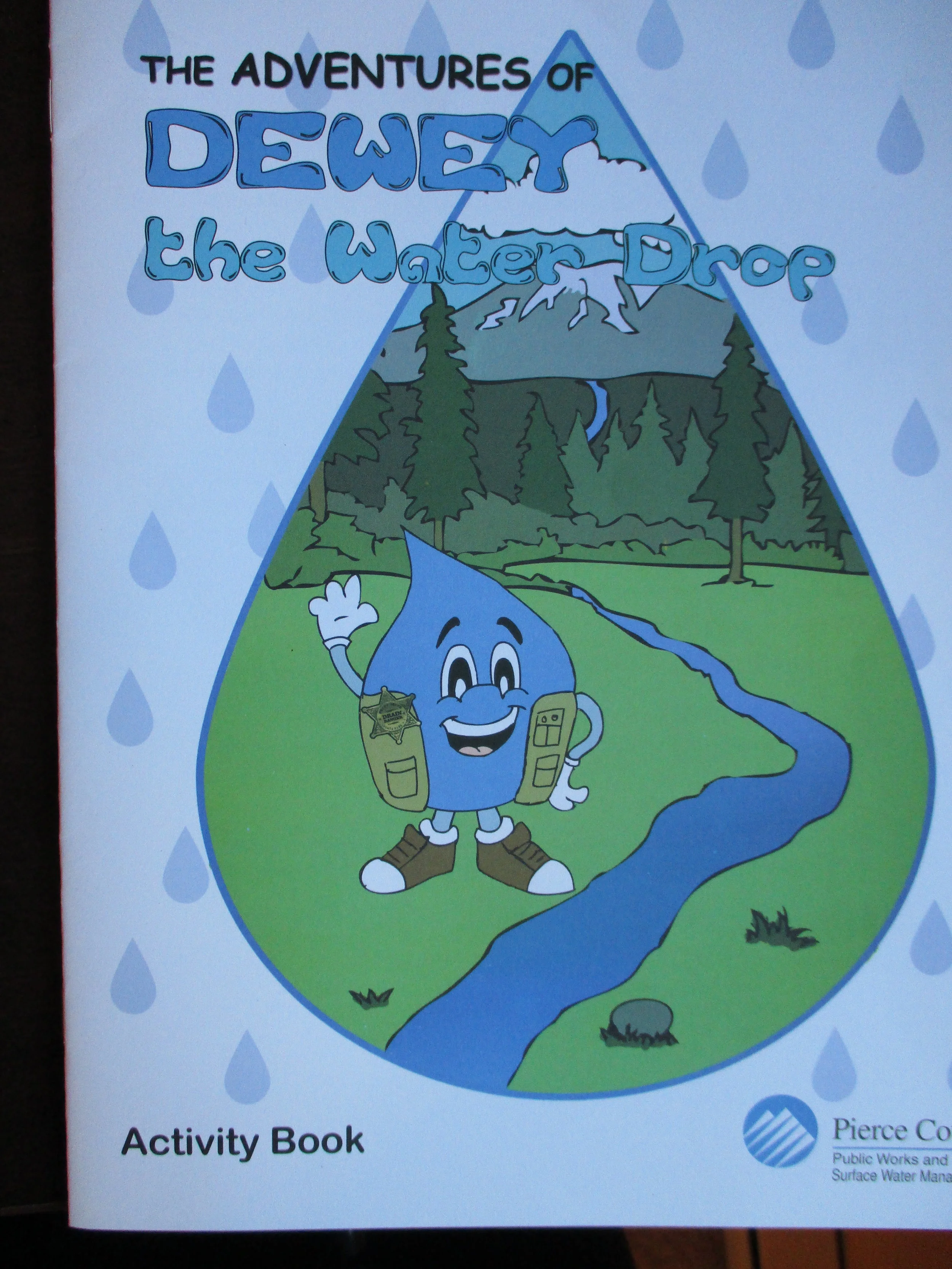
And how about this friendly li'l guy who misleads school children everywhere? Water droplets are not teardrop shaped. Rain drops are not teardrop shaped. Even tears are not teardrop shaped! Only when water leaks or drips slowly out of a faucet does …

And how about this friendly li'l guy who misleads school children everywhere? Water droplets are not teardrop shaped. Rain drops are not teardrop shaped. Even tears are not teardrop shaped! Only when water leaks or drips slowly out of a faucet does it resemble this shape. Rain drops are the shape of a hamburger bun--slightly convex on top. But who wants to learn about their watershed or the water cycle from a blue hamburger bun? 

Look at these very dark, scary rain clouds from Seattle. No need to criticize the accuracy of the cloud here (it's "art" on a pair of socks, after all) but I will defend the clouds' reputation by reminding everyone that Seattle, Washington, isn't al…

Look at these very dark, scary rain clouds from Seattle. No need to criticize the accuracy of the cloud here (it's "art" on a pair of socks, after all) but I will defend the clouds' reputation by reminding everyone that Seattle, Washington, isn't all that rainy. It's less rainy than Miami and several other U.S. cities. What Seattle has is clouds--not always rain clouds--but clouds. Lots of them.

Comment

Clouds for Teachers

June 28, 2017 Maria Mudd Ruth
Don't forget the clouds when you talk about your watershed!         Photo by M.M. Ruth

Don't forget the clouds when you talk about your watershed!         Photo by M.M. Ruth

Thanks you to all the dedicated teachers participating in the Summer Teacher Institute offered by the Nisqually River Education Project.  "Forests, Glaciers, and Freshwater" was the theme of the three-day institute this year.  I was invited to speak this morning about observing clouds, the role of clouds in climate change, and why it's important to engage students in citizen-science cloud projects. Clouds are often neglected when we talk about watersheds, environmental stewardship, and climate change so I was glad for the opportunity to bring clouds into the conversation. Keeping an eye on our changing skies is becoming an increasingly important part of understanding our changing planet.

For those of you interested in some terrific cloud resources for your classrooms or living rooms, here are my go-to websites. (Click on the link, not the image).

The World Meteorological Organization (WMO) just published its long-awaited cloud atlas this spring. This is the first ever digital edition of the atlas, which was first published in 1896 and with very few photographs. The WMO is responsible for the naming, categorizing, and description of clouds for use by professional meteorologists, aviation professionals, and amateur cloud watchers world wide. 


The Cloud Appreciation Society: This is a less official, but extremely popular website for all things cloud--a photo gallery, cloud of the day, songs and poems about clouds, terrific newsletter, and members forum where you can find out the name of the strange cloud you just saw (altocumulus stratiformis perlucidus undulatus radiatus, for example). This London-based virtual organization boast more than 43,000 members worldwide. The founder of the Cloud Appreciation Society, Gavin Pretor-Pinney, has done more to bring much-deserved attention to the clouds than any other person in recent years. His website and his marvelous books, A Cloudspottter's Guide and the Cloud Collector's Handbook, are well researched, easy to use, and widely available. 


NASA Globe Observer The National Aeronautics and Space Administration (NASA) offers a free app to help you make environmental observations that complement NASA satellite observations. There are two apps--one for mapping mosquitos habitat and for collecting data on clouds. When you download the cloud app and create a passworded account (of course),  you can take photograph clouds and record sky observations and compare them images of the same clouds taken from the NASA satellite passing overhead. Cool! GLOBE is now the major source of human observations of clouds, which provide more information than automated systems.

Don't get overwhelmed! Just get in the habit of looking up at least once a day to enjoy the wonders of the sky. And remember to find your way to my new book, A Sideways Look at Clouds, which will be published by Mountaineers Books in late September. You can pre-order copies here. 

SidewaysLookClouds_cover draft.jpg

Tags Clouds for Teachers, Cloud education websites, Resources for enviro-ed teachers
Comment

Hope for the Fog Lark?

June 19, 2017 Maria Mudd Ruth
A Marbled Murrelet in flight. "Fog Lark" is one of the many nicknames of this endearing seabird that flies from nearshore waters of the Pacific into our coastal forests in low light (most often before sunrise) during the summer and often in the…

A Marbled Murrelet in flight. "Fog Lark" is one of the many nicknames of this endearing seabird that flies from nearshore waters of the Pacific into our coastal forests in low light (most often before sunrise) during the summer and often in the fog. (Art c 2017 by Alexandra Munters)

Thanks to everyone who submitted public comments on the Marbled Murrelet Long-term Conservation Strategy. Your support for the Conservation Alternative made an enormous impact. On June 4, Public Lands Commissioner Hilary Franz announced that she will be assembling a panel of experts of the environmental community, trust beneficiaries, and timber industry to develop win-win solutions that reach beyond the six alternatives that had been evaluated in the draft Environmental Impact Statement.

The supplemental alternative (the Conservation Alternative) has gotten much attention thanks to the excellent work of the  coalition of conservation groups who developed this alternative as well as a thorough analysis of the six "official" alternatives. The coalition includes the Washington Environmental Council, Defenders of Wildlife, Conservation Northwest, Olympic Forest Coalition, Sierra Club, Seattle Audubon, Washington Forest Law Center, and individual experts. The Marbled Murrelet could not ask for better champions.

According to the timeline of the  Department of Natural Resources (DNR), the BNR would be selecting its preferred alternative (among the six) at a special meeting in July but, with the decision by Commissioner Franz, that selection has been delayed until additional solutions are developed to improve murrelet conservation and also offset the economic and community impacts the conservation plan would have. 

For more information on this decision, read The Olympian article published on June 19. 

Comment

Coming this Fall!

April 27, 2017 Maria Mudd Ruth

You're right! This does not look like a field guide to the clouds. 

This is the cover for my soon-to-be published work of narrative non-fiction about these marvelously entertaining and enigmatic phenomena. It's part natural history, part personal narrative--like my previous book, Rare Bird, only with more physics and less tag-along field work. I spent eight years in the field studying the clouds floating over Olympia, Washington, where I live. It's cloudy 228 days a year here so I had ample time to study them. 

What can a person who knows little to nothing about the clouds figure out by just looking at the clouds? Not much. I hadn't remembered anything from school--not the Latin names of the clouds, not how they form or float, not what they would feel like on my skin. 

 I acquired shelves of books and on-call meteorologists to help me climb a very steep learning curve into the world of clouds and atmospheric science. My book is not about weather. It is about the clouds themselves and how I found my way into their inscrutable little hearts. I don't take a head-on text-book style approach, but follow my own curiosity to come at the clouds from my own angle--sideways. 

If you don't know a cumulus from a cumulonimbus, the difference between fog and mist (or even if fog is a cloud at all), or what exactly the clouds are doing up there...this is your book. 

If you're not a meteorologist, a weather buff, any kind of scientists...but a curious naturalist interested in what's going on up there...this is your book.

If you want to spend just $25 for a book that invites you to enjoy the Greatest Free Show on Earth from your own back yard and for the rest of your life...this is your book.

My book will be out in September. Meanwhile, tip you chin up just a little and take a look at what's happening in the sky. Even on a gray, rainy day, the sky can be a source of joy and wonder. 

Comment
← Newer Posts Older Posts →

Subscribe

Sign up with your email address to receive my blog in your inbox.

Thank you!
Blog RSS

Flying from Mountaineers Books this Spring—the story of the Pigeon Guillemot—the world’s most charismatic alcid. This non-fiction natural history will be on bookshelves and available from online retailers on April 7, 2026. Click a link below to pre-order a copy now from these purveyors:

Mountaineers Books (non-profit, indie publisher based in Seattle)

Browsers Books (Olympia’s indie bookstore)

Bookshop.org (support your local bookstore)

Barnes & Noble (in the book biz since 1971)

Amazon

Other Natural History Titles by Maria Mudd Ruth…

A Sideways Look at Clouds


“Compelling…engaging.” The Library Journal

“Rare insights into the trials and joys of scientific discovery.” Publishers Weekly

Read more reviews and details here: Rare Bird: Pursuing the Mystery of the Marbled Murrelet

Enjoy this song by Peter Horne, "Little Bird, Little Boat, Big Ocean.” Written about the Marbled Murrelet, but the lyrics work well for the Pigeon Guillemot, too.


  • Clouds
  • Natural History
  • Open-water Swimming
  • Lake Swimming
  • Washington Lakes
  • Wild Swimming Washington
  • Pacific Northwest Clouds
  • Books on Clouds
  • Meteorology
  • Wild Swimming
You must select a collection to display.

Subscribe

Sign up with your email address to receive my blog in your inbox.

Thank you!
Blog RSS

©2025 MARIA MUDD RUTH  |  ALL RIGHTS RESERVED