• Home
  • The Bird with the Flaming Red Feet
  • Rare Bird: Marbled Murrelet
  • A Sideways Look at Clouds
  • Author
  • Events
  • Blog
  • Contact
Menu

Maria Mudd Ruth

Street Address
City, State, Zip
Phone Number
author and naturalist
Homepage-Banner.jpg

Maria Mudd Ruth

  • Home
  • Books
    • The Bird with the Flaming Red Feet
    • Rare Bird: Marbled Murrelet
    • A Sideways Look at Clouds
  • Author
  • Events
  • Blog
  • Contact

End of Summer Ramble

August 22, 2014 Maria Mudd Ruth
IMG_0683.JPG
IMG_0684.JPG
IMG_0695.JPG
IMG_0696.JPG
IMG_0698.JPG
IMG_0702.JPG
IMG_0707.JPG
IMG_0709.JPG
IMG_0713.JPG
IMG_0717.JPG
IMG_0720.JPG
IMG_0724.JPG
IMG_0729.JPG
IMG_0730.JPG
IMG_0736.JPG
IMG_0741.JPG
IMG_0744.JPG
IMG_0746.JPG
IMG_0747.JPG
IMG_0749.JPG
IMG_0752.JPG
IMG_0753.JPG
IMG_0754.JPG
IMG_0757.JPG
IMG_0759.JPG
IMG_0761.JPG

Driving 120 miles roundtrip for a 2-mile hike might not sound "worth it," but if you slow down and savor the sights along the Spider Lake loop trail, those 2 miles will take you worlds away.

Bring a good friend with maps and a forest-service pass. Bring coffee, chocolate-chip cookies, trail mix, two peaches. Bring your camera (and know how to work your close-up lens. Be willing to stop and marvel at everything. Bring Plants of the Pacific Northwest ("Pojars") and a guide to fungus. Do not think twice about getting down on your hands and knees to get a good look at a quarter-inch-tall fungus or beetle. Don't be surprised if your camera can't quite capture the colors, the details, the texture, the nuances of sunlight and shadow, the way the forest is telling you that summer is over. Have fun anyway.

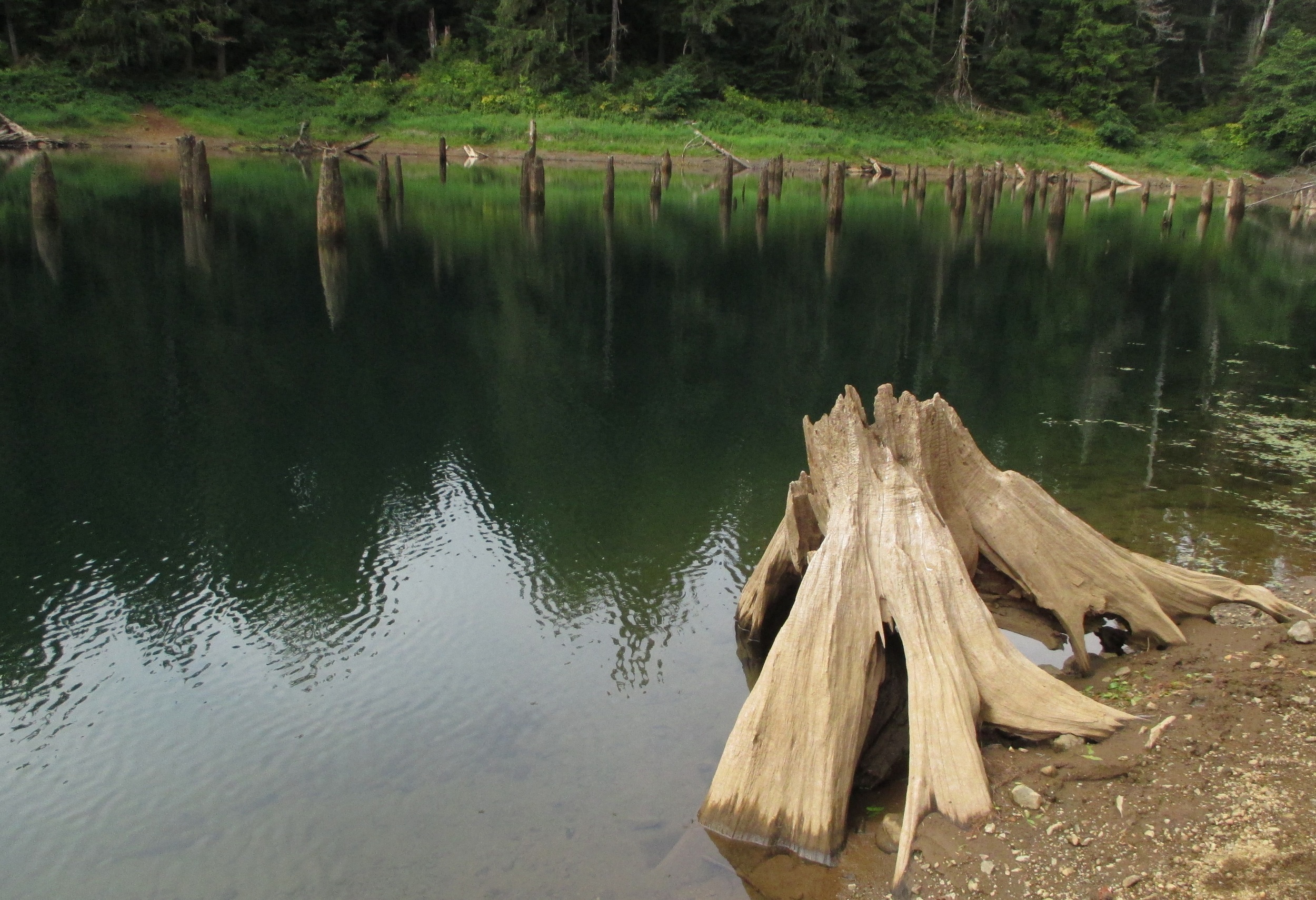
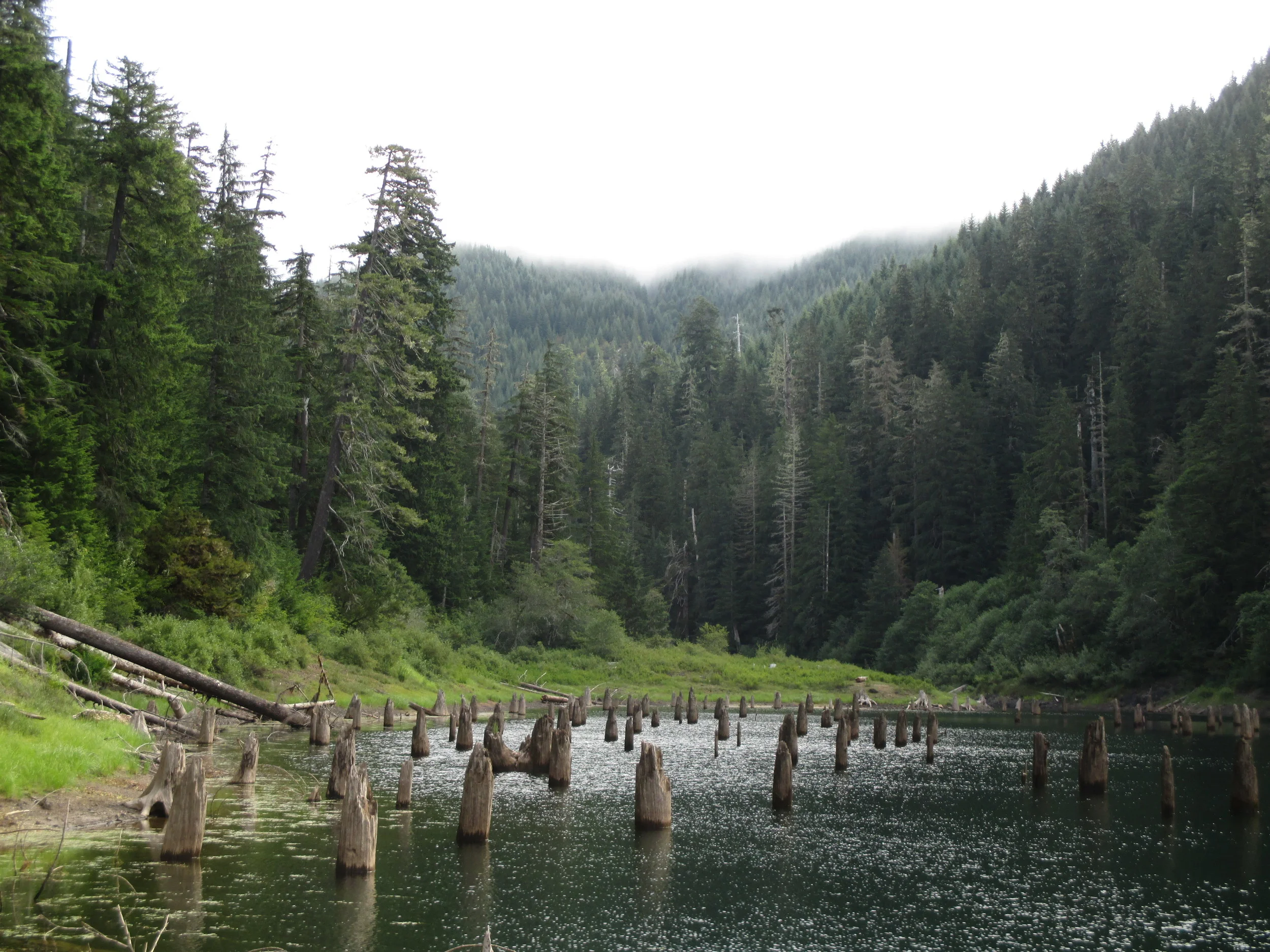
Here are some of the the things we saw in this mature Douglas-fir, Western Hemlock, Western Red-Cedar forest: Vine Maple, Devil's Club, Stink Currant, Cascara, Ocean Spray, Salmon Berry, Thimbleberry, Red Huckleberry, Salal, Sword Fern, Maidenhair Fern, Bracken, Age on Youth, Red Elderberry, Beaked Hazel, Red Alder, False Solomon's Seal, Hooker's Fairybells, False Lily-of-the-Valley, Queen's Cup, Bunchberry, Foamflower, Vanilla Leaf, Scouler's Corydalis, Lungwort. And....shelf fungus resembling stingrays and the starship Enterprise, the shed exoskeletons of dragonfly larvae inside a hollow cedar stump, teeny tiny cup-shaped fungus, a small population of weather-worn tree stumps emerging ghostlike from the clear, blue-green lake.

Spider Lake is a small lake in the Olympic National Forest, halfway between Lake Cushman and the Skokomish River. It's not easy to find, especially since the driving directions in Day Hiking the Olympic Peninsula and on the Washington Trails Association website are not correct (due to changes in forest-service roads and access). I will be posting correct directions here and on the WTA Trip Report for Spider Lake so you can find your way to this gem of a lake and rich, satisfying ramble. The drive to High Steel Bridge after is well worth it as long as you are not afraid of heights, experience vertigo, lean over too far and lose your sunglasses, camera, or cell phone to the Skokomish River.

Meanwhile, enjoy the photo gallery above (just hover 'n' click on the photo to advance them).


Tags lakes, spider lake, olympic national forest
Comment

Learn to Love Scrawny Petunias

August 14, 2014 Maria Mudd Ruth

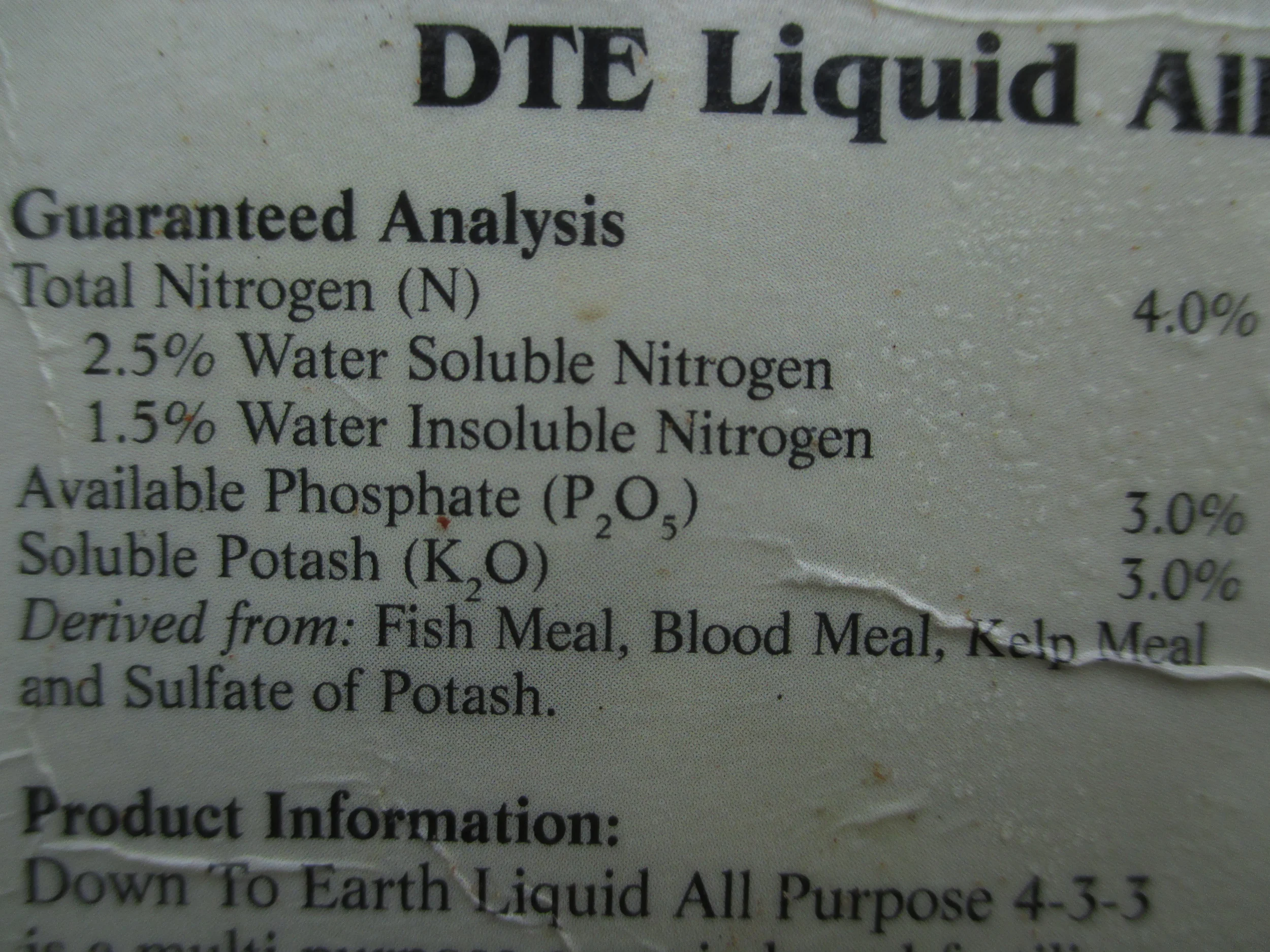
I thought I was doing the right thing for my garden this summer with a little boost of all-purpose fertilizer. My garden is mostly drought-tolerant (save water!) flowering plants (feed the bees and butterflies!) mixed in with some garden vegetables (secure our local food supply!). This fertilizer is distributed by Down to Earth (eco-friendly!) in Eugene, Oregon (go Pacific Northwest!) and I bought this quart  at my local co-op grocery (buy local!) in a recyclable container (save the Earth!). However...I didn't read the fine print.

The main source of all this goodness for my plants comes from fish meal. This meal is not made from "unwanted" fish parts leftover after fish sticks are formed, but from whole small fish known as "schooling fish" or "forage fish." These include herring, anchovies, sardines, sand lance, smelts, saury, menhaden, and others that you don't see on dinner tables (but get picked off of pizza or taken canned on camping trips). These forage fish live in oceans around the globe and are suffering huge population declines from over-harvesting.

How much "fish emulsion" is the world using on their petunias? Garden fertilizer is just one application--but one we can easily do without. It's harder to get forage-fish-based food out of  our diets and our pet's diets. Forage fish are ground into meal for industrial-scale aquaculture (farm-raised salmon are fed red-dyed pellets made from fish meal, for instance), pig feed, cow food, pet foods, fish-oil supplements for humans.

What's the big deal about these little fish? They are critical in all marine ecosystems. They are a major, energy-rich source of food for larger fish, marine mammals, and marine birds (including the marbled murrelet). Depletion of forage fish triggers population declines in the rest of the food web; seabirds starve, cannot successfully breed, and cannot feed their chicks.

The conservation community--particularly national, state, and local Audubon Society chapters--are bringing the issue of forage fish to the forefront, with a focus on ensuring adequate supplies of forage fish for migrating birds along the Pacific Flyway.  

HOW TO HELP: The Pacific Marine Fishery Council is accepting public comments for its September 2014 meeting. The final deadline is Sept. 3 to submit your comments (it's fine to cut and paste these, below!). Please send an email thanking the Council for its work to protect currently unmanaged forage fish and asking it to move forward by:

  • Incorporating unmanaged forage fish as ecosystem component species into each of its existing fishery management plans.
  • Setting a limit on the amount of unmanaged forage fish that may be taken in existing fisheries for groundfish and other species.

Submit your letter to pfmc.comments@noaa.gov.

For more information and resources from Audubon Washington on this important issue, please click here.

If you live on the Atlantic Coast, read about what's in your fertilizer (menhaden!) here.

Tags marbled murrelet
Comment

Pyrocumulus Clouds

August 12, 2014 Maria Mudd Ruth
Smoke and heat from 70-acre  "Lost Ridge" wildfire on Sunday generated pyrocumulus clouds above it.

Smoke and heat from 70-acre  "Lost Ridge" wildfire on Sunday generated pyrocumulus clouds above it.

Our much-anticipated camping expedition to Corral Pass near the Norse Peak Wilderness Area (northeast of Mt. Rainier) this weekend was cut short by a 70-acre wildfire about 4 miles north of our campsite. I took this photo minutes after our campground was evacuated (4 of us broke camp in 20 minutes) and we were driving out on Forest Service "road" 7174.

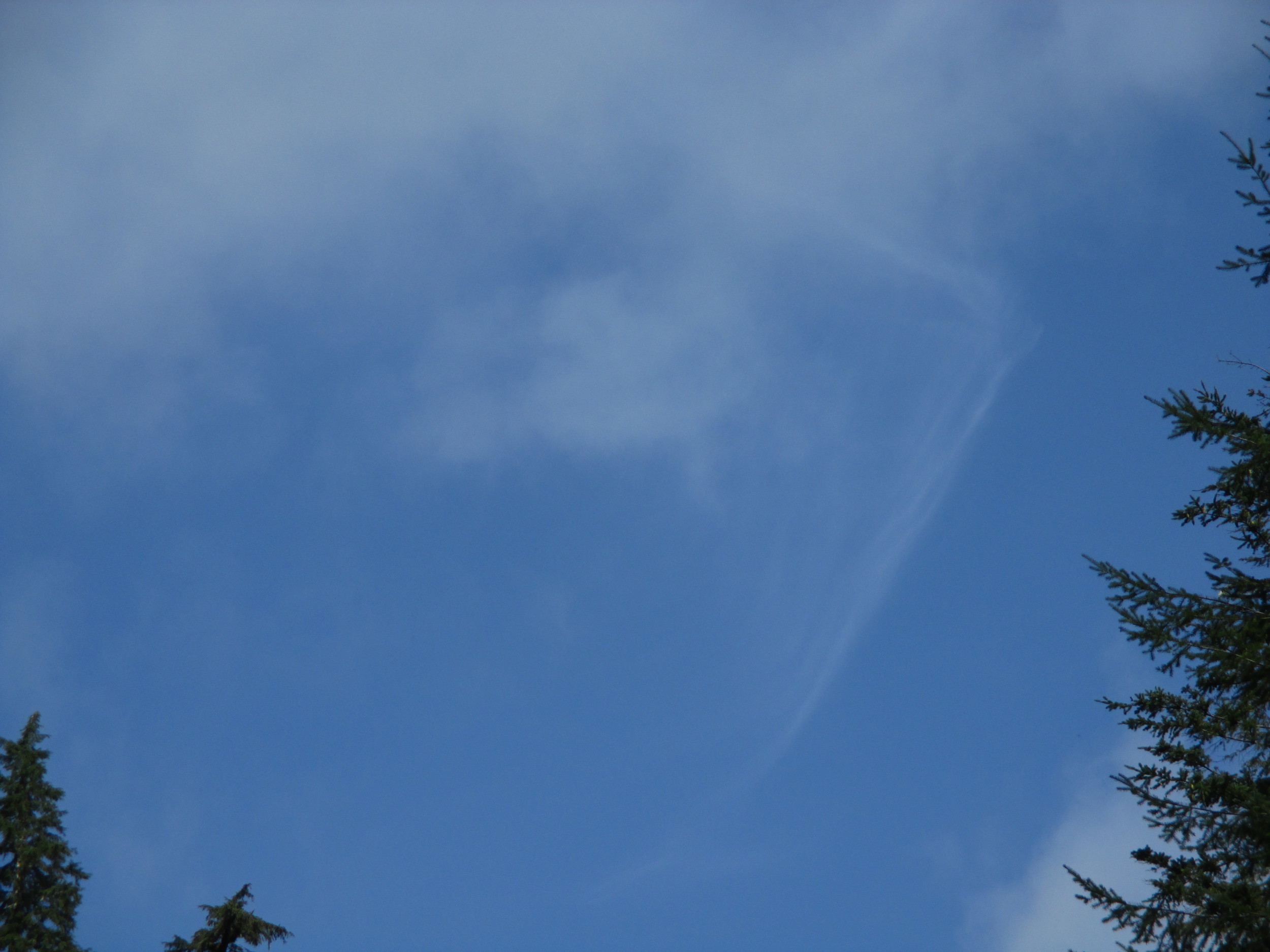
The photo above shows the smoke. Those below show pyrocumulus clouds--a type that forms when warm air from the forest fire rises, expands and cools. The water vapor in the air condenses on the many tiny particles of smoke and soot (condensation nuclei) and creates a cloud or clouds directly above the smoke.

Otherwise, a good time was had by all.

Pyrocumlus clouds forming in the hot, smokey air rising and condensing above the wildfire.  Photo b MM Ruth

Pyrocumlus clouds forming in the hot, smokey air rising and condensing above the wildfire.  Photo b MM Ruth

Pyrocumulus clouds--you can see the olumn of gray wildfire smoke in the center of the clouds.  Photo by MM Ruth

Pyrocumulus clouds--you can see the olumn of gray wildfire smoke in the center of the clouds.  Photo by MM Ruth

This is the sign posted at the trailhead to Greenwater and Echo Lake...and greeted us on our return hike from the lake!  The trail was closed, then the campground (Corral Pass) where we were camping was evacuated, then five-mile road to Corral …

This is the sign posted at the trailhead to Greenwater and Echo Lake...and greeted us on our return hike from the lake!  The trail was closed, then the campground (Corral Pass) where we were camping was evacuated, then five-mile road to Corral Pass was closed on Monday afternoon.      (Photo by MM Ruth)

Tags clouds, pyrocumulus
Comment

Cross-Quarte Fog

August 7, 2014 Maria Mudd Ruth
Quarter-point clouds...the harbinger of autumn in the Pacific Northwest. (Photo by MM Ruth)

Quarter-point clouds...the harbinger of autumn in the Pacific Northwest. (Photo by MM Ruth)

Standing in the middle of an early August day, I know fog season is just around the corner. My yard is at its warmest, ripest, driest, and deciduously greenest. Plants are not growing or blooming, nor are they fading or drooping. They are just there in the dirt waiting. Songbirds are few, the dawn chorus is silent, nestlings have fledged. There is an eerie stillness in which a few languid bees buzz. Something in that stillness tells me the earth is exhausted and can no longer hold onto summer. The fogs are rolling in from the Pacific over the Black Hills. Our warm landscape, clear skies, and cool nights create the possibility of patchy fog in our fields and valleys and over our lakes.

   This is the feeling of one of the cross-quarter point—the halfway point between the summer solstice (June 21) and the autumn equinox (September 22). When I mention this to friends, they say they have noticed something, too—something in the air or in the quality of light—but they didn’t know it was called the cross-quarter or had a name at all.

  Most of us don't celebrate these cross-quarter points, but ancient cultures did as these were important times to plant, to harvest, to move, to stay, to respond to the living planet. Each quarter point has a Gaelic-Celtic name:  This year, February 2 is Imbolc, May 5 is Beltane, August 7 is Lughnasa, and November 11 is Samain.

You may have heard of these names if you are familiar with things Celtic, pagan, or the novels of Mary Renault. I had heard of Lughnasa (spelled in various ways, but all pronounced Loon-na-sah) only because of the 1998 movie Dancing at the Lughnasa, starring Meryl Streep and Michael Gambon. The movie, based on a 1990 play, is set in 1936 in County Donegal, Ireland, during a summer of personal "turning points" for five sisters.

 Lughnasa marks the end of summer and the beginning of autumn. (Though our calendars mark September 21 or 22 as the first day of autumn, that day of equal day and night really marks the peak of autumn and the beginning of winter. (In the same odd way, when we celebrate our birthday we say we are turning 39 or we are 39. In fact, we have completed our 39th year and are beginning our 40th).

  Every morning now is a noticeably darker, every night a little cooler, and there is nothing the earth can do about it. Resigned, the earth simply lets go and releases its summer into the autumn air. But not all at once. Slowly, and in a long series of sighs and exhalations.

On still, cool nights you can hear the tired earth sighing. In the morning, you can see the fog it has exhaled. 

Welcome Autumn!

Tags fog
Comment
← Newer Posts Older Posts →

Subscribe

Sign up with your email address to receive my blog in your inbox.

Thank you!
Blog RSS

Flying from Mountaineers Books this Spring—the story of the Pigeon Guillemot—the world’s most charismatic alcid. This non-fiction natural history will be on bookshelves and available from online retailers on April 7, 2026. Click a link below to pre-order a copy now from these purveyors:

Mountaineers Books (non-profit, indie publisher based in Seattle)

Browsers Books (Olympia’s indie bookstore)

Bookshop.org (support your local bookstore)

Barnes & Noble (in the book biz since 1971)

Amazon

Other Natural History Titles by Maria Mudd Ruth…

A Sideways Look at Clouds


“Compelling…engaging.” The Library Journal

“Rare insights into the trials and joys of scientific discovery.” Publishers Weekly

Read more reviews and details here: Rare Bird: Pursuing the Mystery of the Marbled Murrelet

Enjoy this song by Peter Horne, "Little Bird, Little Boat, Big Ocean.” Written about the Marbled Murrelet, but the lyrics work well for the Pigeon Guillemot, too.


  • Clouds
  • Natural History
  • Open-water Swimming
  • Lake Swimming
  • Washington Lakes
  • Wild Swimming Washington
  • Pacific Northwest Clouds
  • Books on Clouds
  • Meteorology
  • Wild Swimming
You must select a collection to display.

Subscribe

Sign up with your email address to receive my blog in your inbox.

Thank you!
Blog RSS

©2025 MARIA MUDD RUTH  |  ALL RIGHTS RESERVED