• Home
  • The Bird with the Flaming Red Feet
  • Rare Bird: Marbled Murrelet
  • A Sideways Look at Clouds
  • Author
  • Events
  • Blog
  • Contact
Menu

Maria Mudd Ruth

Street Address
City, State, Zip
Phone Number
author and naturalist
Homepage-Banner.jpg

Maria Mudd Ruth

  • Home
  • Books
    • The Bird with the Flaming Red Feet
    • Rare Bird: Marbled Murrelet
    • A Sideways Look at Clouds
  • Author
  • Events
  • Blog
  • Contact

51 Names for Fog

July 31, 2014 Maria Mudd Ruth
The Great Fog of December 1952 reduced visibility in London to ten feet. This thick fog--a stratus cloud--was known as a "pea souper."  

The Great Fog of December 1952 reduced visibility in London to ten feet. This thick fog--a stratus cloud--was known as a "pea souper."  

“Fog” is a clunky name for a cloud, especially one that appears so delicate and ethereal.  It’s a simplistic name, too, one that doesn’t do justice to the myriad and nuanced forms fog assumes across the globe. Meteorologists have added some polysyllabic complexity by describing several basic fog types: radiation fog, advection fog, freezing fog, ice fog, and upslope fog. Few people (including weather reporters) use these names. We rely instead on generic adjectives—“thick,” “dense,” “heavy,” “patchy,” or “light”—to describe most fogs we encounter.

Can’t we do better?  Why, the Eskimos have fifty words for snow!

In fact, we have done better. A recent moderate-effort search in my guidebooks to the weather, textbooks on atmospheric science, and cloud-related websites, yielded these names: air hoar, acid fog, advection fog, antarctic sea smoke, arctic sea smoke, arctic mist, black fog, cacimbo, California fog, caribou fog, dry fog, evaporation fog, flash fog, fog streamer, fog bank, fog bow, fog belt, fog drip, fog horizon, force 10 fog, frontal fog, frost smoke, frozen fog, freezing fog, frost smoke, ground fog, high fog, hill fog, ice fog, killer fog, London Fog, mixing fog, mist, monsoon fog, pea souper, pogonip, precipitation fog, radiation fog, frost flakes, rime fog, sea fog, sea mist, sea smoke, smog, steam devil, steam fog, supercooled fog, tule fog, upslope fog, and valley fog, and water smoke.

Unless you live in the U.K., you might not know about the "pea souper," the local name for the famous and infamous thick fog that occurs there. Thick fogs have always occurred naturally in London, but they became increasingly toxic during the Industrial Revolution when factories and fireplaces belched black smoke and soot from burning cheap sulfur-laden coal. Once-benign fogs formed around the particles of smoke and soot and became dangerous to breathe.  

In December 1952, one especially thick pea souper hung over London for five days and caused widespread coughing, choking, bronchitis, lung inflammation, and the deaths of 12,000 people from respiratory failure. An estimated 4000 people died during the five days and another 8000 in the months afterward.

This nightmarish cloud event and public-health crisis lead to the passage of the 1956 Clean Air Act in the United Kingdom. Though coal burning has decreased, pea soupers still occur in London, though they contain the “smoke” of automobile exhaust and industrial air pollutants instead of burning coal. In London as elsewhere, this menacing cloud is known as smog—a name derived from combining smoke and fog. 

Click here to read more about the Great Fog of 1952.

Tags fog, clouds, stratus
2 Comments

The Wilderness Act and the Marbled Murrelet

July 28, 2014 Maria Mudd Ruth
The pugnacious marbled murrelet has usurped the wolf as the iconic wild species for this celebration.

The pugnacious marbled murrelet has usurped the wolf as the iconic wild species for this celebration.

Fifty years ago, President Lyndon Johnson signed into law the Wilderness Act, which set aside public land for special protection. Thanks to this act, we now have 758 official wilderness acres covering nearly 110 million acres across the United States.

Looking back, it seems incredible that it was not until 1964 that we had a legal definition of wilderness or rules to protect it. "Wilderness" is different from national park, national forest, and wildlife refuge. The Wilderness Act defines it this way:

"In contrast with those areas where man and his own works dominate the landscape...wilderness is an area where the earth and its community of life are untrammeled by man, where man himself is a visitor who does not remain."

David Brower, founder of the Sierra Club, produced a tongue-in-cheek definition that is easier to remember: "Wilderness is where the hand of man has not set foot."

Last weekend, I had the privilege of spending time in the Siuslaw National Forest on the central Oregon coast. This national forest includes three wilderness areas--Rock Creek, Drift Creek, and Cummins Creek--total 23,000 acres of nearly pristine old-growth temperate rain forests. These wilderness areas, as well as much of the Siuslaw, are prime nesting habitat for the marbled murrelet. These seabirds nest on wide, mossy branches in the mature and old-growth Sitka Spruce, Douglas-fir, and other native conifers growing in these areas.

To keep the wilderness areas untrammeled, visitors are allowed to hike, back-country camp--though Rock Creek Wilderness Area has no developed trails or trailheads. Given the remoteness of Rock Creek and the fact that I was hiking solo last weekend, I opted for a more trammeled experience in state park.

The "Unwelcome Mat"--very glad to know this area will not be trammeled for a while.       Photo by MM Ruth

The "Unwelcome Mat"--very glad to know this area will not be trammeled for a while.       Photo by MM Ruth

The upland and marsh trails through the Beaver Creek section of Brian Booth State Park were pleasant, but had been lovingly "trammeled" over the years--mostly by beaver, but more recently by humans. Still, I was delighted to see the sign (above) at the end of a boardwalk over the creek. Though this park is not managed as official wilderness, it is reassuring to know that it will regain some of its wildness in years to come. 

The challenging of protecting and managing our wild places has never been greater. The observance of the 50th anniversary of the Wilderness Act has allowed for much reflection (at least in the conservation community) of the value of wild lands and what it means to leave them untrammeled. One thought-provoking article, "The Wilderness Act is Facing a Midlife Crisis," appeared in the New York Times and asks readers to ponder how to manage wilderness in the face of climate change and its impacts--something no one anticipated in 1964.  "Why not intervene--carefully, selectively, with humility--in the places that need help the most, with an eye toward giving nature, and us, more option?" asks author Christopher Solomon.

Should some "trammeling" be allowed if it means moving Joshua trees to higher elevations within Joshua Tree Wilderness Areas so we don't lose them (as models predict) by century's end? Should trammeling include removing invasive species in wilderness areas? Should it include clearing old-growth forests of fallen timber to reduce the risk of catastrophic forest fires?

I am not sure anyone (and most especially me) has any answers--at least at the 110-million-acre scale. Perhaps not even at the 110-acre scale. Still, it is important to ask the questions and have a conversation. And even more important to find your way to your nearest Wilderness Area. You can do that at the bottom of here.


Tags wilderness
Comment

Stratocumulus Clouds

July 22, 2014 Maria Mudd Ruth
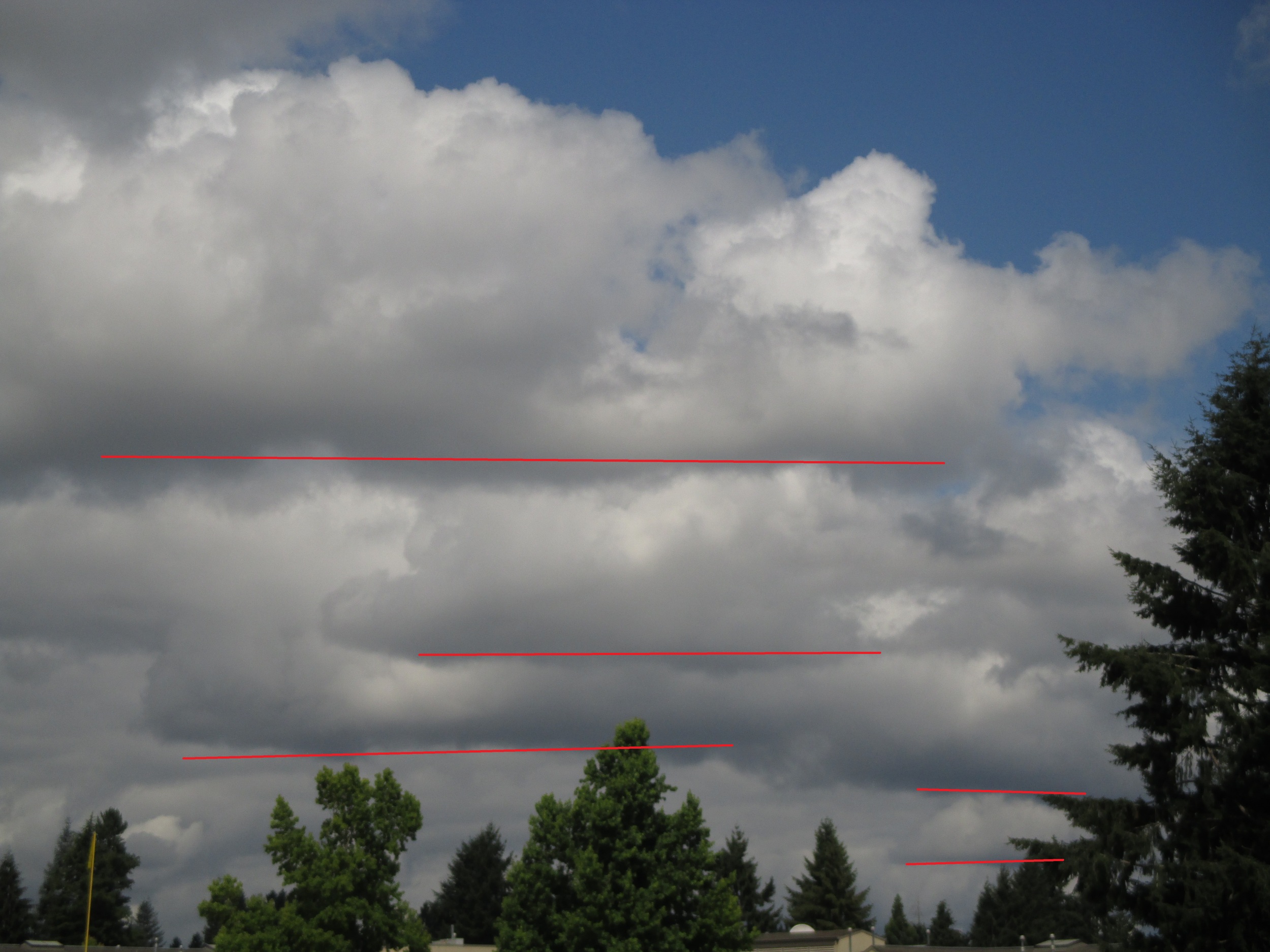
Stratocumulus clouds to the northwest of Olympia yesterday morning. The red lines (added by me) indicate the bases (bottoms) of these clouds.   (Photo by MM Ruth)

Stratocumulus clouds to the northwest of Olympia yesterday morning. The red lines (added by me) indicate the bases (bottoms) of these clouds.   (Photo by MM Ruth)

One of the more challenging aspects of watching the clouds is tricking your brain into believing, cloud-wise, that the earth is flat. I have to override my perception that the sky is a celestial dome covering the land from horizon to horizon like a huge mixing bowl covering a plate of brownies. It is not. 

Yesterday morning I was reminded of this when I noticed these stratocumulus clouds and their dark bases--the flat bottoms I have marked with red lines. Each of the red lines--hence, each cloud, is at the same altitude above the ground. It is.

The base of the cloud marks the condensation level--the altitude at which molecules of water vapor (the invisible gaseous form of water) in the atmosphere cool to the point at which the molecules slow down, condense, then glom onto each other to form liquid water droplets. When these droplets attain a certain size, they interact (refract, reflect, scatter) sunlight in such a way that they become visible to us.

How high all of these clouds? If you check the National Weather Service for July 21 at 10:54 a.m. (you cannot calculate this on your own),  you will learn that when I photographed these clouds, the temperature was 65 degrees F and the dew point (temperature at which water vapor condenses to liquid) was 49 degrees F. Subtract the second number from the first and you get 16. Multiply that by 228 and you get 4,648. This is the number of feet above the earth these clouds were floating. With enough practice I could imagine pointing to such clouds a few years from now and saying, "Look at the those strats!* I  bet they are nearly a mile high!"

Knowing how high these clouds are means knowing how high their bases are--not their tops. Stratocumulus is considered a "low" cloud type, with a a base hovers between 2,000 and 6,500 feet.

Read here how I figured all this out two years ago. Sort of.

*No one calls them "strats."

Tags clouds, stratocumlus
Comment

Hands-on Cloud Identification

July 17, 2014 Maria Mudd Ruth
What kinds of clouds are these? Aren't sure? Stratus? Cumulo-something? Do you need a field guide or an app? No.

What kinds of clouds are these? Aren't sure? Stratus? Cumulo-something? Do you need a field guide or an app? No.

It's not altocumulus, mid-level clouds with individual cloudlettes the size of your thumbnail when you hold it at arm's length 30 degrees above the horizon. (Some say altocumulus are between one and three fingers wide.

It's not altocumulus, mid-level clouds with individual cloudlettes the size of your thumbnail when you hold it at arm's length 30 degrees above the horizon. (Some say altocumulus are between one and three fingers wide.

It's not cirrocumulus, higher clouds with cloudlettes the size of your pinky nail (or rice grains some say).

It's not cirrocumulus, higher clouds with cloudlettes the size of your pinky nail (or rice grains some say).

They are larger than my fist....so they could be cumulus or stratocumlus but....

They are larger than my fist....so they could be cumulus or stratocumlus but....

...these are even bigger than my very large outstretched hand. The clouds don't have well-defined edges, flat bases, or the look of cumulus clouds. This leaves stratocumulus--a large, lumpy cloud that forms at low altitudes and is often formed as la…

...these are even bigger than my very large outstretched hand. The clouds don't have well-defined edges, flat bases, or the look of cumulus clouds. This leaves stratocumulus--a large, lumpy cloud that forms at low altitudes and is often formed as layered stratus clouds (fog) rise as they move inland over low hills. These clouds come in a variety known as stratocumulus fractus, which are the smaller (factions) of the stratocumulus cloud as it breaks apart or evaporates.

Sure enough, when I checked the National Weather Service's forecast discussion, the morning cloud cover was described as "low clouds" and "stratus" and were predicted to rise, evaporate, and give way to mostly sunny skies.

Tags cumulus, stratocumlus
Comment
← Newer Posts Older Posts →

Subscribe

Sign up with your email address to receive my blog in your inbox.

Thank you!
Blog RSS

Flying from Mountaineers Books this Spring—the story of the Pigeon Guillemot—the world’s most charismatic alcid. This non-fiction natural history will be on bookshelves and available from online retailers on April 7, 2026. Click a link below to pre-order a copy now from these purveyors:

Mountaineers Books (non-profit, indie publisher based in Seattle)

Browsers Books (Olympia’s indie bookstore)

Bookshop.org (support your local bookstore)

Barnes & Noble (in the book biz since 1971)

Amazon

Other Natural History Titles by Maria Mudd Ruth…

A Sideways Look at Clouds


“Compelling…engaging.” The Library Journal

“Rare insights into the trials and joys of scientific discovery.” Publishers Weekly

Read more reviews and details here: Rare Bird: Pursuing the Mystery of the Marbled Murrelet

Enjoy this song by Peter Horne, "Little Bird, Little Boat, Big Ocean.” Written about the Marbled Murrelet, but the lyrics work well for the Pigeon Guillemot, too.


  • Clouds
  • Natural History
  • Open-water Swimming
  • Lake Swimming
  • Washington Lakes
  • Wild Swimming Washington
  • Pacific Northwest Clouds
  • Books on Clouds
  • Meteorology
  • Wild Swimming
You must select a collection to display.

Subscribe

Sign up with your email address to receive my blog in your inbox.

Thank you!
Blog RSS

©2025 MARIA MUDD RUTH  |  ALL RIGHTS RESERVED