• Home
  • The Bird with the Flaming Red Feet
  • Rare Bird: Marbled Murrelet
  • A Sideways Look at Clouds
  • Author
  • Events
  • Blog
  • Contact
Menu

Maria Mudd Ruth

Street Address
City, State, Zip
Phone Number
author and naturalist
Homepage-Banner.jpg

Maria Mudd Ruth

  • Home
  • Books
    • The Bird with the Flaming Red Feet
    • Rare Bird: Marbled Murrelet
    • A Sideways Look at Clouds
  • Author
  • Events
  • Blog
  • Contact

Window Crashes and Birds

January 10, 2014 Maria Mudd Ruth
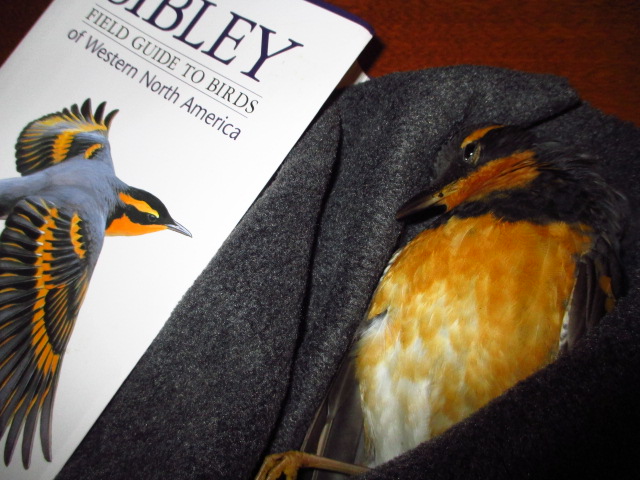
The end of a Varied Thrush, one of my favorite birds, at my window this morning.

The end of a Varied Thrush, one of my favorite birds, at my window this morning.

Just as I was sitting down at my desk to start working on my book on clouds, I heard a loud thud from downstairs. I know my house sounds well and knew it was not the sound of the antique writing desk warping, but of a bird hitting the picture window in the front of my house.

I ran outside to find the bird beneath the window and though I had had a success last summer encouraging a window-stunned bird back to life, this bird had clearly broken its neck and died within a few minutes of my finding it.

It was a Varied Thrush--one of my favorite birds of the Pacific Northwest. A bird I first heard while surveying Marbled Murrelets in the old-growth forests at dawn. This thrush's song is a strange one--a buzzy hum at different pitches. A group of thrushes sounds like someone impersonating a spaceship landing. In the forest at dawn, it was surreal. You can hear the call anywhere, anytime here.

Varied Thrushes are about as hard to spot as a Marbled Murrelet in the forest, but the thrushes are common in my suburban neighborhood where there are plenty of shady coniferous woods for them. Still, it wasn't until a few summers of living in Olympia that I was able to track the strange song an actual bird. One. In a Douglas-fir in my backyard. They are well camouflaged and seem to prefer singing from near the tops of the towering trees.

I didn't expect to see a thrush this early in the year--I always associate them with the end of winter along with the greening Indian Plum in the forest understory. So, with this first thrush and this first window crash of the season, I am determined to figure out how to reduce the fatalities for the rest of 2014. Though I love seeing the birds out my picture windows, I stopped feeding the birds with feeders as even the Varied Thrush will feed on the ground below feeders. I am planning to make my windows less reflective so other birds don't attempt to fly through them. It doesn't make sense to create an environment that enhances our bird-watching pleasure if it is fatal to the birds we are attempting to attract.

If you have this same problem, American Bird Conservancy has some tips here for reducing window crashes. Please send any tried-and-true tips this way.

Tags Varied Thrush, Window-crashing birds, Birds crashing into windows, preventing birds from crashing into windows
2 Comments

Marbled Murrelets in the News

December 11, 2013 Maria Mudd Ruth
Photo of a juvenile marbled murrelet on its nest courtesy Tom Hamer, www.hamerenvironmental.com

Photo of a juvenile marbled murrelet on its nest courtesy Tom Hamer, www.hamerenvironmental.com

Salem, Oregon: The Oregon Department of State Lands says Elliott State Forest no longer produces enough revenue to even manage it, much less fund public education through timber sales because of marbled murrelets. Therefore, in a controversial move made Tuesday, the state has decided to sell off three parcels totalling 2,728 acres (3% of the entire forest)  that include known marbled murrelet nesting habitat and potential nesting habitat.

Because the murrelets are a federally threatened and also state-threatened species in Oregon, the presence of marbled murrelets on these parcels in the Elliott State Forest devalues the land for timber sales--from $22.1 to $3.6 million, according to the assessment by timber cruisers.  This low value will allow private timber companies to bid on the parcels at bargain prices and reap a huge profit given that Endangered Species Act protections designed to prevent "take" of murrelets or destruction of their nesting habitat are difficult to enforce on privately owned forests. Some say the US Fish and Wildlife Service, the federal agency responsible for enforcing the  ESA protections, seems willing to turn a blind eye when habitat is on private land.

While the potential logging of these three parcels might seem insignificant, the decision sets a shameful precedent for forest management and shows infantile stubbornness against making critical steps toward de-linking school funding from timber harvest.  And it's bad news for a federally threatened seabird whose populations are declining steadily and rapidly primarily because of the loss of its nesting habitat--the mature and old-growth forests like those in Elliott State Forest.

Olympia, Washington: The December 3 meeting of the Washington State Board of Natural Resources heard from the Department of Natural Resources that it received 1,975 comment letters on its proposed alternatives for its Long-Term Conservation Strategy for the Marbled Murrelet in the state forests it manages for this species. These comments will be used by the DNR and USFWS to prepare a Draft Environmental Impact Statement in early 2014. There will be public meetings and opportunities for the public to provide written comment on this draft before Fall 2014.

Tidal Turbines drew a full house at Orca Books last night in Olympia for the monthly Science Cafe.

Tidal Turbines drew a full house at Orca Books last night in Olympia for the monthly Science Cafe.

And...last night's Science Cafe of Olympia featured the energetic and articulate UW engineer and energy researcher Brian Polagye, who discussed tidal energy turbines and the potential impacts of these structures on marine wildlife--mammals, fish, and birds--including the marbled murrelet. It seems that when most of us think of turbines in the marine environment, we think "sushi." Polagye explained how his research is addressing potential impacts of turbines--not only blade strikes but also sound disturbance. Through a very large array of detectors deployed in Admiralty Inlet, for instance, initial studies show no mortality to marine life from a single turbine--the blades rotate slowly (slower than you'd imagine) and fish tended to swim around the structues. There is very little data on hearing in fish and seabirds so the issue of sound disturbance is harder to address.

UW Energy Engineer Brian Polagye at the Science Cafe in Olympia 

UW Energy Engineer Brian Polagye at the Science Cafe in Olympia
 

Admirably, Polagye's work is being conducted in the early phase of tidal turbine development--before turbines are actually installed and during pilot-scale projects so engineering solutions can be introduced to avoid or mitigate negative impacts before installations are scaled up.

Polagye fielded numerous questions from a SRO crowd, which included a large number of engineers and fans of Star Wars. I am neither, but found this lecture fascinating, clearly presented, and--for now--good news for energy, the marbled murrelet, and thinking ahead.

Tags Elliott State Forest, Sale of Oregon State Forest, Brian Polagye, Tidal energy
Comment

'Tis the Marbled Murrelet

December 10, 2013 Maria Mudd Ruth
IMG_8137.JPG

I just couldn't resist.

Comment

Marbled Murrelets and Green Energy

December 10, 2013 Maria Mudd Ruth
The Marbled Murrelet by Atanasio Echeverria in Noticias de Nutka: An Account of Nootka Sound in 1792, by Jose Mariano Mozino. Photo by Maria Mudd Ruth. 

The Marbled Murrelet by Atanasio Echeverria in Noticias de Nutka: An Account of Nootka Sound in 1792, by Jose Mariano Mozino. Photo by Maria Mudd Ruth.
 

Tonight at 7: Science Cafe of Olympia presents TIDAL ENERGY RESEARCH


Tidal energy shows promise as a resource for sustainable, renewable power generation. Research is underway on the technical, environmental and social challenges to its deployment, such as designing and engineering tidal turbines for power production on a utility scale; identification and mitigation of underwater sound and direct interactions between marine animals and marine energy converters; and the development of hydrokinetic turbines at the micro-scale to provide power for autonomous oceanographic instrumentation.

Underwater tidal and wave turbines have been identified as a potential threat to marbled murrelets, the diving seabirds that forage in the nearshore waters where these structures would be installed. I'll be posting here tomorrow on tonight's presentation by Dr. Brian Polagye.

Dr. Polagye, PhD, is the  Co-Director of the Northwest National Marine Renewable Energy Center and Research Assistant Professor in the Department of Mechanical Engineering at the University of Washington.

When:     7:00 pm, Tuesday, December 10, 2013

Where:    Orca Books (509 East 4th Avenue, Olympia)  Phone 360.352.0123

Tags tidal energy, science cafe, science cafe olympia, Marbled murrelet images, Brian Polagye
Comment
← Newer Posts Older Posts →

Subscribe

Sign up with your email address to receive my blog in your inbox.

Thank you!
Blog RSS

Flying from Mountaineers Books this Spring—the story of the Pigeon Guillemot—the world’s most charismatic alcid. This non-fiction natural history will be on bookshelves and available from online retailers on April 7, 2026. Click a link below to pre-order a copy now from these purveyors:

Mountaineers Books (non-profit, indie publisher based in Seattle)

Browsers Books (Olympia’s indie bookstore)

Bookshop.org (support your local bookstore)

Barnes & Noble (in the book biz since 1971)

Amazon

Other Natural History Titles by Maria Mudd Ruth…

A Sideways Look at Clouds


“Compelling…engaging.” The Library Journal

“Rare insights into the trials and joys of scientific discovery.” Publishers Weekly

Read more reviews and details here: Rare Bird: Pursuing the Mystery of the Marbled Murrelet

Enjoy this song by Peter Horne, "Little Bird, Little Boat, Big Ocean.” Written about the Marbled Murrelet, but the lyrics work well for the Pigeon Guillemot, too.


  • Clouds
  • Natural History
  • Open-water Swimming
  • Lake Swimming
  • Washington Lakes
  • Wild Swimming Washington
  • Pacific Northwest Clouds
  • Books on Clouds
  • Meteorology
  • Wild Swimming
You must select a collection to display.

Subscribe

Sign up with your email address to receive my blog in your inbox.

Thank you!
Blog RSS

©2026 MARIA MUDD RUTH  |  ALL RIGHTS RESERVED