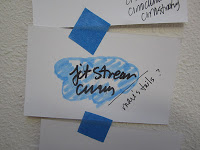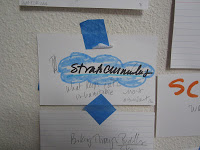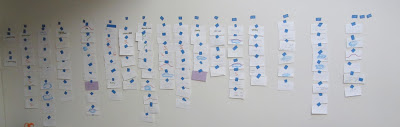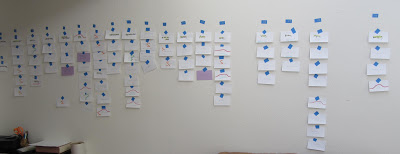
| Like a cumulus cloud, my book developed with each 3 x 5 card I added. |
The next step (I think) is to remove each column of cards again and begin the second draft. The trick will be to keep it all from evaporating.
| Like a cumulus cloud, my book developed with each 3 x 5 card I added. |
Kinda dull cloudwise, but the birds are fantastic at Nisqually NWR right now.
I spent this glorious May morning at Nisqually National Wildlife Refuge. With the help of dozens of fellow birders (ace to amateur), several mega-spotting scopes, various field guides, and lots of pointing, I caught sight and sound of all sorts of birds I never would have seen or been able to identify on my own.
For example: one guide pointed into the sky behind us and told us to "put your bins on the moon." We focussed our binoculars on the waning gibbous moon, still high in the sky, and saw several dark twinkling shapes flying past the pale, white face of the moon. Vaux's swifts. Stunning. Fleeting. Unphotographable.
As it turns out, none of the birds I saw over the next few hours were interested in having their picture taken. Most birds were too fast (Vaux's swift), too twitchy (rufous hummingbird, yellow warblers), too distant (juvenile bald eagle, green winged teal, cinnamon teal, cliff swallows, pie-billed grebe), or too camouflaged (Rail, lesser yellow legs, greater yellow legs), too fascinating to watch (tree swallows) or just plain invisible (sora). Only a camera with a lens the size of a cannon was a match for some of these species.
So I focused on the greening landscape and the bounty of bright wings and songs and marveled at the unremarkable looking birds I was told were en route to the Arctic tundra....from South America.
No one noticed or even mentioned the Canada Geese-the very conspicuous, very common year-round residents at the refuge. They are really too large and too abundant to be "special" or worth going out of your way to photograph as they sit (pose?) at the edge of the refuge walking trails. The Canada Geese know they don't rate. At least one goose did today, the one looking wistfully out toward all the birders with their attention and binoculars focused elsewhere.
What do I have to do to get noticed around here?
for more information on Nisqually NWR.
for information on The Black Hills Audubon Society, which conducts weekly bird walks at the refuge.
Just a glimpse of the 30,000 shorebirds moving through the refuge now.
Grays Harbor possesses a subtle kind of beauty, the kind that requires an appreciation for the dazzling range of gray in the landscape. I have always loved remote, edge-of-the-continent places where big, honkin' tulips and other showy flowers can't get a foothold or survive the battering wind, rain, and salt spray.
A view from the boardwarlked Sandpiper Trail (my first "stiched" panorama!)
Just west of Hoquiam, Washington, you'll find such a less-is-more place at Grays Harbor National Wildlife Refuge. Unless you go now to witness the spectacular show of shorebirds-hundreds of thousands of them --moving onto the estuary's mudflats to refuel as they migrate some 15,000 miles from as far south as Argentina to their breeding grounds in the Arctic. The mudflats offer a bounty of food--clams, worms, grubs, shrimp-like creatures all burrowed down in the mud--many not far enough to evade the probing bills of the hungry birds.
I had visited the refuge in the past, but, being the Accidental Naturalist, didn't plan around the season or the tides and, while I enjoyed the stroll along the boardwalked Sandpiper Trail, was always a wee bit disappointed that I hadn't seen "anything good." This year, thanks to my Intentional Naturalist friends who told me about the Shorebird Festival, I showed up at exactly the right time--in the middle of high tide last Saturday--to see some 30,000 birds, mostly Western Sandipers, feeding along the shoreline. My camera and binoculars are underpowered for capturing individual birds, but there were several refuge volunteers stationed along the boardwalk with spotting scopes focussed on the flocks; the will be happy to point out the differences between the Western Sandpipers, Dunlins, Sanderlings, Semipalmated Plovers, and two dozen other species migrating through the refuge.
Weatherproof and bird-savvy refuge volunteers are stationed along the trail.
Most enjoyable for me was watching the different feeding styles of the different species and seeing waves of birds fly off the mudflats as peregrine falcons swept in to hunt.
Click here for information on the Grays Harbor NWR, best shorebird viewing times, information on the birds, and directions to the refuge. Though the festival was last week, the birds will be migrating for another few weeks.
Oh, I wasn't just watching a film on soil to celebrate Earth Day this year, I was also digging up my front lawn, harvesting rhubarb, planting kale, and watching a 42-minute film about climate change. A very important film with a powerful, simple message: Do the Math...and then Do Something.
The film features Bill McKibben and the work of his powerhouse climate-change action group, 350.org. Only they don't call it "climate change" or "global warming" (which sounds innocuous, even cozy) but "climate crisis." Which is what we are facing, which is what we can longer pretend is too complex and big and out of our control to do anything about.
According to McKibben, a warming of the Earth by just 2°C, will put an end to Nature and life on Earth as we know it. Scientists have already documented half this rise. We can burn less than 565 more gigatons of carbon dioxide and stay below 2°C of warming.
No matter how many Priuses or bus tickets we buy, how many incandescent light bulbs we change out for LEDs, or how many times we lobby our elected officials to create Green jobs, our efforts will amount to little if we do not take on the fossil fuel industry.
Little old me? Take on the Big Oil Giants? Yup.Based on current reserves of gas, coal, and oil--reserved the fossil-fuel corporations are planning to burn--we will pump 2,795 gigatons of carbon dioxide into the atmosphere. This is five times the safe amount. Why don't they stop? Money. The profits are too great and greed to entrenched. Unless....
Unless every "little old me" joins the movement to end this madness, this crisis in the making. The most effective action to take right now, according to McKibben, is for everyone one of us to encourage corporations, universities, colleges, pension funds, churches, state treasuries to divest--to get rid of stock, bonds, and investments in fossil-fuel corporations.
Click here to make a big difference. They've made it easy. Trust me. The very least thing you could do for Mother Earth is to click your mouse.
If you're not sure you buy the climate crisis "argument," or need to have The Math explained, Click here to read Bill McKibben's article in Rolling Stone magazine where it's all spelled out. (If you're over 30, think how "cool" you'll feel quoting the Rolling Stone !)