Is Your Town Newtown?

  I would so much more be writing about clouds or marbled murrelets right now. But it is time for the Accidental Naturalist to write about something that is not beautiful or rare.
   Sunday night, friends hosted a casual dinner for six—a dinner they had planned over a week ago. My husband and I arrived to a home that was warm and fragrant, where a Christmas tree was lighted, soup simmered on the stove, the main course baked in the oven, the table was set, and another couple wore matching Santa hats. The event had the look of a jolly holiday dinner. But Newtown was on everyone’s minds. So we took our places at the table and launched in.
   We didn’t know how willing each of us would be to discuss this tragedy (was it too soon? would it ruin the party?) or where the conversation would lead (would it get uncomfortable? would we offend each other?), but we began offering up ideas on how such an event could happen. Everyone had ideas and theories, and everyone had opinions about everyone’s ideas and theories. In no time, the volume ramped up and we began completing each other’s sentences, interrupting each other, having side conversations. The host grabbed a yellow cat toy.
   From now on, he announced, we could speak only if we were holding the cat toy. While we ate our delicious meal, the host deftly moderated from the head of the table, making sure everyone had equal time, calling on people (me) who dorkily raised their hand for a turn to hold the cat toy and speak.
   It soon became clear that we were all serious but we could also laugh, joke, and tease each other while having a difficult conversation. We wanted to do something that might make a difference—even a small difference—to change the pattern of violence in our communities. We knew there would be no quick fixes, we suspected gun sales would escalate in the wake of the shootings, but we weren’t content to shrug and resume “business as usual” after a weekend of heartbreaking news.
   After dinner and before dessert, our host stood up and walked over to the whiteboard.
    Our friends’ kids have used this whiteboards for years to work out complex homework problems, equations, and formulas. Now, the six of us would use it to work out the complex set of problems we believed were at the root of the Newtown tragedy. Keep in mind that at the time of our dinner (2 days after the shooting), the police had released little information about the crime; we were all speculating based on what we had read or heard about Newtown, and similar shootings.  

a)   the mother (what kind of mother keeps four assault weapons in a house with a child with mental health problem?)
b)   gun availability (anyone can buy an assault weapon with minimal oversight)
c)   mental health problems (shooter - diagnosed, mother – remains to be seen)
c)   the media (turning shooters into “celebrities”)
d)   pharmaceuticals (mismanagement of anti-depressants, other medications a factor?)
e)  business case (there is money to be made by pharmaceutical companies and gun manufacturers for keeping population in constant state of fear)
f)  access to violent video games and TV
g)  lack of meaningful connections/care in family/neighborhood
h)   divorce of parents
i)   no job prospects for young adults
j)  social isolation/”loner”
k) we are a nation involved in multiple wars
l) lack of crisis intervention in schools


     Then we erased the board and started a new list of action items—things we could do to prevent this kind of violence from happening in our community and in communities across the country. “Writing our representatives,” to encourage them to support tighter gun control measures and to support counseling services in our public schools. We soon discovered that we weren’t exactly sure of our state gun-control laws or where our representatives stood on the issue. How about contacting our county commissioners instead? We didn’t know enough about county gun laws to jump on this plan either. How about our neighborhood associations? What about our own neighborhoods?  Hey, I said, what about us?
     Here we sat, three married couples collectively having raised 6 kids to adulthood, pointing fingers at a single gun-proud mother, her troubled son, and a host of problems they evidently failed to control. We were in dangerous territory: we had made ourselves exceptional. We had distanced ourselves from this mother, this son, and their community’s problems. We were expecting our elected officials to fix the problem. We were approaching this the wrong way. So I took a risk: I asked a round of uncomfortably personal questions questions. Through raised hands alone, here is what we learned:
   All six of us had been lax parents at times,  that our kids weren’t always happy in high school where they often seemed depressed and isolated, that we let our kids play violent video games, that we took them to movies that glorified guns and violence, that our sons had had occasional violent outbursts, that at least one kid in every family had undergone some type of psychological counseling for depression at one time, that our medicine cabinets contained more than Pepto Bismol and Advil, that we had watched for warning signs of suicidal behavior at one time or another, that our kids were anxious about the economy and finding jobs, that we adults didn’t know all our neighbors. And that everyone household had a gun.
     I felt ashamed and horrified admitting to all of these things—especially about the gun (one used 30 years ago for skeet shooting, but still a gun). But there we were, our true confessions bringing our families closer to shooter Adam Lanza and his mother and our community closer to Newtown. What was the tipping point? We were inclined to blame a severe imbalance of pharmaceuticals, but then retracted it. Any of the 11 factors could tip the balance. Now what? What meaningful change could we enact?
   One couple vowed to eliminate the recent holiday laser-tag event at their office party during which they admitted (much horrified) they were “running around shooting kids!” Less than 12 hours after our dinner party, our friends notified me that they had succeeded in getting their company to agree to eliminate laser-tag from its 2013 holiday party…and every party after that.
   Another couple planned to spend more time talking to neighbors and engaging their son and his friends in conversation about Newtown, gun control, and about reaching out to their peers who might need support.
    My husband took up the job of writing our state and U.S. representatives. The U.S Congress, sold and delivered to the gun lobby, needs to enact meaningful reform—to support tighter controls such as limiting gun purchases to one a month, restricting sales of high-capacity magazines, imposing a universal background check for gun buyers, and backing efforts to microstamp handgun shells. Enacting these reforms will take a while, but the pattern of mass shootings needs to end: there have been 68 deaths from 8 separate shootings since April 2012.  At that rate, we are due for another one in January or February.
     Me? I will keep this conversation going—with my kids, neighbors, extended family, friends, and community. One young man took twenty-eight lives on Friday. One conversation might help save a life or lives. Conversations heal woulds, bind neighbors together, help keep the troubled out of trouble.
     Do something—no matter how small you think your effort might be—to keep your town from becoming the next Newtown. I believe it will make a difference.
Timing is Everything

  It's been a while, I know. My dug-up iris corms (featured in my last blog of August 7) sat in two canvas in the garage until about a month ago. There were just so many of them I felt daunted by the task of making room for them in the garden. I finally replanted them in the garden in late October. Almost all of them, anyway. Some I gave away, some rotted, and a few (I just noticed yesterday) are still in a small pile waiting to be planted.
   As they say, "The way you do anything is the way you do everything." Which brings me to this morning and to this blog. Actually to last night.
  I sat in front of the fire reading The Creative Habit, by Twyla Tharp, and was inspired to improve my writing habits which, like my garden, have gotten a bit lax of late. I needed to break a few habits--listening to NPR news in the morning (which is incredibly soporific), oversleeping (because the news just goes on and on),  drinking tea which is a very poor substitute for coffee, getting wrapped up in e-mail (despite the egg timer I set for 15 minutes for this activity), and putting off exercise until so late that I skip it altogether.
  New World Order! I spent a while last night rigging up my house to break myself of these habits. I pulled out the dusty (literally) Mr. Coffee and set the auto-brew to make me 2 cups at 5:15. I plugged a bedroom lamp into an auto-timer to turn on at 5:20. I moved a clock-radio next to my bed so it would go off at 5:30. I attached a double hand-me-down iPod (1g) to the clock-radio so I could hear Domenico Scarlatti's "Piano Sonata in C Major K132" (on piano not harpsichord). I set out my stretchy exercise clothes on a chair near the bed.
   The plan was to wake up with the light, smell the coffee, traipse to the kitchen, return to drink coffee with Scarlatti, go to the gym, return by 7 to feed and walk the dog, then write.
   I was so excited by my new plan that I could hardly sleep.
   But I did. Before I knew it, the light had come on. I sniffed for the coffee, but it's aroma hadn't reached the bedroom. The clock-radio didn't go off and I had dimmed the LED clock light so low that I couldn't see what time it was. The Audubon bird-call clock in the bathroom read 5:30. Except that I never re-set it when Daylight Savings Time ended, so it was actually 4:30.
  I was not getting up at 4:30. So I closed my eyes and tried to fall back asleep. Which I could not.
  At the civil hour of 5 a.m., I turned over-rode the clock-radio alarm and put on Scarlatti. It was so beautiful that I began to cry. My tears were not happy or sad or melancholy or hormonal--they just flowed because the music flowed in a way that touched some truth that only music can touch. I have fourteen Scarlatti piano sonatas on my iPod, but the K 132 in C Major--with its pure, measured, and insistent lines--is simultaneously arresting and inspiring.
   And, because I was alert and dressed in my gym togs by the time the coffee was ready, I decided not to get back into bed with my coffee but--here in the pre-dawn darkness before I head out to the gym--drink my coffee while letting you know that my iris have been planted, the words are flowing, and timing is everything.


Writing with a Pitchfork

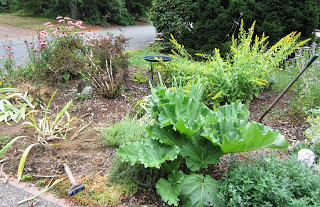
   I felt a little sheepish this morning as I took up a pitchfork instead of a pen, but the garden--not my book on clouds--was calling. The sky was uniformly gray and my garden was just shy of a eyesore. See for yourself:
The mid-summer garden: a good place for a writer.
   You're right, the rhubarb in the foreground looks healthy. That yellow thing behind it, however, is an undisciplined goldenrod whose variegated foliage I welcomed in spring. Clumps of nepeta (lower right corner) are in their second bloom and, to be honest, I am a bit tired of their constancy. The pink echinacea  hovers mildly above what's left of a hacked-up nine-bark that needs a new home. The real disaster is just past the handle of the pitchfork: two patches of iris that gave me no blooms this year, but filled the garden with yellowing, unlovely leaves.
   T.S. Elliot writes of the "objective correlative", a high-falutin' name for an objective fact,circumstance, or series of events that correspond to an emotion. When the objective correlative is presented, the emotion is necessarily evoked. Elliott was arguing against the vague and abstract use of words and language and in favor of the presentation of things--real things--in literature.
  When I am writing, I often spend my breaks in the garden. This is because my garden is full of objective correlatives. There is always something in my garden that exactly corresponds to the state of my writing at the time. Just look at what I found today after a very aggravating few weeks of trying to work out some structural problems with my book on clouds. Just look!
Iris grow from underground corms (like a bulb), which multiply and become multi-corm masses that do not produce blooms. Does my book have too many sections? Too many themes? Too much going on to "bloom?"

Corms need to be dug up and divided every two or three years. Do I have too much material--enough for two books?

After you dig up your corms, you hose off all the dirt and gently separate corms and their roots. Are my stories entwined skillfully or tangled in an ugly and amateurish mess?

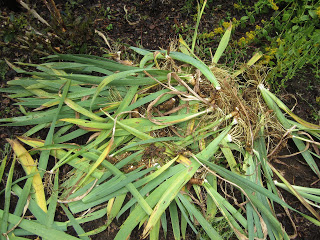
Here is one pile of irises (quadruple the biomass of what I planted three years ago), shortly after corm hosing. Where do I start making sense of all the material I've accumulated and organized?

After they bloom (or in August when you get around to it), cut iris leaves down to six inches for easier handling as you inspect them for rot, boring insects, other ills that will result in inferior or non-blooming plants next spring. How much editing do my chapters need? Can the book survive a drastic pruning? 
Some corms are too shriveled to save. Do I have to toss out entire chunks of text? Any way to resuscitate?
I'm afraid, the corms tell me, to get blooms like these you have to do the hard work--the digging, the cleaning, the cutting, the sorting, the nurturing, the waiting. Ah yes, you have to do the work, put in the time.

Amazon Attacks Olympia

     As many Olympia-area residents and shoppers know, the Fireside Bookstore is closing its doors on July 31. Read article in The Olympian here.This wonderful, small, independent bookstore in downtown Olympia has been owned and operated by Jane Laclergue since 1995. Jane has many fans and friends in town, many dedicated readers, grateful authors, and fabulous staff--many sang her praises at farewell/retirement party of Jane Wednesday night. Her passion for books, her charm, her personal approach to book buying has made Fireside a favorite place of mine to buy books over the past several years.
  Though Jane is of retirement age, the closing of the Fireside Bookstore comes at  time when fewer people seem to consider reading a priority pastime and more readers are acquiring digital books or ordering from online distributors such as Amazon. Sure, independent bookstores are not known for their bargain prices, but I think we need to look closely at the cost of our book-buying habits (and shopping habits in general) on  the physical place that is our downtown.
   Every digital book we download is one less book sold at a bookstore. Though I am a tree-hugger and can appreciate the paper being saved through digital books, I cannot overlook the costs to the environment of e-readers and toxic components. Compare "footprint" of printed books to electronic ones here.
  Every book we buy on Amazon or other online booksellers is one less book sold at a bookstore.
  At the end of the month there will be one more empty store in Olympia, one less place to visit. Is Orca Books next? Our only remaining independent bookstore? What about the other used book stores tucked into our downtown? What about Barnes & Noble, our only remaining chain bookstore in the great Olympia area? Oh, and what about all the other stores that offer products that could be acquired online? I fear the worst. And here's why.
   The morning after Jane's farewell party, I heard a piece on NPR about Amazon's plans to introduce a new smartphone. This product has the potential to bring down any downtown in America. Here is what one analyst had to say about Amazon's plans:
       "...Amazon probably sees a smartphone as a way to drive more dollars toward its digital offerings like movies and music. And he says Amazon could add applications to the phone that people could use to comparison shop in brick and mortar stores."
    Brick and mortar stores--like Fireside, like many stores in Olympia and other real towns. 
"Perhaps an app that says, 'Oh, you’re in a store, hit this app, scan the barcode, oh, you can get it on Amazon shipped to your door tomorrow, just hit this button'"
 This is where I lost it. Does anyone think this is really a good idea? Imagine a downtown where shoppers are merely smartphone-toters, barcode-scanning app users, bargain hunters, citizens operating under the illusion that they are saving money when what they are doing is putting stores out of business. What they would be doing (and what we are all doing now if you order anything online) is creating a landscape of empty stores, abandoned downtowns, and roadways plied dawn to dark by gas-guzzing UPS and FedEx trucks bringing our "bargains" to our front doors.
    Would that app also calculate shipping and handling charges from Amazon? Would it calculate the cost to the environment of the bubble wrap and cardboard each and every items is swathed in? The gas for the delivery trucks? The cost to our downtown businesses when we decide to "just hit this button" ?
   We need to make personal appearances in our stores if we want to have a downtown in our future. Downtown does not need more apps. Jane Laclergue said it best on Wednesday night: "Downtown needs your footsteps."


 If you live in Olympia, click here to find out what's happening.