Stay Away from Screens


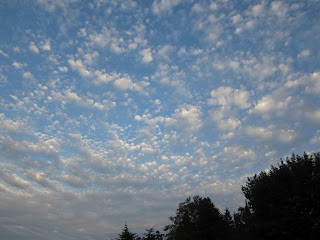
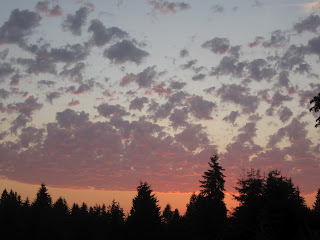
The show stopper: Altocumulus perlucidus
 This is what you might have missed over Olympia last night around sunset had you been looking at any number of screens available to you. I am not talking about screen doors, but the other kind, the kind you plug in and forget to look up from because you sense some strange urgency there. 
text-align: left;">   Without a trace of urgency, but on a steady wind from the south, these altocumulus perlucidus moved in silently late yesterday afternoon. I was in my hammock when the first several appeared in the blue sky and over the dark roof line. I wasn't sure what they were--they were too large for cirrocumulus and too small for cumulus humilis or fractus. I can't recall having seen them before. And so I went out for a walk under the celestial dome.
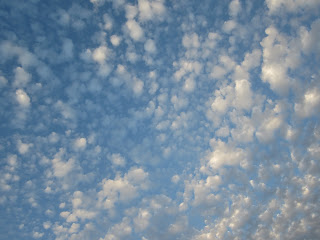
A sky full of popcorn or spilled cotton balls?
These are altocumulus perlucidus--a mid-level cloud formed of patches of cloudlets that are, according to my favorite Cloud Collector's Handbook, appear between "the width of one and three fingers, held at arm's length when they are more than 30 degrees above the horizon." The most distinguishing feature I noticed was the beautiful shading of the cloudlets--they were a luminescent white and gray and shaded on the side away from the sun. Cirrocumulus clouds are just the width of one finger (or less) and are not shaded.
   As you can see from the photograph above, that shading is different in nearly every cloudlet as each cloudlet is being shaded by the cloudlet, or cloudlets, to its west.
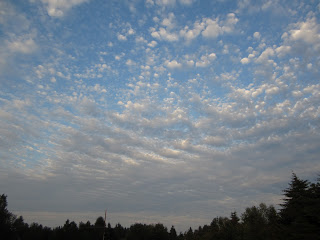
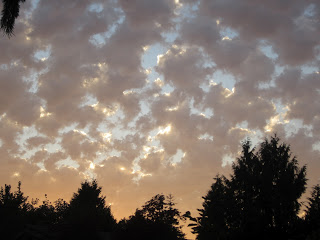
Looking to the east (above), you can see the individual cloudlets starting to thicken toward the horizon. I wasn't sure if this was because of my perspective, or there was something else going on. So I turned back toward the west and watched for another hour while the setting sun turn the white clouds into shades of lavender, gray, pink, and orange that would challenge the best of painters to reproduce. 
 Every time I started to head for home--thinking the show was over and the cloud were going to turn a flat, drab gray--they lingering light of the setting sun kept on with its finales with me offering a standing-walking ovation.

   This morning the solid gray skies were evidence that those cloudlets had ganged up overnight into a low sun-obnubilating mass. I check Art Rangno's Guide to the Sky poster and here is what he says about altocumulus perlucidus: "...usually indicates that large areas (thousands of square miles) are undergoing gradual ascent brought about by an advancing trough and area of low pressure." Which could mean rain--but it doesn't--at least not today. Checking in with the National Weather Service charts and forecasts (which don't address clouds specifically), it looks to me like these clouds were "embedded moisture" in the "southerly flow," clouds that made the skies "bumpy." 
    The gray of this morning is stratus clouds--fog--pushing in from the coast. It is supposed to retreat from whence it came later today, giving us our sunny skies. And maybe a chance for another spectacular sunset.


Natural History in the Methow

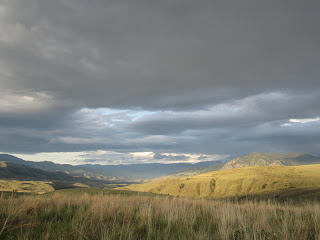
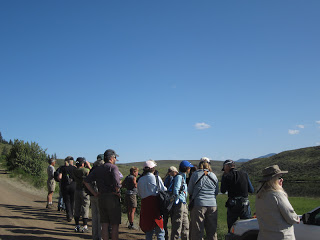
East of here: The scrub-steppe landscape of the Washington's Methow Valley.
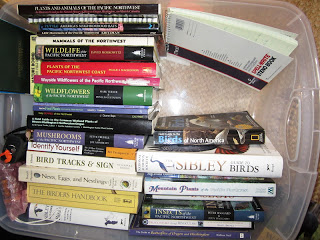
  Over Memorial Day weekend, I joined a large and convivial group of naturalists for a weekend retreat    in the drier, sunnier scrub-steppe landscape on the East side of the Cascade Range. The retreat was offered by the fabulous Methow Conservancy based in Winthrop, Washington, and featured three nights and two-and-a-half days of field trips and talks on the valley's flora and fauna. This was the first retreat of this kind I had ever participated in. I was a little nervous about the intensity of being among Intentional Naturalists, Expert Birders, Stamen-Scrutinizing Botanizers, and friends who travel with entire libraries of really fabulous field guides (below). But I had a lot to learn. Too much as it turns out.
Have tub, will travel. 
   Our field trips began at 8 a.m., but birding began at 6 a.m. when I opened my eyes to see two of the friends I was camping out with sitting up in the sleeping bags, their binoculars focussed on something in the sagebrush, whispering giddily over Sibley's Guide to Birds. A meadowlark. A blue grouse. A kestrel.
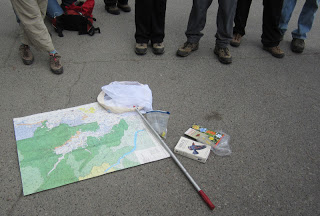
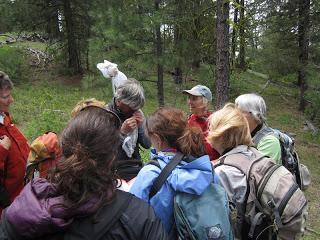
   A few hours later, twenty or so of us were gathered around our two leaders to get a lay of the land and split into two groups--half to spend the morning among the birds, half among the plants. We'd join up for lunch and then switch groups. Everyone packed field guides, lunch, water, binoculars, loops, essentials.

The 11th Essential: a butterfly net
  I was off to a good start among the birders. Did I mention that I am not a birder? I really love just a few birds--the marbled murrelet being my number one--but do not keep a checklist or have a particular desire to see or hear a certain bird except the Swainson's Thrush, whose call I learned when moving to the Pacific Northwest. I did not hear the thrush on this trip, though I did hear a plethora of warblers, bluebirds, robins, kingbirds, grosbeaks, blackbirds, nutcrackers, nuthatches, woodpeckers, killdeers, and coots. I studied their field marks, listened for their calls, tried to memorize the mnemonic for their song, translated their Latin names. Wichety wichety wichety. Receiver receiver receipt. Kon-ka-reeee.
A fabulous birding spot...despite the clouds.
  I had started writing down the names of the birds I saw and heard, but there were just too many of them. I stopped taking notes and decided to let the songs and calls wash over me and let my brain chose what to remember. It remembered Wilson's Warbler--bright yellow, black yarmulke. Chchchchchchchchchchch.
A 10X magnifying loop should be in everyone's backpack. 
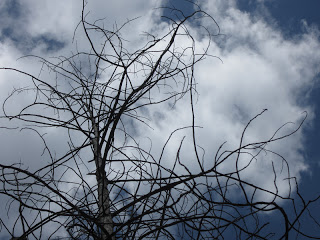
After lunch, fauna. Much. It was all new to me. I hadn't expected the plant life to be so different on this side of the mountains, but this was the near-desert scrub-steppe, not the lowland temperate rain forest where I lived. I tried to make sense of it all, think of the plants in families, groups of dicots and monocots, but still had some wichety wichety wichety noise buzzing in my brain. I looked to the sky. Ahh. Cumulus fractus with tree representing ganglia in Accidental Naturalist's brain.

Haywire in the clouds. 
  I was having a problem. I was overwhelmed, my brain was saturated. I needed to retreat, to hear just one bird, to study just one plant. But I had two more days to go. So fell several paces behind the group and pulled out my camera. Using the macro setting, I shrunk my universe down as small as I could. This felt so much better. I could breathe. I could see.
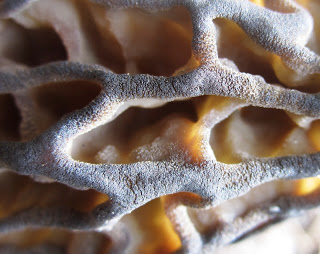
The crevasses of a morel mushroom.

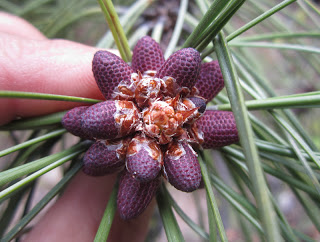
Easily overlooked buds on a Ponderosa Pine.

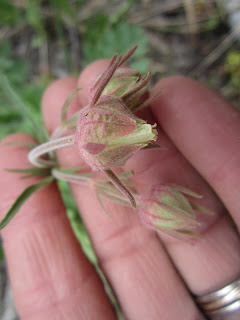
Ummm...

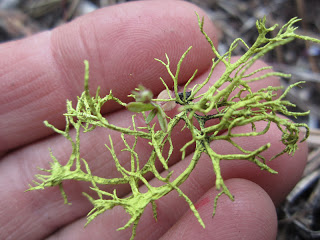
Lichen in a color I would have said "could not be found in nature."

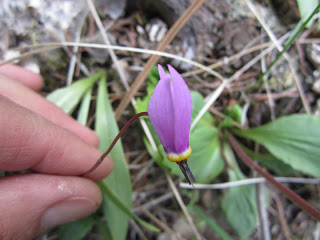
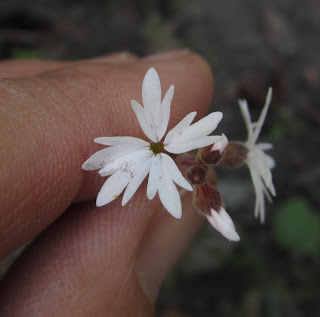
A shooting star.
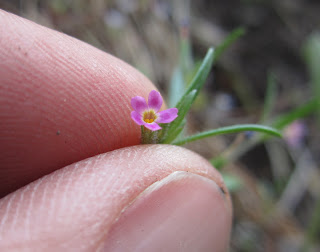
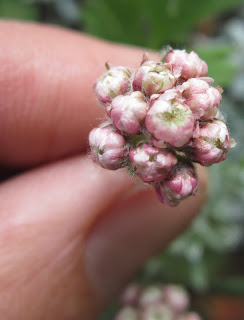
Rosy Pussy Toes.
Ummm....


Ummm...

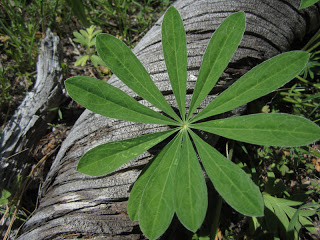
Lupine. 
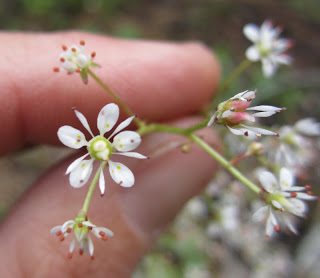
Saxifrage?

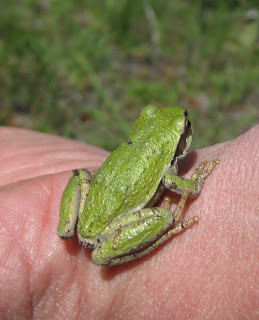
A moment of stillness: The only fauna that posed for me all weekend.

  Despite my self-preservation efforts, I was really in bad shape by the end of the second day. The species and names and Latin and songs and calls and flowering parts and fruiting bodies just kept accumulating. I wasn't sure what to do with all of the information. There was no time to sort, categorize, let everything soak in. This is not the fault of the retreat, but of my easily overwhelmed brain, my Accidental Naturalist approach: Let's take a hike and maybe hear a bird or two. Let's try to remember the Latin name of a sword fern. Or not.
  I wanted to think about everything, why these plants and animals were where they were, where they had flown in or blown in from, how they lived in the world, what made life challenging for them. Yet I am not sure what I would have done with all of that knowledge either. And I seem to be the kind of person who needs to use knowledge. What action could I take? I couldn't figure out how to show my astonishment and my gratitude for all of these birds and plants who were so much more than their names--common, Latin, bi-nomial--and so much more than we'd ever have time to understand.  
  I opted out of the last morning field trip, though I took a field trip of my own, just walking slowly by myself along a dirt road beside a creek. In the sun, in the breeze, amid the chattering birds.
  The day after I returned home, I took a walk in the rain and heard the one song I had craved all spring--the song of the Swainson's Thrush. This is the song a friend describes as "the sound of what my heart longs for but can’t name." Here it here.