• Home
  • The Bird with the Flaming Red Feet
  • Rare Bird: Marbled Murrelet
  • A Sideways Look at Clouds
  • Author
  • Events
  • Blog
  • Contact
Menu

Maria Mudd Ruth

Street Address
City, State, Zip
Phone Number
author and naturalist
Homepage-Banner.jpg

Maria Mudd Ruth

  • Home
  • Books
    • The Bird with the Flaming Red Feet
    • Rare Bird: Marbled Murrelet
    • A Sideways Look at Clouds
  • Author
  • Events
  • Blog
  • Contact

Three Keers for Science!

November 3, 2015 Maria Mudd Ruth
Marbled Murrelet in Winter. LInocut by Manke Mistry. Printing and taping of image to marbled composition book by M. Ruth.

Marbled Murrelet in Winter. LInocut by Manke Mistry. Printing and taping of image to marbled composition book by M. Ruth.

Thank you all Marbled Murreleteers who have been supporting a Science-based conservation strategy for this imperiled species in Washington state. It's been a long haul (at least two years of monthly meetings with the Board of Natural Resources), but today the board approved an expanded range of alternatives including one based on the 2008 Science Team report (officially known as Recommendations and Suporting Analysis of Conservation Opportunities for the Marbled Murrelet Long-Term Conservation Strategy, (Raphael, M.G., S.K. Nelson, P. Swedeen et al). 

Additionally, the board approved adding and amending other alternatives to create a total of six alternatives, one including expanded buffers (from 100 meters to 150 meters) around occupied nest sites. It is unlikely this expanded buffer will be approved, but it is important that buffers with meaningful and documented conservation value be analyzed for comparison to less buffer-generous alternatives.

This is a big victory! Thanks to all the individuals, staff of the Washington Forest Law Center, the Murrelet Survival Project and partners, and many Audubon chapters who have been providing public comment in person or in writing lo these many months. Every voice matters--truly. And we seem to have a board that listens.

Kyle Blum of Department of Natural Resources has done a remarkable job getting all the stakeholders to this point. It's amazing how complex, time-consuming, and fraught the conservation of such a little bird can become. The members of the BNR (with one notable and unnamed exception) should be praised for their engagement in the material presented and for their insightful questions all along the way. This is how we get to a win-win. Maybe even a win-win-win if we are lucky.

Up Next: More analysis by the DNR and USFWS. This is just the end of one phase and the beginning of the intense scrutinizing the environmental impacts of each alternative strategy. We are probably looking at summer/fall for a Draft Environmental Impact Statement (DEIS) and opportunities for Murreleteers and others to provide comment. Adding and modifying alternatives will extend the time line to reach an approved Long-Term Conservation Strategy--but what's a few months given the interim strategy has been in place since 1997!

In Endangered Species, Conservation Tags marbled murrelet, Washington BNR, Washington DNR, Long-term conservation strategy
Comment

Someone Else's Writing

September 30, 2015 Maria Mudd Ruth

I get a poem a day in my inbox courtesy of The Writer's Almanac. Sometimes I don't even open the e-mail, sometimes I do. It's uncanny the way, on the days I do open the e-mail, the poem hits home in a way that makes me think the poet (or the Almanac's editor) was spying on me. Today's poem was one of those poems. And, because I am spending my word budget on writing my book on clouds, I am grateful to have someone else's words to share. You can subscribe to The Writer's Almanac (an American Public Radio, Poetry Foundation, Garrison Keillor collaboration) yourself here.   PS: Happy Birthday Truman Capote and W.S. Merwin!

Talk about Walking
by Philip Booth

Where am I going? I’m going
out, out for a walk. I don’t
know where except outside.
Outside argument, out beyond
wallpaper and walls, outside
wherever it is where nobody
ever imagines. Beyond where
computers circumvent emotion,
where somebody shorted specs
for rivets for airframes on
today’s flights. I’m taking off
on my own two feet. I’m going
to clear my head, to watch
mares’-tails instead of TV,
to listen to trees and silence,
to see if I can still breathe.
I’m going to be alone with
myself, to feel how it feels
to embrace what my feet
tell my head, what wind says
in my good ear. I mean to let
myself be embraced, to let go
feeling so centripetally old.
Do I know where I’m going?
I don’t. How long or far
I have no idea. No map. I
said I was going to take
a walk. When I’ll be back
I’m not going to say.


"Talk about Walking" by Philip Booth from Lifelines: Selected Poems 1950-1999 (Viking Press).

Comment

I Didn't See it Coming

August 28, 2015 Maria Mudd Ruth
IMG_1519.JPG
IMG_1522.JPG
IMG_1525.JPG
IMG_1529.JPG
IMG_1530.JPG
IMG_1531.JPG
IMG_1533.JPG
IMG_1534.JPG

(CLICK ON PHOTO TO ADVANCE IMAGE GALLERY)

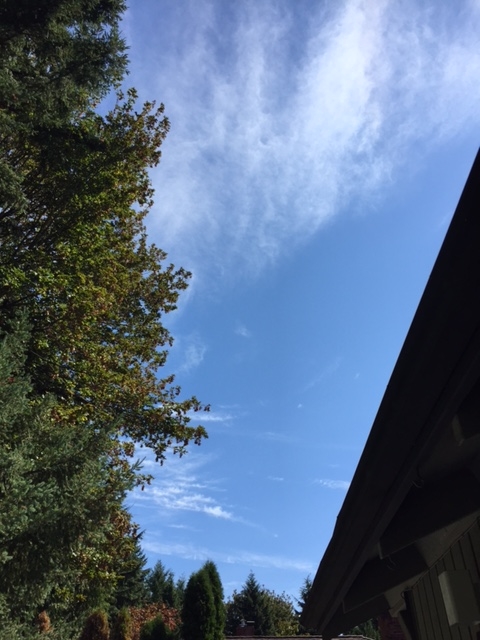
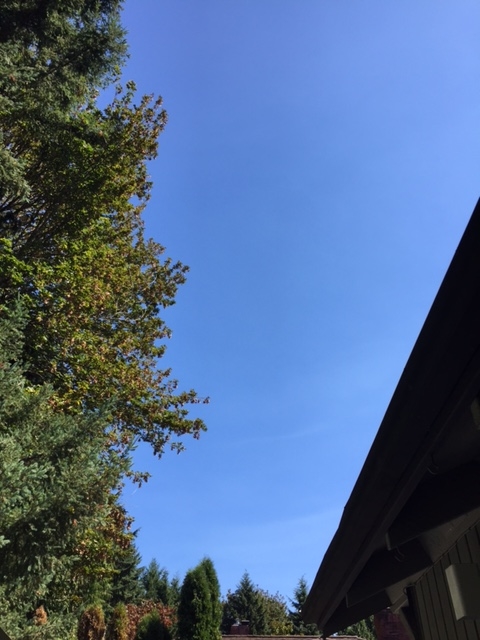
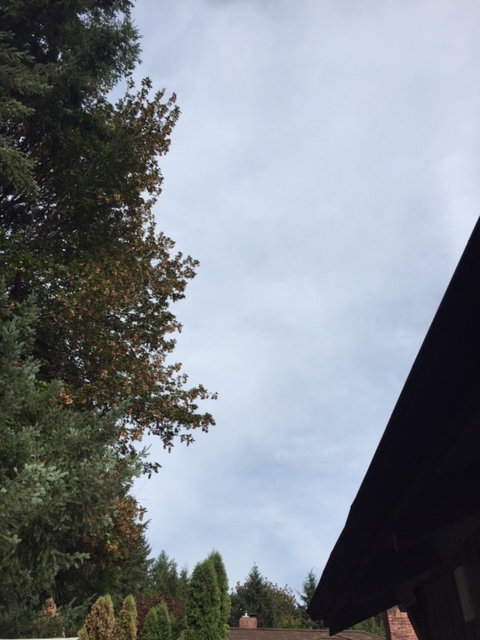
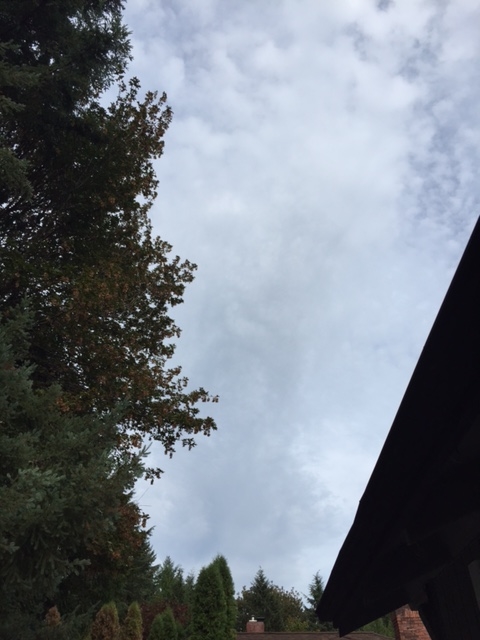
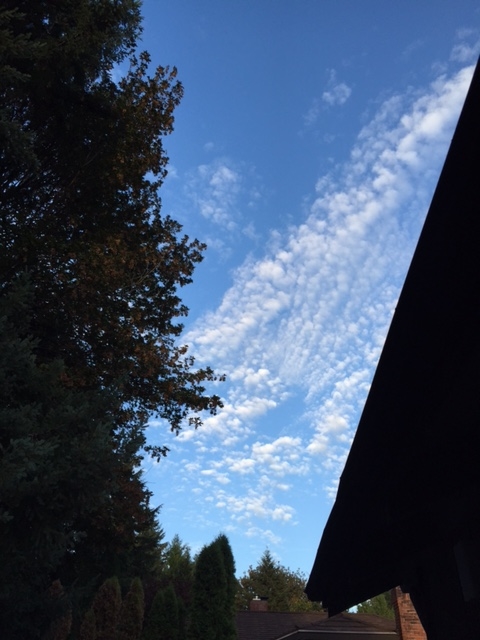
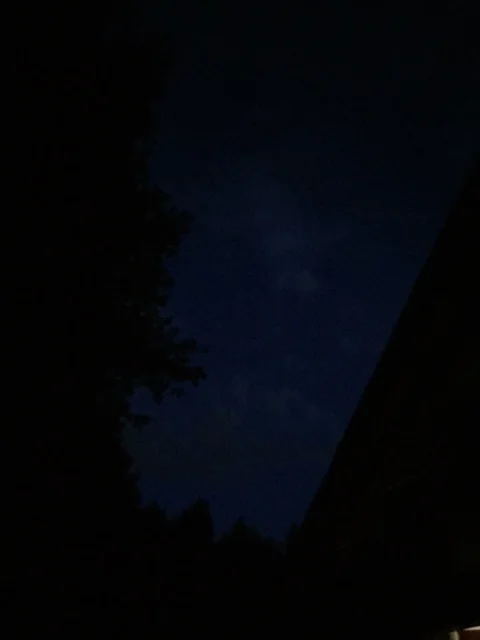
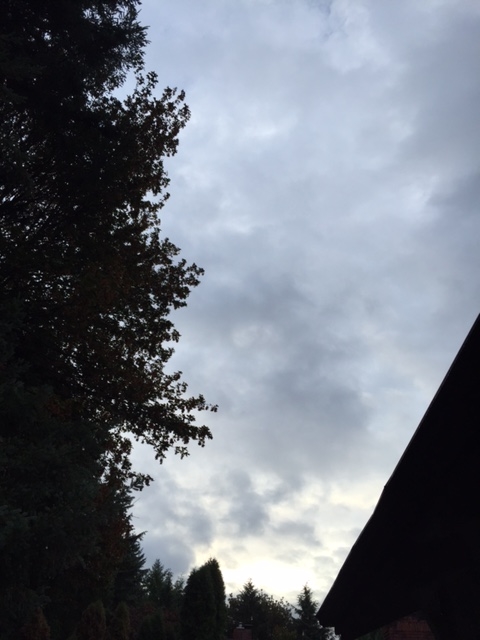
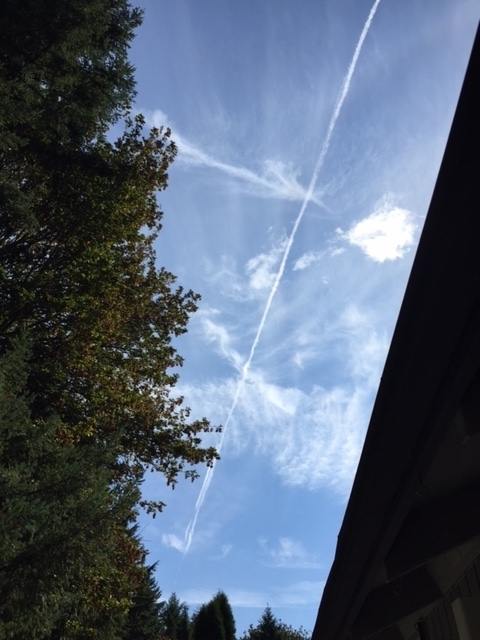
Rain was forecast yesterday (Thursday) for Olympia so I thought I would watch the sky carefully all day long to see if I could track the changing cloud pattern and see the rain coming. Starting at 7:30 a.m., I stepped out on my back porch (mere feet away from my desk where I am writing my cloud book) and snapped a photo every few or so. The slice of sky you see here is not particularly photogenic, but it points to one of the problems of cloud watching--a slice is not as good as the whole pie. But most of us don't have panoramic vistas of the sky (the pie) so I took what I could get here.

I expected to see the clouds move in from the southwest and cover the sky, then gradually lower to the gray blanket of nimbostratus. Well...I witnessed nothing of the sort as you can tell from the gallery here. There were high, wispy cirrus clouds...then a sort of lowering...then blue skies. To my eye, the skies never "looked like rain." The clouds that brought the rain must have moved in after 11 p.m. (I could still see the moon then). Not until I woke in the middle of the night and heard the raindrops did I have proof that the clouds had done their thing. The last photograph shows the sky the morning after the rain.

If you are like me and you watch the clouds sporadically and by the slice--the clouds will always surprise you. It's one of their charms. And it's why meteorologists use radar and why sailors and farmers and airplane pilots have an advantage over urban/sub-urban dwellers in reading the skies.


Comment

Murrelet Expert Addresses Board

August 25, 2015 Maria Mudd Ruth
redblu44-2 resize.jpg

Renowned murrelet researcher, Dr. Martin Raphael will be making a special presentation at the September 1st Board of Natural Resources (BNR) meeting in Olympia.

Raphael is a Research Wildlife Biologist of 26 years with the USDA Forest Service Pacific Northwest Research Station in Olympia and co-author of the Recommendations and Supporting Analysis of Conservation Opportunities for the Marbled Murrelet Long-Term Conservation Strategy. Funded by the Department of Natural Resources (DNR), this important report is more commonly known as the 2008 Science Team Report.

Dr. Raphael will discuss why Washington's state-forest lands are crucial to the survival of the marbled murrelet. There is an unfortunate impression among members of the BNR board that because "only" 11% of Washington's marbled murrelet habitat is managed by the state (DNR) that this habitat is not crucial to the survival of this species in its listed range--a federally threatened species in Washington, Oregon, and California under the Endangered Species Act.

Of the estimated 2,099,900 acres of forested habitat for the marbled murrelet in Washington, the DNR manages 238,900 acres; the federal government 1,446,800 acres (national parks, national forests, etc); and private and tribal entities manage 414,200 acres.

Habitat losses across all land ownerships--primarily from logging and forest fire--are too great to provide the quantity and quality of nesting habitat critical to the marbled murrelet's survival.  In the next few months, the DNR has an opportunity to make a significant contribution to the survival and recovery of this species--and adopting a conservation strategy based on the 2008 Science Team Report would go a long way toward that laudable goal.

The only scientists the BNR board members have heard from during their monthly meetings are employed by the DNR. Dr. Raphael's presentation comes at the behest of the conservation community, which has been urging theDNR staff to adopt a conservation strategy based on the best-available science and to add to the three alternatives strategies under consideration a fourth based on the 2008 Science Team Report.

The DNR has been managing its forested trust lands in accordance with a 1997 Habitat Conservation Plan, a document created when little science was available on the biology and behavior of the elusive, secretive marbled murrelet and its well-hidden nesting sites. The DNR's progress updating this document has been as slow and awkward as an alcid on land.

The conservation community worked hard for Dr. Raphael to be invited to speak to the Board of Natural Resources. Your attendance at the September 1 meeting would be greatly appreciated.  The meeting begins at 9 a.m., Raphael's presentation starts at 9:30 and is schedule to last 30 minutes. Their will be a chair report by DNR's Kyle Blum on the Marbled Murrelet Long-Term Conservation Strategy and Sustainable Harvest Calculation at 11:20.

There is an opportunity for public comment at 11 a.m. If you wish to speak, please arrive by 8:50 to sign in.  If you do not wish to speak, be sure to pick up a marbled murrelet button to wear to show your support. The meeting is held in the Natural Resources Building, 1111 Washington St. SE, Olympia.

You can also submit written comments to the BNR, MS 47000, Olympia, WA 98504-7000 or bnr@dnr.wa.gov

If you cannot make the meeting, Dr. Raphael's presentation can be viewed as a PDF through the BNR's website. Scan down to September 1 "Meeting Materials" and click on "Marbled Murrelet Modeling Presentation."  Everyone will benefit from Dr. Raphael's narrative.

Please note, the BNR will not be presented with or be voting on any strategy alternative at this meeting.  For the most up-to-date information on all things murrelet, please visit the Murrelet Survival Project.

In Endangered Species Tags Marbled Murrelet conservation
Comment
← Newer Posts Older Posts →

Subscribe

Sign up with your email address to receive my blog in your inbox.

Thank you!
Blog RSS

Flying from Mountaineers Books this Spring—the story of the Pigeon Guillemot—the world’s most charismatic alcid. This non-fiction natural history will be on bookshelves and available from online retailers on April 7, 2026. Click a link below to pre-order a copy now from these purveyors:

Mountaineers Books (non-profit, indie publisher based in Seattle)

Browsers Books (Olympia’s indie bookstore)

Bookshop.org (support your local bookstore)

Barnes & Noble (in the book biz since 1971)

Amazon

Other Natural History Titles by Maria Mudd Ruth…

A Sideways Look at Clouds


“Compelling…engaging.” The Library Journal

“Rare insights into the trials and joys of scientific discovery.” Publishers Weekly

Read more reviews and details here: Rare Bird: Pursuing the Mystery of the Marbled Murrelet

Enjoy this song by Peter Horne, "Little Bird, Little Boat, Big Ocean.” Written about the Marbled Murrelet, but the lyrics work well for the Pigeon Guillemot, too.


  • Clouds
  • Natural History
  • Open-water Swimming
  • Lake Swimming
  • Washington Lakes
  • Wild Swimming Washington
  • Pacific Northwest Clouds
  • Books on Clouds
  • Meteorology
  • Wild Swimming
You must select a collection to display.

Subscribe

Sign up with your email address to receive my blog in your inbox.

Thank you!
Blog RSS

©2025 MARIA MUDD RUTH  |  ALL RIGHTS RESERVED