• Home
  • The Bird with the Flaming Red Feet
  • Rare Bird: Marbled Murrelet
  • A Sideways Look at Clouds
  • Author
  • Events
  • Blog
  • Contact
Menu

Maria Mudd Ruth

Street Address
City, State, Zip
Phone Number
author and naturalist
Homepage-Banner.jpg

Maria Mudd Ruth

  • Home
  • Books
    • The Bird with the Flaming Red Feet
    • Rare Bird: Marbled Murrelet
    • A Sideways Look at Clouds
  • Author
  • Events
  • Blog
  • Contact

Science, Math, and Marbled Murrelets

November 5, 2013 Maria Mudd Ruth
We have logged and lost 80-95% of our original old-growth forests in the Pacific Northwest. Will we lose as many murrelets?

We have logged and lost 80-95% of our original old-growth forests in the Pacific Northwest. Will we lose as many murrelets?

I am trying to understand a scientific report on the population trend of the marbled murrelet. The report I am reading is the Marbled Murrelet Effectiveness Monitoring, Northwest Forest Plan: 2011 and 2012 summary report. This is the ungainly title of a 27- page report by the Northwest Forest Plan Interagency Regional Monitoring Program. Within in the confines of this blog, I am going to call this report the "Report" and its author, "Falxa et al." Gary Falxa is the Marbled Murrelet Module Lead and the "et al" are the ten other scientist-authors of this report. 

Though I have shortened its name, I imagine you are not interested in the Report by Falxa et al.  I was told it contains some good news for the marbled murrelet--that population numbers for 2011 and 2012 showed a slight increase. I would like to stop telling people that the murrelet populations in California, Oregon, and Washington have declined 29% between 2001 and 2010 (which, in fact, they did) and that the trend is continuing downward. But I have a problem: the meat of the Report by Falxa et al goes like this (ellipses indicate where parenthetical citations and references to tables occur):

"Population demographic models predicted population declines of 3 to 7 percent per year for the listed range, which includes Zone 6...Miller et al. (2012) reported a statistically significant decline of 3.7 percent per year for the combined population of Conservation Zones 1 through 5 for the 2001-2010 period. For the new analysis based on 2001-2012 data, no trend was detected at the 5 percent leve... While the trend line slope for this period is slightly negative...the 95 percent confidence interval for the trend slope includes zero... which also indicates no statistically significant trend. The reason for finding no significant trend through 2012, when Miller et al (2012) found a declining trend through 2010, is the increased estimate of murrelet abundance for both 2011 and 2012. In 2011, estimates of murrelet population size increased in all conservation zones except Zone 2, compared to estimates from recent years. In 2012, population estimates remained higher in some zones, most notably Stratum 1 of Zone 1 (Strait of Juan de Fuca, Washington), and the 2012 population estimate for all conservation zones combined (Washington south to San Francisco Bay) also remained above that of recent years, in large part an effect of the increase in Zone 1...."

"The sampling error associated with population estimates for such a mobile and patchily distributed species could have contributed to the increased estimates, as could other factors. Results of murrelet population monitoring in 2013 and beyond will help further clarify populations status and trend, as will explorations underway."
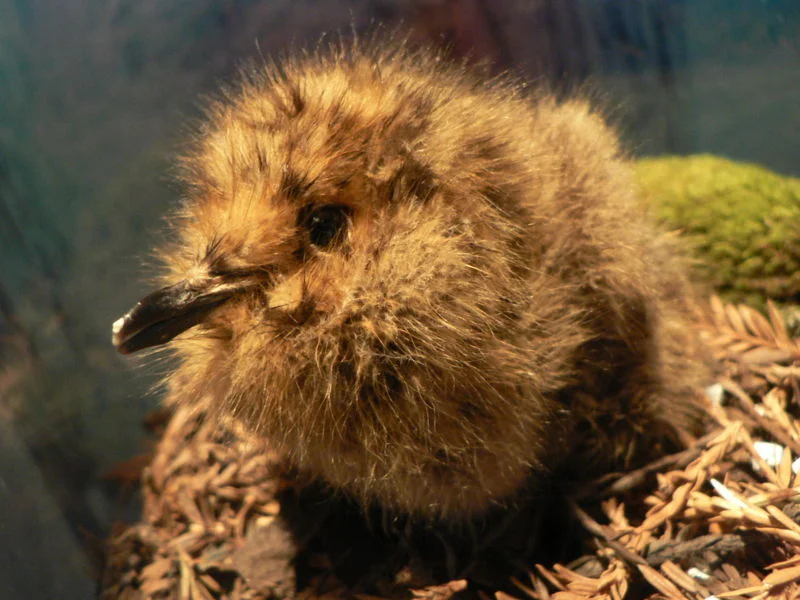
I am including this photo of a murrelet chick for the sole purpose of keeping your attention.  

I am including this photo of a murrelet chick for the sole purpose of keeping your attention.  

I thought by typing out the meaty paragraph above while reading it aloud to myself would increase my comprehension and have me rushing off to the store for a bottle of celebrator champagne. It did not.

I was frustrated and, after multiple readings, set the report aside and picked up the latest issue of Orion magazine. I  quickly flipped to Derrick Jensen's "Upping the Stakes" column which, I think Jensen may have written after reading the Report by Falxa et al. It's about simple math and our planet-destroying unwillingness to embrace it. Here is some of what he writes: 

"I know if there are 6 billion passenger pigeons and you subtract 1 billion, and then another billion, and keep subtracting them fast than the can add to their own population, then eventually there will be none. I know if there are uncountable salmon and you reduce their numbers to where you can count them, and they you keep subtracting, eventually there will be none....I know the same is true for native forests reduced from 100 percent to 2 percent, and for native grasslands and wetlands reduced to the same extent. 

"I also know that if you take the number 315 (as in parts per million) and keeping adding to it, eventually you will get to 350. And if you keep adding to that, you'll bet to 400. And if you keep adding to that you'll get some approximation of hell."

Global-Warming.jpg

"I don't understand why so many of us don't seem capable of subtracting and adding. Oh, sure, I understand that people come up with lots of rationalizations for avoiding simple math and they come up with lots of fancy names and algorithms to attempt to convince themselves that 100 minus 90 doesn't equal 10, or that 315 plus 85 doesn't equal 400, but whether you call it "managing forests," "generating hydroelectric power," "developing natural resources," "sustainable development," or any of a thousand other names, the subtraction and the addition continue." 

It would be folly, given what we've done to our forests and oceans in the past few hundred years to think that the marbled murrelet was on the road to recovery. The scientists themselves cannot quite explain the murrelets'  2011 and 2012 population bump (and a "bump" is what some are calling it). The trend analysis at the end of the Report is full of questions. Were the population estimates the result of sampling error? Has the distribution (not the population) of the birds changed? Did functions of the model change between years? Did survey effort vary? Were more murrelets on the water in 2011 and 2012 because they were not in the forest on nests?

Nowhere is this question: Are we finally managing our forests to improve breeding success of marbled murrelets? Have our paltry restrictions on gillnetting somehow saved enough  murrelets to increase the population? Have our aquatic reserves and shoreline management plans actually worked to protect the fish murrelet eat? Have more and more chicks successfully fledged because our spotty predator-control measures are paying off? 

Let's not fool ourselves. Let's not pat ourselves on the back for an enigmatic "bump. " We have reduced our original old-growth coastal forests by 80 to 95% in the Pacific Northwest. Scientists who documented the 29% decline in murrelet populations between 2001 and 2010 noted that "[t]hese declines coincide with the reductions in the amount of nesting habitat." So...are we not looking at a corresponding and eventual 80-95% reduction in murrelets? Unfortunately, we cannot know how many murrelets there were "originally," so the question becomes 80 to 95 % of what?  

Given that we are logging and losing more murrelet nesting habitat every year--and failing spectacularly at growing any new forests for future murrelets...well, it's simple math and, sadly, we seem all too willing to accept zero as the answer. But the sooner we embrace the possibility of zero, the sooner we can begin changing the equation.

Tags old-growth forests, derrick jensen, marbled murrelet population, Gary Falxa et al
Comment

Wild Thyme Farm & The River of Words

November 2, 2013 Maria Mudd Ruth
IMG_7546.JPG

This is Wild Thyme Farm in Oakville, Washington, where I spent two beautiful days last week presenting a workshop on writing and nature to teachers and students in the Chehalis River Basin. On this well-kept and thoughtfully managed farm, it was tempting to just let nature speak for itself, to let the stories flow directly from the woods and ponds and trees and vistas.

IMG_7553.JPG
IMG_7541.JPG
IMG_7564.JPG

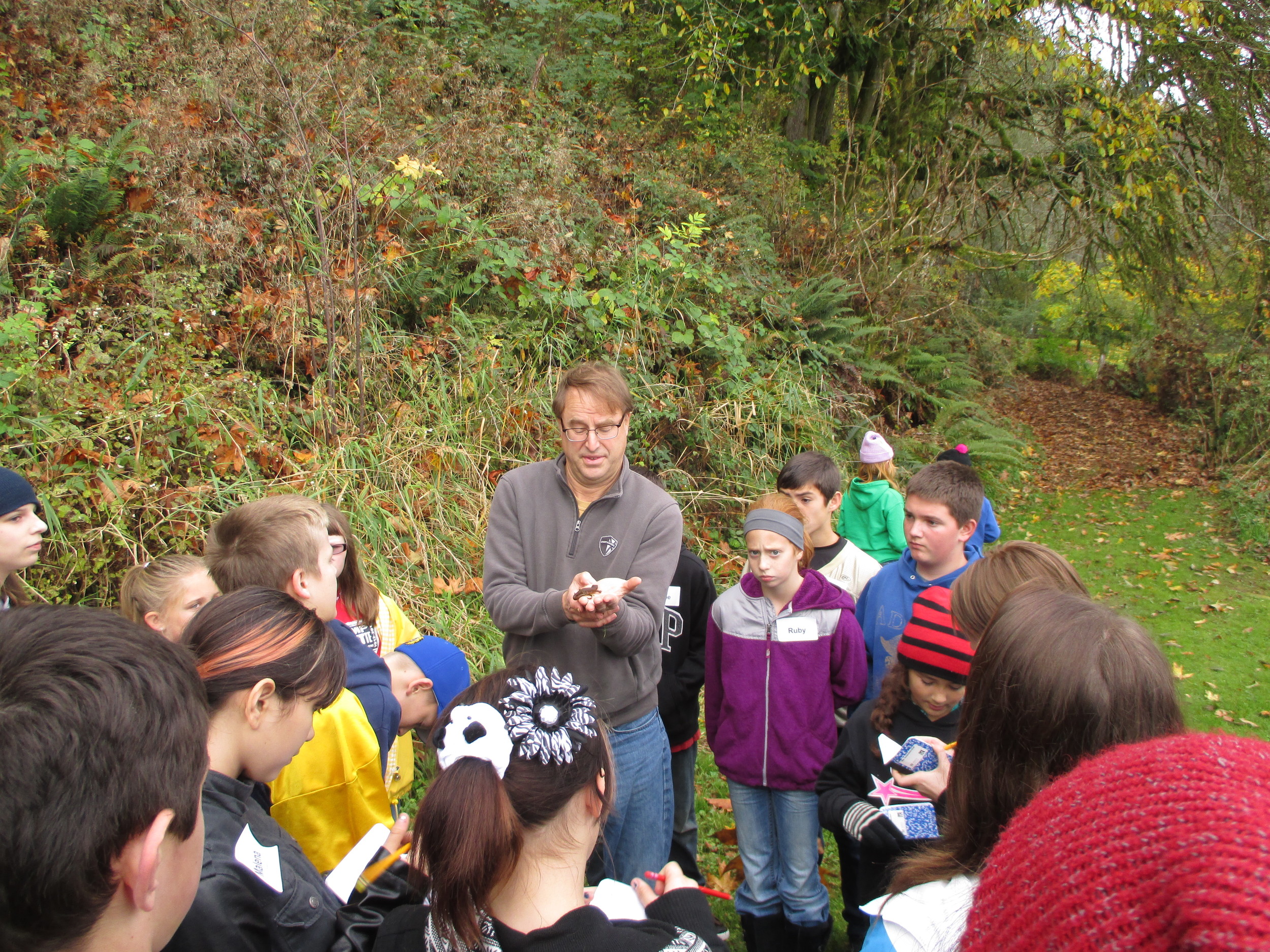
Which it did all day long. Which it did while farm owner John Erikson (above) took us on a tour of Wild Thyme which he and his two brothers have managed and restored  with an eye to optimizing--not maximizing--productivity of the land. What this farm produces is food, timber, habitat, open space, eco-tourism, watershed protection, community, connectivity, and inspiration for visitors. The students here listened intently as John talked about permaculture, sustainability, eco-tourism, and forest management, and the rough-skinned newt he held in his hands.

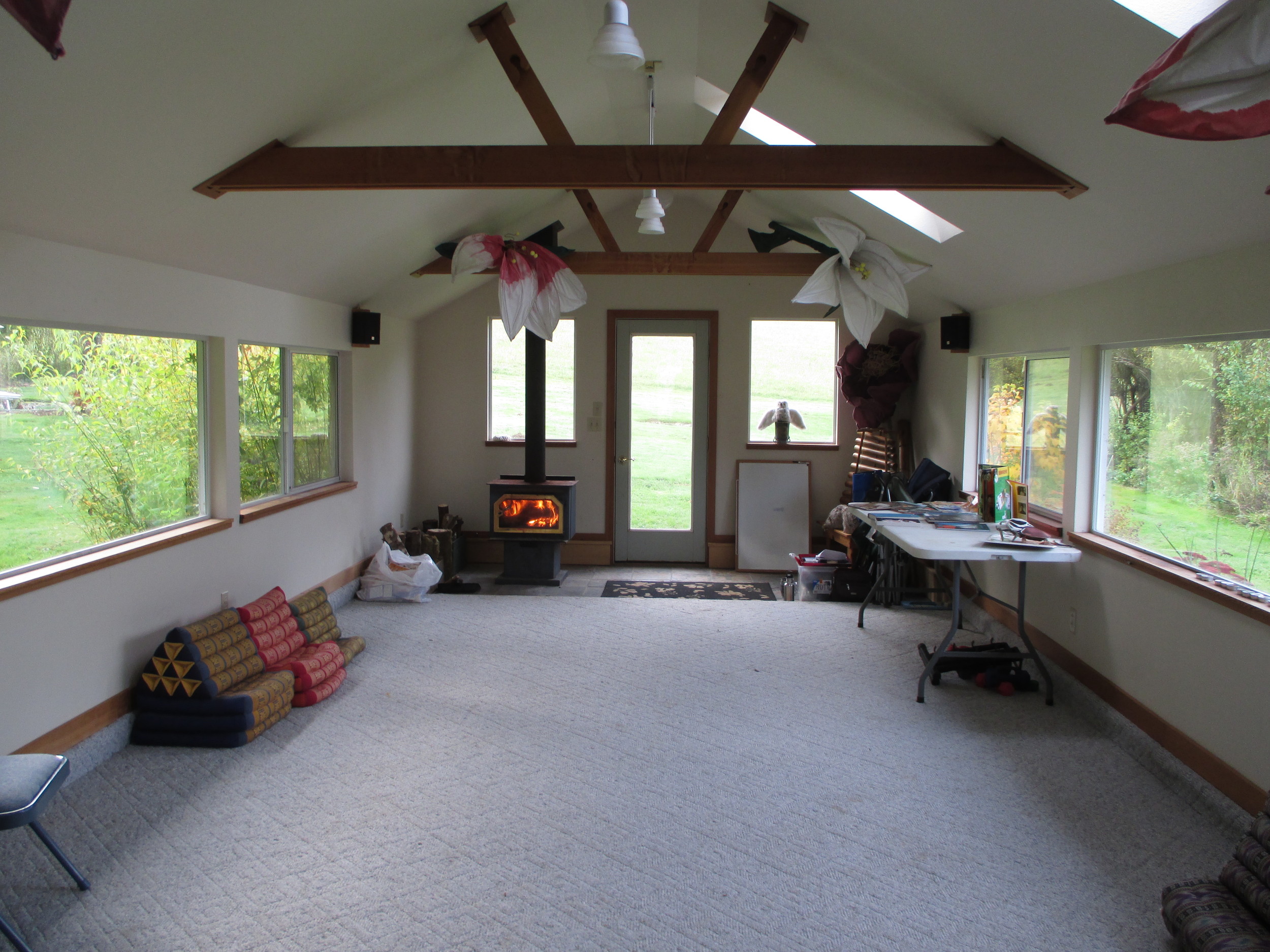
 After our walk, I retreated to this cozy former chicken-coop (below) to offer some ideas on writing about nature to teachers and students. The goal, though not the sole purpose of my workshop, was to encourage the students from schools within the Chehalis River Basin to participate in the River of Words International Poetry and Art Competition. 

IMG_7554.JPG

One of my favorite ways to engage people in the natural world is to get them to slow down and focus. I have two simple tools that seem to work 99.9% of the time to accomplish this. Getting students to focus on something small, something they can fully describe, something that will not overwhelm them requires an old-fashioned 35-mm slide mount.  

IMG_7568.JPG

If you are of the pre-digital-camera era, you will no doubt have a store of these in a spare-bedroom closet or in a shoebox in your attic. I have plenty to go around and am delighted to hand them out to kids who seem eager to use them to find some one thing to look at. For five minutes.

 Five whole minutes. And for that major challenge, I use a timer. Any stopwatch or timer will do.

IMG_7735.JPG

And then you lead your future poet laureates out to sit or perch in a tree or nest to a pond and, when they have found their small thing to focus on and have stopped wiggling, you set the timer and start. And then forever begins. The students have been told to look at their one thing, to think about that thing, to think about how they feel being still and staring, to think about what is happening to them and to the object of their attention over the five minutes. When the timer beeps, everyone gathers to talk about what  happened.  

I have been using this technique successfully for a few years but am always amazed at how well it works. The stories pour forth.

IMG_7569.JPG

One student took the assignment quite literally and had wedged a hazelnut that had fallen on the ground into his slide mount. As he contemplated this small scene for five minutes, the student said he starting thinking about the cycle of the nut: on the ground it would take root, produce a shoot, then a tree that would eventually be large enough to bear nuts which would then fall to the ground to begin the cycle again.  

Another student had started by focusing on a spider crawling on the bark of a tree. She looked away for just a few second, she said, and the spider wasn't within the frame of the slidemount. "I didn't realize how fast spiders could move," she said. 

Several students noticed how, when they were still and focused, they noticed how everything was moving.

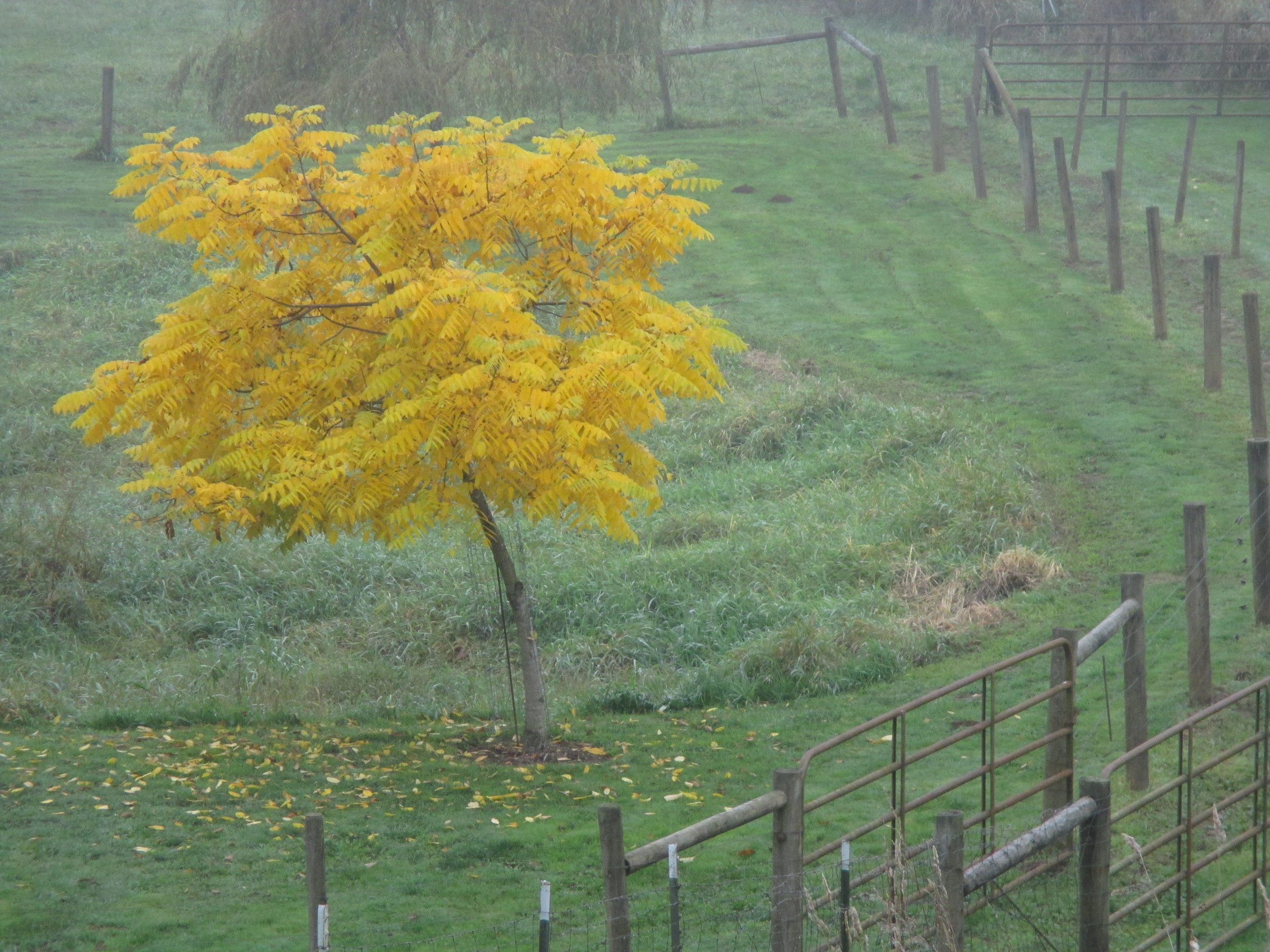
One teacher had focused on a beautiful walnut tree (below) whose top few leaves were waving in the gentle breeze. During the five minutes, she said, her eyes would wander but the waving golden leaves would draw her back. Like grandparents, she said. Like grandparents who are so beautiful, aware that they are in the autumn of their lives, and have so much to offer--if only they could get our attention. There they stand--waiting, offering, waving.

IMG_7545.JPG

Follow these links to Wild Thyme Farm and to the River of Words.  

Tags Wild Thyme Farm, River of Words, Chehalis River Basin
Comment

Cozy Spot for the Marbled Murrelet

October 15, 2013 Maria Mudd Ruth
Before.... 

Before.... 

After

After

I've passed by this charming neighborhood book exchange--the Little Free Library--for several weeks. I just loved looking at it from across the street on the sidewalk where I usually walk. But today, with a copy of Rare Bird in one coat pocket, my camera in the other pocket, I crossed the street and tucked a copy of my book in with the other paperbacks there for passersby to share and swap.

Spine-side out, Rare Bird did not make much of an impression in my photograph, so I plucked it out and turned it cover-side out. I was moving around to make sure I wasn't in the reflection in the glass and....busted...."are you dropping off a book?" a woman asked from behind me. 

 "I, uh, yes, well, umm. I live in the neighborhood and I thought it would be fun to add a copy of my book to the library here."  I was a bit embarrassed, but she was dropping off books, too (JRR Tolkein and CS Lewis, I believe) and we ended up talking about the marbled murrelet, the Little Library, the Good Shepherd Church group that built and installed the charming literary outpost, and the clouds.

Which were lovely, white, wind-swept cirrocumulus puffs. Which is really why I went for a walk this afternoon.

I left as she was adding her books to the collection. I hope she took Rare Bird home with her, loves it, and brings it back to the Little Free Library some day. 

Tags Rare Bird
Comment

The Shape of Beginnings & Endings

October 12, 2013 Maria Mudd Ruth
The monkfish, or goosefish, lays this billowing veil containing 1 million pinhead-size eggs. Such veils drift in the ocean for days and can reach 60 feet in length. Credit: New England Aquarium via LiveScience.com

The monkfish, or goosefish, lays this billowing veil containing 1 million pinhead-size eggs. Such veils drift in the ocean for days and can reach 60 feet in length. Credit: New England Aquarium via LiveScience.com

This LIDAR (Laser Interferometry Detection and Ranging) image shows the historic channels and meanderings of a section of the Willamette River in Oregon.  Credit:  Dan Coe/ Oregon Department of Geology and Mineral Industries. Order a …

This LIDAR (Laser Interferometry Detection and Ranging) image shows the historic channels and meanderings of a section of the Willamette River in Oregon.  Credit:  Dan Coe/ Oregon Department of Geology and Mineral Industries. Order a poster version here.


Filamentous remnant of an explosion of the Vela Supernova 10,000-12,000 years ago. Credit: Earth Science Picture of the Day 

Filamentous remnant of an explosion of the Vela Supernova 10,000-12,000 years ago. Credit: Earth Science Picture of the Day 

These three images appeared to me electronically within the span of twenty-four hours--one on someone else's SmartPhone and two in my e-mail inbox.

I have written several sentences in this space, but have deleted all but this one.

Comment
← Newer Posts Older Posts →

Subscribe

Sign up with your email address to receive my blog in your inbox.

Thank you!
Blog RSS

Flying from Mountaineers Books this Spring—the story of the Pigeon Guillemot—the world’s most charismatic alcid. This non-fiction natural history will be on bookshelves and available from online retailers on April 7, 2026. Click a link below to pre-order a copy now from these purveyors:

Mountaineers Books (non-profit, indie publisher based in Seattle)

Browsers Books (Olympia’s indie bookstore)

Bookshop.org (support your local bookstore)

Barnes & Noble (in the book biz since 1971)

Amazon

Other Natural History Titles by Maria Mudd Ruth…

A Sideways Look at Clouds


“Compelling…engaging.” The Library Journal

“Rare insights into the trials and joys of scientific discovery.” Publishers Weekly

Read more reviews and details here: Rare Bird: Pursuing the Mystery of the Marbled Murrelet

Enjoy this song by Peter Horne, "Little Bird, Little Boat, Big Ocean.” Written about the Marbled Murrelet, but the lyrics work well for the Pigeon Guillemot, too.


  • Clouds
  • Natural History
  • Open-water Swimming
  • Lake Swimming
  • Washington Lakes
  • Wild Swimming Washington
  • Pacific Northwest Clouds
  • Books on Clouds
  • Meteorology
  • Wild Swimming
You must select a collection to display.

Subscribe

Sign up with your email address to receive my blog in your inbox.

Thank you!
Blog RSS

©2026 MARIA MUDD RUTH  |  ALL RIGHTS RESERVED