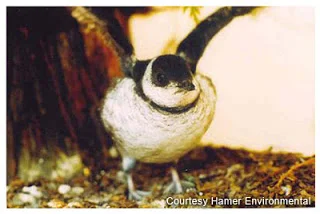
The Washington State Department of Natural Resources (DNR) has a tough job--likely the toughest when it comes to managing its forested Trust Lands. In 1889, when Congress granted these lands to the state as it entered the union, few people had ever heard of the Marbled Murrelet (above).
The endangered Marbled Murrelet nests in the mature and old-growth coastal forests along the Pacific Coast; millions of acres of this forest falls in Washington State, much of it on DNR-managed Trust Lands. The Marbled Murrelet needs these forests, specifically the wide nesting platforms near the tops of the forests's largest trees, to lay its egg, raise its chick (above), and maintain its population. This means the DNR is responsible for conserving this habitat to protect a species (Brachyramphus marmoratus).
The citizenry of Washington State also need these forests, specifically, the revenue generated from the sale of timber, which helps fund the construction of schools and universities and local services (public safety, libraries, roads, parks, fire districts, for example). This means the DNR is responsible for destroying (logging) this habitat to protect another species (Homo sapiens).
We bemoan cuts to school funding, reduced library hours and services, seasonal park closures, and the loss of other services we deem important to a healthy, well-educated, and safe population.
For Washingtonians, cutting services is inconvenient at best, shameful, dangerous, and immoral at worst. For the Marbeld Murrelet, cuts trees is life threatening.
The population of marbled murrelets is crashing. The most recent scientific report
(Falxa et al, 2011) shows a decline of nearly 30% in Washington between 2001 and 2010. Though there are many causes for the murrelet's decline, the loss of nesting habitat remains is the greatest cause. And by loss I mean logging--the cutting down of documented nesting trees, potential nesting trees, stands of trees classified as potential nesting habitat, and the protective buffers of younger trees around them.
This is happening not only in Washington State but also in California, Oregon, British Columbia and Alaska where the murrelets nest. Unfortunately, this kind of logging is legal despite the fact that the bird is protected at state, provincial, and federal levels to prevent its extinction.
Since 1997, the DNR has had a Habitat Conservation Plan (HCP) in effect on its forested Trust Lands for the murrelet in Western Washington. And, for 16 years, they have been operating under an interim conservation plan for the murrelet--a plan based on the "best available" science at the time. The plan is clearly not working for the murrelet. The plan is being amended, finally.
This week, the DNR is holding a series of public-input meetings to help define the scope of the Long-Term Conservation Strategy for the Marbled Murrelet.
Public meetings will be held at the following locations and dates:
June 05, 2013 – Olympia
June 10, 2013 – Sedro Woolley
June 12, 2013 – Forks
June 19, 2013 – South Bend
Now is the time to out on behalf of the shy, silent, and imperiled Marbled Murrelet. Now is the time to use our collective power to find alternative ways to fund our public services.
The Marbled Murrelet cannot find alternative places to nest. It depends on old-growth forests and cannot--as many might want to believe--adapt to nesting in smaller trees or on the ground (as a very few number of birds do in Alaska).
The DNR is not deciding whether or not to log. They are deciding how to log.
Unfortunately, the DNR is taking some dangerous short cuts to create its long-term strategy. They are, I believe, not using the best available science to guide them. A 2013 report* by the Washington Department of Fish and Wildlife shows that on certain Trust Lands, DNR did not follow the official Pacific Seabird Group survey protocol, they assessed murrelet habitat incorrectly, and delineated that habitat inaccurately on their maps.
This is shameful, irresponsible, and--dare I say?--immoral. The DNR needs to take the time to acquire the best scientific data and heed its conclusions if its Long-Term Conservation strategy is to be truly long term for the Marbled Murrelet.
*Desimone, S. M., J. L. Anthony, and E. B. Cummins. 2013.
An Evaluation of Marbled Murrelet Habitat Prediction and Survey Implementation in the Washington Department of Natural Resources Straits Planning Unit. Technical Assessment Report, Washington Department of Fish and Wildlife, Olympia, WA.
For more information on the DNR and the Marbled Murrelet:
http://www.dnr.wa.gov/ResearchScience/Topics/SEPANonProject/Pages/amp_sepa_nonpro_mm.aspx