Heading north from Olympia Friday morning, I almost made a U-turn under these beautiful cloudy skies when I so much more gray than white. Maybe clouds really weren't actually white after all and I'd be off the hook for the final ta-dah installment of this long-running blog topic. But I kept driving.
I was off to see the wizards, the wonderful wizards in the University of Washington's Atmospheric Sciences Department in Seattle who were willing to help answer my question about clouds.
The man behind the curtain this morning was a graduate student (below) who knew the atmospheric science side of clouds as well as the physics side. Though one graduate student had already provided me with a perfectly excellent "classical physics" explanation of why clouds are white, I had been flirting with the ideas presented in another style of physics called quantum electrodynamics, or QED.
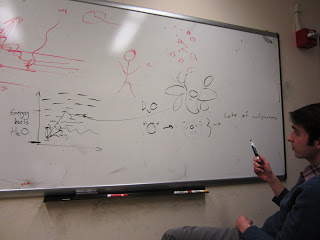 |
| What better way to discuss the whiteness of clouds than with a whiteboard and a brilliant grad student! |
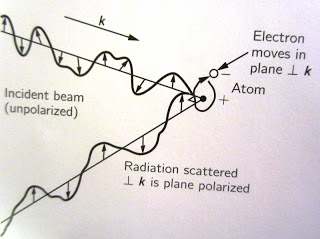
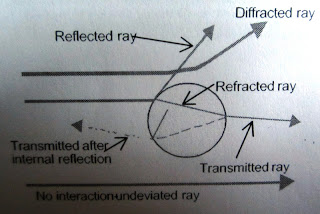
The classical physics explanation--and the one you read pretty much everywhere--tells us that clouds are white because they scatter all the visible wavelengths present in sunlight equally. When white light reaches a cloud, a cloud droplet may separate into its component colors (red, orange, yellow, green, blue, indigo, violet) but another cloud droplet will recombine the colors or refract (bend) them in a slightly different direction. This happens over and over and over within the cloud so that the net result is white. None of the wavelengths is favored so the light retains its original color--white--when it reaches our eyes.
To understand the QED explanation, let's start with a blue sky. Outside the cloud, in the clear atmosphere, the nitrogen in the air does something different that water does to light. Nitrogen is preferential; it scatters the blue wavelengths more efficiently and therefore our skies are blue. That is because the electrons in a molecule of nitrogen (two atoms of nitrogen) match the energy level of certain short wavelengths (the ones that appear blue to us).
This makes sense to me (it is true as far as I know) but for some reason, I needed to find out what, to a photon, was the difference between a molecule of nitrogen and a molecule of water. Why does light behave differently?
Within a cloud we have cloud droplets of all different sizes (10-100 microns) and air (nitrogen, oxygen, and other molecules) in between them. Within the cloud droplets are many very active water molecules, which are oscillating, rotating, vibrating, and zinging around. Within the molecules, we have electrons occupying a cloud-shaped spaces around the centers (nuclei) of the hydrogen and oxygen atoms in the molecule. The electrons do not "sit" in a fixed position the way planets do in their orbits around sun. Au contraire! Scientists can only offer probabilities of where they might within the atom at any given time. Trying to pin down the location of an electron is like trying to pin down the location of an ocean wave.To understand the QED explanation, let's start with a blue sky. Outside the cloud, in the clear atmosphere, the nitrogen in the air does something different that water does to light. Nitrogen is preferential; it scatters the blue wavelengths more efficiently and therefore our skies are blue. That is because the electrons in a molecule of nitrogen (two atoms of nitrogen) match the energy level of certain short wavelengths (the ones that appear blue to us).
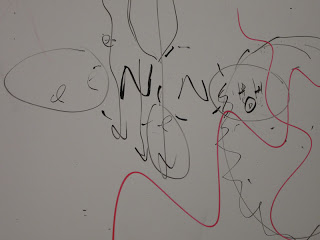 |
This is why the sky is blue. N stands for nitrogen. The rest is kind of self-explanatory.
|
These electrons absorb the energy of the photons in this wavelength and re-emit it as blue. This particular dance of light and matter, danced on the stage of our atmosphere, turns the sky blue.
 |
| Ignore the Bald Eagle. Just look at all this nitrogen! |
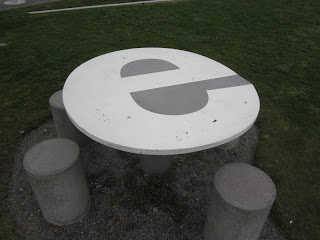 |
| This letter 'e,' symbol of the electron. Unlike actual electrons, this e is visible, super-sized, cemented into one position, and I know exactly where it is at all times: The Olympic Sculpture Park in Seattle. |
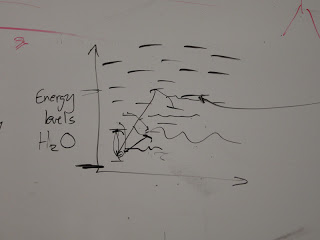 |
Water molecules--H20--contain electrons that exist at certain energy levels. This graph shows the different levels. The Y axis shows the energy levels, and the X axis something I wasn't allowed to know about yet.
|
When pure white sunlight reaches the cloud, the different wavelengths of visible light start the dance. They might dance with the nitrogen or oxygen molecules between the cloud droplets or enter a droplet itself. The photons do not "bounce" off the outside of the droplet.
At this point, it is easier to treat the light as particles/photons instead of as waves.
Within the cloud droplet, the photons might encounter the electron or it might not. No one knows for sure. And why not? There is much empty space inside an atom and no one can actually see electrons and photons or the dance they are doing at the speed of light--186,282 some miles per second.
If a photon of a certain energy level encounters an electron, and the electron has an available energy level that is the same as the photon, the electron will absorb the photon, "jump" to a higher energy level, then fall back to its ground state or even a lower energy state. As it falls back, it releases energy. That energy is re-emitted in the form of a photon. If that photon is a yellow wavelength photon, yellow light will be emitted. If the photon is a green wavelength photon, green light.
No one can predict what any one photon will do. This, as it turns out, really doesn't matter. What matters is that when wavelengths in visible light that encounters certain-sized water droplets will be absorbed and re-emitted multiple times before it reaches our eyes. While a certain wavelength photon might be absorbed and re-emitted more than another for a very short while, overall, no particular wavelength is absorbed and re-emitted more than another. A white cloud one way our eyes see the result of a bazillion encounters of light and water.
 |
| Gray is the new white. |
It is, unfortunately, more complicated than this, but I am losing sight of the clouds themselves as I explore the mysteries of their subatomic life. Seeing clouds through quantum electrodynamics is like listening to Bach's Cello Suites through the individual hairs on the cello bow. Each hair is important, and its particular role fascinating, and it's all so beautiful really but, at this micro level, I am unable to hear the music.