• Home
  • The Bird with the Flaming Red Feet
  • Rare Bird: Marbled Murrelet
  • A Sideways Look at Clouds
  • Author
  • Events
  • Blog
  • Contact
Menu

Maria Mudd Ruth

Street Address
City, State, Zip
Phone Number
author and naturalist
Homepage-Banner.jpg

Maria Mudd Ruth

  • Home
  • Books
    • The Bird with the Flaming Red Feet
    • Rare Bird: Marbled Murrelet
    • A Sideways Look at Clouds
  • Author
  • Events
  • Blog
  • Contact

How I Stopped Worrying and Learned to Love the Plunge

March 9, 2019 Maria Mudd Ruth
Looking warmish, but not exactly relaxed, after a90-minute summertime swim around and across cool Josephine Lake on Anderson Island, WA.

Looking warmish, but not exactly relaxed, after a90-minute summertime swim around and across cool Josephine Lake on Anderson Island, WA.

“Wild swimming” and “open-water swimming” both take place in lakes, ponds, rivers, bays, and oceans, with “cold-water swimming.” Cold-water swimming takes places in natural bodies of water, too, but it is accompanied by xtreme bravado and/or a wetsuit, yelping and/or cold-water acclimatization training, and the risk of both hypothermia and euphoria. At least this is what I thought.

This winter, I have read Lynne Cox’s Swimming to Antarctica(not a metaphorical title). I’ve watched many videos of crazy-happy people dipping into icy lakes in Speedos and wool hats. I stood idly and warmly by while 300 people jumped off a dock and into a lake during the New Year’s Day 2019 Polar Bear Plunge. The water as 40°F that day. No one really “swam,” but they were immersed in that water for at least 30 seconds, which counts for a lot in my book. The Polar Bear Plungers looked ecstatic as they waded back to shore—either because they were glad to be done or because they had quickly reaped the benefits of a dip in cold water: adrenaline rush, exhilaration from increased endorphin levels, and reduced cortisone levels. Or they knew that they would later benefit from increased mental fortitude and clarity, boosted immune system, supercharged metabolism, reduced inflammation, less pain from rheumatism, fibromyalgia, and asthma. What’s not to like about cold-water swimming? 

Just some of the 300 swimmers who joined the New Year’s Day 2019 Polar Bear Plunge in the extremely-cold-by-any-standard Long Lake, in Lacey, Washington.

Just some of the 300 swimmers who joined the New Year’s Day 2019 Polar Bear Plunge in the extremely-cold-by-any-standard Long Lake, in Lacey, Washington.

You have to get into cold water.

Really cold water.

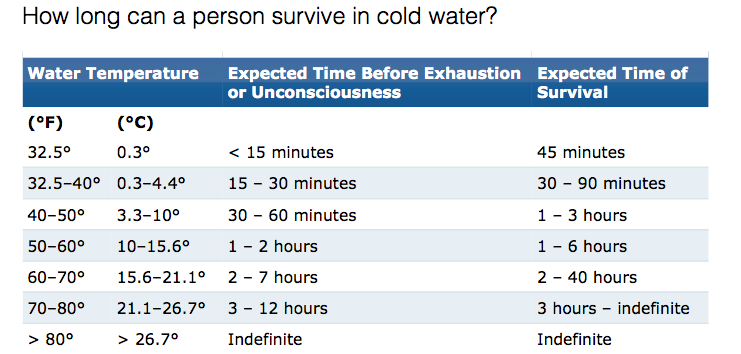
But how cold is “cold” water I wondered. “Cold” is very subjective, it turns out. Some people consider water below 70°F “cold.”  Others use a standard of 64.4°F to define “cold”—or really “too cold.” This is the temperature at which hypothermia is believed to set in for those people not acclimatized to this temperature and who are suddenly immersed in such chilly water, typically when cast overboard from a boat. Some rare swimmers are acclimatized and habituated to swimming as low as 45°F and do not become hypothermic. Is 45°F “cold” or “too cold” for them?

Cold? Cool? Bracing? Refreshing? Too Cold? It’s up to you to decide.

Cold? Cool? Bracing? Refreshing? Too Cold? It’s up to you to decide.

Because I am planning to write about the natural and human history of several lakes in Washington, I wanted to be prepared for swimming in them when I did my “field work.” I figured I would have to work hard to join the ranks of the elite open-water wild swimmers who frolick in those 45°F waters year-round. I was dreading it. I worried about not only becoming hypothermic but also about just being plain uncomfortable. But wait! 

I swim in cold water! I’ve swum in the Tenino Quarry Pool for crying out loud! The water temperature is between 50 and 55°F. In 2018, I swam from April to October in lakes and rivers around western Washington. I doubt any of them were over 65°F. Only once did I feel the water was too cold and that my safety was at risk. I returned to shore as quickly as my sluggish body would let me.

The perception of cold is influenced by many factors: Air temperature as well an individual’s acclimatization and habituation to cold water, physical condition, body size and build, body mass index, attitude, alcohol level, psychological makeup, swimming ability, can affect an individual’s response to the water. The importance of knowing how cold is too cold for yourelates to yoursafety, which is really about and how far and how quickly yourbody temperature drops and you become hypothermic. The temperature of the water and how long you are in the water must both be factored in. A 2-minute dip into 50°F water is one thing, but a 20-minute swim is another. 

On the excellent LoneSwimmer blog, I found references to a smart and flexible guide for clarifying “cold.” Using the “Combined 100” method for ranking “cold.” If the combined temperature and water temperature (in Farenheit) is less than 100. For example, when the water temperature is 60°F and the air temperature is less than 40°F, it’s cold. But on a 70°F day, 60 is merely “cool.”

Now that I have convinced myself (sort of) that I am not a wimpy swimmer or an Xtreme cold-water swimmer, I can stop worrying about the semantics and look forward to a long season of wild, open-water swimming in water that may or may not seem to be cold. I have to remember to carry a thermometer to test the water and air temperature before I enter a lake. And I have to pay close attention to how my own watery body responds to being in the water. Relaxing into a nice long swim is a valid response. So is yelping, swearing, and thrashing, and shivering yourself warm. 

 Meanwhile…while you are learning what “cold” means for you, please look at this helpful chart and info on hypothermia from the Minnesota Sea Grant program’s website:  
Screen Shot 2019-03-08 at 5.14.07 PM.png

Write here… 

Screen Shot 2019-03-09 at 8.59.55 AM.png
In Lake Swimming, Maria Mudd Ruth, Washington Lakes Tags Wild Swimming, Open-water Swimming, Cold-water swimming, How cold is cold water?, Long Lake, Lake Swimming in Washington, Thurston County Parks, Lakes in Thurston County, Hypothermia, Lone Swimmer, Minnesota Sea Grant

The Problems with Clean Energy

January 16, 2019 Maria Mudd Ruth
But it looks so clean!

But it looks so clean!

Washington Governor Jay Inslee says tackling climate change is our state’s “hour to shine,” but we should be under no illusions about new forms of so-called “clean energy,” especially from wind turbines.

But they look so clean! There they are, dotting the ridge lines across the landscape, turning their blades in the fresh breeze, harkening back to old-fashioned Dutch windmills or a brightly colored pinwheel toy from our childhood. What’s not to like? Much.

I have just finished writing a set of public comments critical of the Skookumchuck Wind Energy Project—a 38 wind-turbine facility proposed to be built in Lewis County (south of Olympia, east of Centralia). Why do I get to criticize this project? Because the Lewis County Community Development Department determined the project will have a significant adverse impact on the environment. How ironic! Under state laws, this determination triggers an environmental review, In this case, the “environment” encompasses the habitat of several species of wildlife listed by the state or federal government as threatened, endangered, or in need of special protection and so these species are expected to be adversely impacted by the project. “Adverse impacts” generally means the species are at risk of being directly or indirectly killed or harmed by the project.

And by “project” we are talking about not only the 38 wind turbines (each 500 feet tall) but also the 120 towers and 17 miles of transmission lines that carry the energy produced by the turbines to Puget Sound Energy’s substation where it is fed into the grid. The towers will look something like this:

An estimated 17 miles of energy generator transmission tie lines (“gen-tie lines”) and and 120 towers are included in the Skookumchuck Wind Energy Project.. Photo by Stefan Andrej Shambora (St_A_Sh), CC BY 2.0, https://commons.wikimedia.org/w/index.…

An estimated 17 miles of energy generator transmission tie lines (“gen-tie lines”) and and 120 towers are included in the Skookumchuck Wind Energy Project.. Photo by Stefan Andrej Shambora (St_A_Sh), CC BY 2.0, https://commons.wikimedia.org/w/index.php?curid=9431898

Why am I concerned? Because this project, located on Weyerhaeuser property, is sited in the Pacific Flyway for migratory birds (68 species document at the site), is a place where both Bald and Golden Eagles are common, and is on the commuting route of the endangered Marbled Murrelet—the seabird that flies through the project area en route between the Pacific Ocean and/or Puget Sound to the west and north and its nesting habitat on federal forestland at the eastern edge of the project. The proponents of the project, RES-Americas, estimates that 2.496 Marbled Murrelets will be “taken” (killed) each year as well as 4.86 Bald Eagles and 1.65 Golden Eagles during turbine operations. They are not willing to take responsibility for adverse impacts to these birds or any other wildlife during the year-long construction phase of the project when birds could be at risk for colliding with turbines, towers, and get tie-lines. This means that over the 30-year lifespan of this “clean” energy project, we are likely to lose 75 Marbled Murrelets, 66 Bald Eagles, and 23 Golden Eagles, not to mention untold numbers of migratory birds as well as bats that occur in the project area.

To its credit, RES-Americas has worked diligently to figure out ways to minimize the toll on these special-status birds and they have grappled nobly with the strange and somewhat unpredictable breeding behavior of the Marbled Murrelet, whose remarkable life history hovers on the edge of possibility. Since 2001, Washington state has lost 44% of our murrelet population. The loss of its nesting habitat—our coastal old-growth and mature forests—as well as the depletion of the fisheries that supply its food, oil pollution, and entrapment in fishing nets, and a host of habitat-degrading problems have all caused this decline. And then there’s climate change and its impacts on both the marine and forest ecosystems to which murrelets belong.

To some the murrelet is doomed and therefore why not throw 38 spinning turbines and 120 transmission towers in its way? Why not log this parcel of land, or this one, or this one? There are so many forces at work against the murrelet’s survival that no one person, agency, or corporation could possibly be accused of dealing the fatal blow. If no one can prove that the Skookumchuck Wind Energy Project caused of the deaths of the murrelets nesting nearby, or contributed to the loss of the murrelet population barely hanging on in Southwest Washington, or proverbially hammered the nail in the coffin of the 4,913 murrelets left inWashington —then who is? The Washington Department of Natural Resources? The U.S. Forest Service? The U.S. Fish and Wildlife Service? Private timber companies? The salmon gill-net fisheries? There will be such a feast of finger pointing that guilt for this crime won’t stick to anyone. But we’ll all feel it.

We’ll tell ourselves that we address climate change NOW! We must reduce human impacts on the environment NOW! We must wean ourselves from fossil fuels NOW! We need to divest our money and our souls from the dirty oil and the dirty coal that visibly pollutes our water, air, and soil. We need to tax the polluters, educate the wasteful, and “green” our economy! We need to install big, beautiful, white wind turbines across our landscape. Everyone for miles around needs to see us conspicuously generating clean energy!

Few of us will see the hundreds of bird carcasses on the ground beneath these symbols of clean energy. That job will be left to an unlucky few hired to conduct carcass searches beneath the turbines. Has any one considered that the birds using the Pacific Flyway to move northward into a cooler climate may not be able to navigate through this clean-energy obstacle course? How many birds will fatally collide with the very turbines installed in part to reduce the fatal impacts of climate change on these birds?

When operational, the proposed Skookumchuck Wind Energy Project will produce 137 megawatts of electricity. My annual electrical bill from Puget Sound Energy (PSE) is TK kilowatts. So this project could potentially power TK homes. Given the population growth in our region, this energy will not be used to replace but to supplement our current energy needs. The Evergreen State may become forested with forests of wind turbines—sterile forests where no trees grow and no birds sing.

So, Governor Inslee, how about some truly conservative policies—that is, ones based on actually conserving energy? Remember former President Jimmy Carter asking the American people to waste less energy? This was in 1979—forty years ago! (Interesting Carter didn’t ask us to use less, just to waste less!) Watch a short excerpt from his speech to the American people on energy here.

Screen Shot 2019-01-16 at 2.40.20 PM.png

Frumpy cardigan aside, what’s wrong with an extra layer of fleece? How about turning your thermostat down to 65F in the day and 55F at night (you’ll sleep better, trust me!). How about unplugging a few energy-sucking appliances, electronics, and gizmos? Would you not make some minor life-style changes to save a Marbled Murrelet? A Bald or Golden Eagle? What about a Peregrine Falcon, Pileated Woodpecker, Olive-sided Flycatcher, Vaux’s Swift, special-status bats, and any of the 68 migratory bird species flying in harm’s way?

We expect bird, bats, and other wildlife to change their habits, to fly around or over thousands of acres of enormous turbines and towers and electrical lines, to forage and nest elsewhere, and to adapt quickly and successfully to whatever impediments we decided to place in their environment. As we modify and degrade wildlife habitat in the name of “clean energy” and “progress,” we are forcing our wildlife to spend get by with less. Because we refuse to do so ourselves. This is the dirty little secret clean energy. We can do better.

Despite my criticism, the Skookumchuck Wind Energy Project has the potential to be a model project for Washington state and for any place where wildlife is abundant, imperiled, at risk. So everywhere. In my view, the project needs to be downsized. Operations of turbines needs to be curtailed during murrelet breeding season. And the investors need to rethink their expected (large) profits.

There are plenty of very smart and motivated people developing new wind-energy technologies that don’t cause more harm than good. The American Wind and Wildlife Association is leading the way on this front. Check out this uplifting video that gives a glimmer of hope as we navigate our way through our energy crisis. Skookumchuck Wind Energy Project can help us find the win-win in wind energy.

In Endangered Species, Marbled Murrelets, Maria Mudd Ruth, Volcanoes Tags conservation, murrelet conservation, wind energy turbines, skookumchuck wind energy project, American Wind and Wildlife Association, myth of clean energy
Comment

Sideways Wins Silver Nautilus Book Award

April 23, 2018 Maria Mudd Ruth
Screen Shot 2018-04-20 at 11.07.30 AM.png

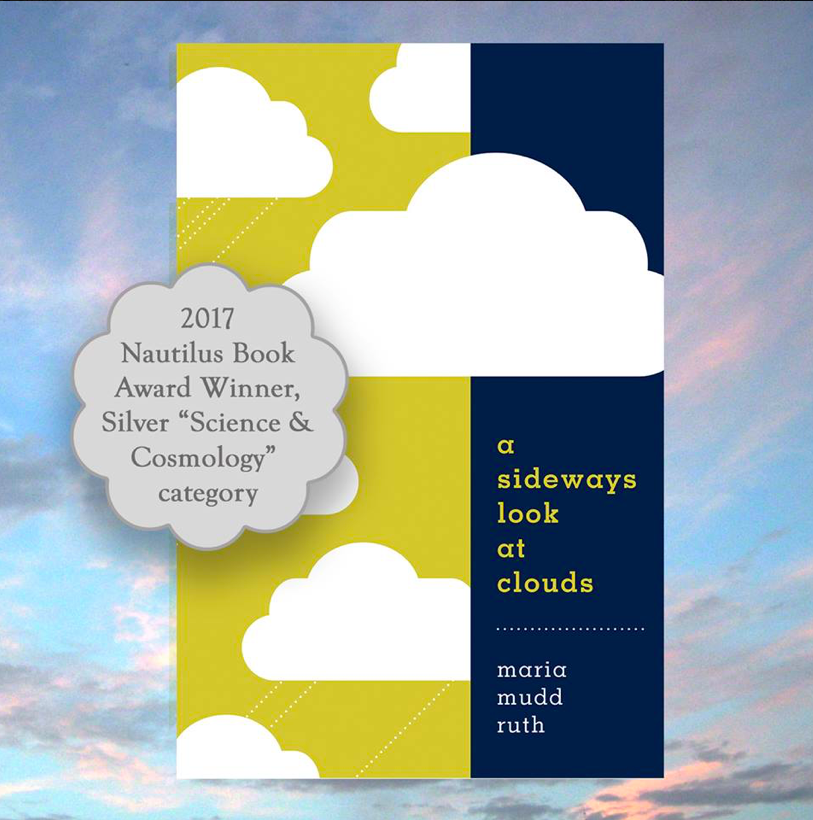
A Sideways Look at Clouds has just been named a Nautilus Award Winner--a silver medal in the Science and Cosmology category. The Nautilus Awards represent "Better Books for a Better World." Of course the clouds make the world a better place (actually a livable place as a well as a gorgeous place) but I'm beyond thrilled to think my book on clouds could help make the world a better place, too. 

The core mission of the Nautilus Awards Program is to celebrate and honor books that "support conscious living & green values, high-level wellness, positive social change, and spiritual growth."  How can a book about clouds do this?

My book is a hybrid--natural-history, memoir, humor--and encourages every reader to look up and better appreciate the ubiquitous, life-giving, shape-shifting clouds in all their forms. Even the gray blankets that rain and rain and rain. Appreciating the beauty and function of clouds is just one part of my book. Understanding what a cloud is and does takes some grappling with physics, chemistry, and meteorology. What is a cloud? How does it float? What does it tell ups about atmospheric conditions and the weather ahead? What is the role of clouds in the changing global climate? Understanding what a cloud is also means some grappling with what you, the reader, want the clouds to mean.  

When I started writing my book, I wasn't interested in studying what kind of weather a certain type of cloud indicated. I was more interested in what would happen if I began looking up and wondering about something I had taken for granted all my life.  Why did I know so little about them? Why don't we talk about them? What happened happened over eight years--the forging of a profound, abiding connection to the clouds while also embracing the ephemeral nature of the clouds--of life.  The clouds were (and are) for me a source of joy, wonder, comfort, and even solace. As a global natural phenomenon that requires special equipment or access to observe, the generous clouds are there for everyone to explore. There's no cost, no side-effects, no expiration date. 

What you'll notice when you start looking up is that...things are looking up. 

Screen Shot 2018-05-02 at 12.06.28 PM.png
In Books on Clouds, Clouds as metaphors, Clouds, Maria Mudd Ruth, Meteorology, Natural History, Pacific Northwest Clouds Tags Natural History, Nautilus Book Awards, A Sideways Look at Clouds, Maria Mudd Ruth, Mountaineers Books
Comment

The Way You Do Anything...

April 14, 2018 Maria Mudd Ruth
20171227_130834.jpg

NOTE: This is the second half of my story presented at the Center Salon on April 13, 2018. The first half can be read here. Both stories are true and appear in slightly different form in my book, A Sideways Look at Clouds.


It didn’t take long for the euphoria of my hallway epiphany to wear off. I knew nothing about clouds and assumed I could learn what I needed to know by watching them, by reading books on clouds and weather and atmospheric. 

The clouds proved to be overwhelming—in the sky and on the page. There were so many of them—and they were hard to identify. They were constantly changing shape, by the minute, by the hour, and over the course of the day. Their Latin names were difficult to keep straight. Understanding the clouds required a specialized vocabulary, a firm grasp of chemistry and physics, and more math than an English major like me could ever hope to learn. 

My Muse may have sparked the idea for my book, but apparently she wasn’t going help me understand the clouds or figure out how write about them.

I could not find my way into the clouds. I was lost.  I was frustrated. I was ready to give up. Until l remembered what happened 10 years earlier when I had lost my way—literally.

I was trying out a new yoga studio I had driven past many times. It was on the ground floor of a two-story office building that wrapped around a downtown corner. The yoga studio had big storefront windows on both sides of the block. Signs and banners with the studio’s name doubled as privacy shades from the street.

I walked toward the door thatI assumed was the entrance. It was locked. I walked around the corner to a similar door on the other side of the studio. It too was locked. I continued further down the block to another door. It opened and  so I stepped off the sidewalk and into a vestibule. I looked around for signs to the studio. There were none. 

I walked down a dim corridor lined with closed doors of various small businesses, none offering yoga classes. At the end of the hall I found an elevator. I pushed the button to call it. The elevator arrived, I got on. I pushed the button for the second floor. Why not? I stepped out into another hallway with more office doors. It led to another dead end. I started giggling. I walked back toward the elevator, but took the stairs and found myself in the interior lobby of the building, facing the wide open doors to the yoga studio. 

I walked toward a small desk where a woman (the teacher I presumed) sat in her yoga togs and in an aura of calm. 

“Hi!” I blurted out. “I’m glad I found my way in! The entrance from the street wasn’t exactly obvious so I….” 

I recounted my story of the locked doors, the elevator, the hallways, the stairway. She listened patiently but didn’t smile or acknowledge that the entrance was perhaps a problem.  

Instead, she handed me a pen, gestured toward the sign-in sheet, and said matter-of-factly, “The way you do anything is the way you do everything.”

How rude! How dare she? How wise! She was totally right. This, this, this total stranger, this yogini knew me better than I knew myself. 

The way we do anything—and therefore everything—is the result of who we are: our age, our childhood experiences, our families, our education, our friendships, the condition of our physical bodies, the acuity of our senses, our mental and emotional state. Our habits. Our quirks. All of it. 

We each have a unique and idiosyncratic way of being in the world, of looking at the world the lies before us, and of sharing our understanding of the world with each other. 

And so, I year into my study of the clouds, I embraced the truthful words of the condescending-but-insightful yogini. To find my way into the clouds, I would wander and get lost. I would take the scenic route, follow my curiosity, try all the doors, make wrong turns, giggle a lot, go down rabbit holes, hit dead ends, get derailed, find some truth, make some discoveries along the way.

It wasn’t necessarily the best---nor certainly the most efficient way---to write a book but it was my way forward—or sideways—into the clouds. 

20171227_130845.jpg


In Books on Clouds, Clouds, Maria Mudd Ruth, Meteorology, Natural History, Pacific Northwest Clouds Tags A Sideways Look at Clouds, The Way You Do Anything, Advice from a Yogini
Comment
← Newer Posts Older Posts →

Subscribe

Sign up with your email address to receive my blog in your inbox.

Thank you!
Blog RSS

Flying from Mountaineers Books this Spring—the story of the Pigeon Guillemot—the world’s most charismatic alcid. This non-fiction natural history will be on bookshelves and available from online retailers on April 7, 2026. Click a link below to pre-order a copy now from these purveyors:

Mountaineers Books (non-profit, indie publisher based in Seattle)

Browsers Books (Olympia’s indie bookstore)

Bookshop.org (support your local bookstore)

Barnes & Noble (in the book biz since 1971)

Amazon

Other Natural History Titles by Maria Mudd Ruth…

A Sideways Look at Clouds


“Compelling…engaging.” The Library Journal

“Rare insights into the trials and joys of scientific discovery.” Publishers Weekly

Read more reviews and details here: Rare Bird: Pursuing the Mystery of the Marbled Murrelet

Enjoy this song by Peter Horne, "Little Bird, Little Boat, Big Ocean.” Written about the Marbled Murrelet, but the lyrics work well for the Pigeon Guillemot, too.


  • Wild Swimming
  • marbled murrelet
  • clouds
  • A Sideways Look at Clouds
  • Mountaineers Books
  • Rare Bird
  • old-growth forests
  • Open-water Swimming
  • Maria Mudd Ruth
  • Lakes of Washington
You must select a collection to display.

Subscribe

Sign up with your email address to receive my blog in your inbox.

Thank you!
Blog RSS

©2025 MARIA MUDD RUTH  |  ALL RIGHTS RESERVED